


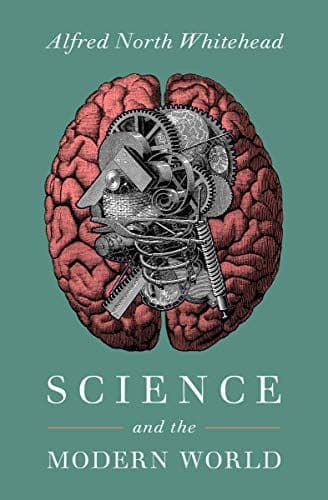
Science and the Modern World

Whitehead's central argument is that the scientific worldview inherited from the seventeenth century rests on a fatal abstraction: the 'fallacy of misplaced concreteness,' which mistakes the colorless, valueless matter of mechanistic physics for concrete reality. This abstraction has generated an incoherence at the heart of modern culture, separating science from the aesthetic and moral dimensions of experience. Whitehead traces the historical development of science and proposes a new cosmology in which nature is a process of events, and values are intrinsic to the fabric of the real.
Key Insights
✦What is the central claim of Science and the Modern World, and what does it reject?
Whitehead argues that the scientific worldview bequeathed by the seventeenth century is internally incoherent because it rests on the 'fallacy of misplaced concreteness'—the error of mistaking abstract entities (matter, simple location) for concrete reality . This fallacy has generated a split between the world described by physics and the world of human values, purposes, and aesthetic experience. The book rejects the assumption that science requires a valueless, mechanistic ontology. Whitehead traces how this abstraction arose historically and proposes an alternative cosmology in which nature consists of events and processes, and in which values are not subjective additions but intrinsic features of the real.
✦What is the 'fallacy of misplaced concreteness,' and why does Whitehead consider it so damaging?
The fallacy of misplaced concreteness is the mistake of treating an abstraction as if it were the concrete reality from which it was abstracted . In the case of modern science, the abstraction is 'matter in motion'—a colorless, valueless substance with simple location. Whitehead argues that this abstraction has been mistaken for the fundamental reality of nature, while the concrete experiences of color, sound, purpose, and value are dismissed as merely subjective. The damage is twofold: it produces an incoherent dualism between mind and nature, and it undermines the grounds for aesthetic and moral values by locating them outside the real world. Whitehead's remedy is not to reject science but to correct its metaphysics.
✦How does this book relate to Whitehead's later Process and Reality?
Science and the Modern World is the first work in which Whitehead begins to sketch the speculative metaphysics that culminates in Process and Reality (1929). Lewis Ford's textual analysis shows how Whitehead's views, initially sketched in these Lowell Lectures of 1925, were modified in the Gifford Lectures and modified further during the writing of Process and Reality itself . The later book provides the systematic categoreal scheme; Science and the Modern World provides the historical diagnosis and cultural motivation. Whitehead himself never named Process and Reality as his favorite among his works, more often referring to Science and the Modern World, Adventures of Ideas, and Modes of Thought .
✦What role does the history of science play in the argument?
Whitehead devotes substantial attention to the historical development of modern science, tracing how the mechanistic worldview emerged from the scientific revolution of the seventeenth century and became the dominant framework for understanding nature . This historical narrative is not merely background; it is essential to the argument. By showing that the mechanistic ontology is a historical product rather than an eternal truth, Whitehead aims to loosen its grip and make room for an alternative. He examines how cultural history has affected science in relation to romanticism, relativity, quantum theory, religion, and movements for social progress . The historical method is thus part of the book's philosophical strategy.
✦How was the book received, and what is its reputation today?
Science and the Modern World was a great success at the time of its publication and remains Whitehead's best-selling work . It was praised for its prose style and its accessible presentation of difficult ideas, qualities that distinguish it from the more forbidding Process and Reality. On the centenary of its publication in 2025, scholars continued to defend its relevance, arguing that Whitehead's assessment of modern dualism and reductionistic materialism remains defensible, and that the book exposes the incoherence of 'scientism' as a metaphysical view . Its reputation is that of a classic of popular philosophy of science—accessible, historically informed, and culturally engaged—rather than a technical treatise.
✦What is a common misreading of the book's critique of science?
A common misreading treats Whitehead as an anti-scientific thinker who wants to replace science with metaphysics or religion. This is the opposite of his intention. Whitehead's critique is immanent: he accepts the findings of physics and biology and argues that the philosophical interpretation of those findings has been confused. The fallacy of misplaced concreteness is not a critique of scientific method but of the uncritical metaphysical assumptions that scientists and philosophers have imported into their account of what science reveals. The book's aim is to provide a more adequate cosmology that does justice to both scientific knowledge and the full range of human experience, not to subordinate one to the other.
Wealthy Psyche is an intellectual archive. We do not host, distribute, or sell book copies — physical or digital. We provide structured knowledge to help you think better, faster.