


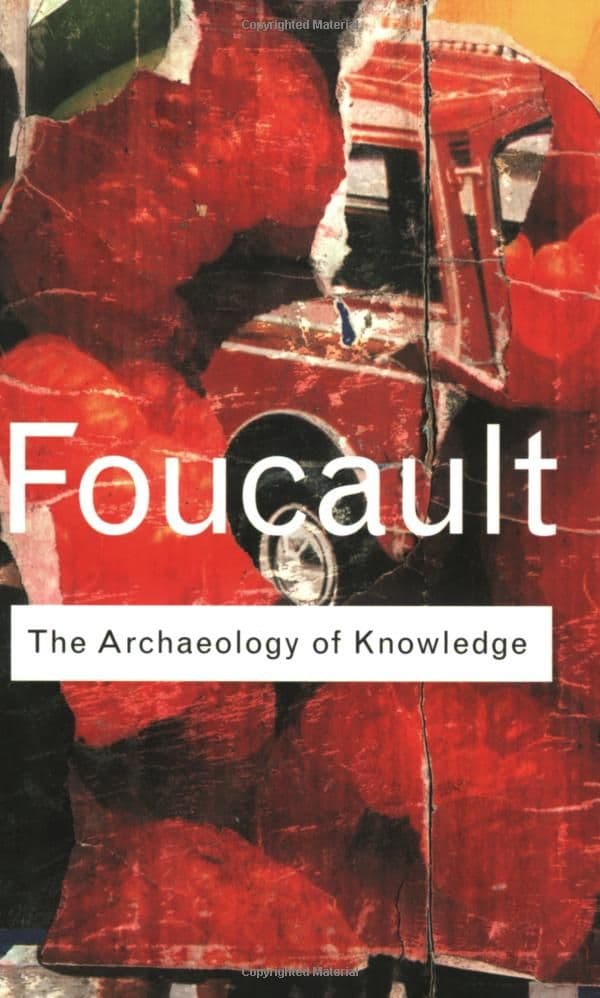
The Archaeology of Knowledge
Foucault's methodological treatise argues that history should be analyzed not through continuous narratives of progress or authorial intention, but through the 'statements' (énoncés) that emerge according to hidden rules of discursive formation. The central claim is that these rules operate beneath the consciousness of speaking subjects, determining what can be said and thought in a given domain. Archaeology is the method of describing this 'archive'—the system that governs the appearance and transformation of discourses—without seeking their origin in a sovereign subject or a deeper truth.
Key Insights
✦What is a 'statement' (énoncé), and how does it differ from a sentence or a proposition?
A statement is not a grammatical sentence or a logical proposition; it is the set of rules that makes an expression discursively meaningful within a specific field. Foucault's example is instructive: the phrase 'the gold mountain is in California' may be grammatically and semantically well-formed, but it has no discursive meaning if it is unrelated to the geographic reality of California . The statement is a function of existence, not of signification. It depends on the conditions in which it emerges and the statements that surround it. This concept allows Foucault to analyze discourse without reducing it to language (langue) or to the intentions of a speaking subject—the statement is the basic unit of the archive, not of speech.
✦What is the 'archive,' and why is it central to the archaeological method?
The archive is not a collection of documents or a library; it is the system that governs the appearance of statements as events. Foucault defines it as the general system of the formation and transformation of statements. Archaeology describes discourses as practices specified in the element of the archive . The archive is what makes it possible for some things to be said and others not, for some statements to be preserved and others to disappear. It operates beneath the consciousness of individuals, which is why archaeology does not seek the origin of discourse in authors or in a founding subject. The method is thus a way of writing history without continuity, without teleology, and without the sovereign subject as its organising principle.
✦Why did Foucault write this book, and how does it respond to the reception of The Order of Things?
Foucault wrote The Archaeology of Knowledge partly to clarify the method he had used in Madness and Civilization, The Birth of the Clinic, and The Order of Things, and partly to distance himself from the structuralist label that had been attached to him after the success of The Order of Things . The book's introduction contains a revealing plea: 'Do not ask me who I am and do not ask me to remain the same' . This is not mere modesty; it is a methodological statement. Foucault is resisting the demand that his work be grounded in a continuous authorial identity. The Archaeology is an attempt to provide the theoretical vocabulary for a kind of historical analysis that does not depend on the category of the subject—a task that the earlier empirical works had performed without fully theorising.
✦How was the book received, and what criticisms have been made of its method?
Reception was mixed. Gilles Deleuze called it 'the most decisive step yet taken in the theory-practice of multiplicities' . But Richard Rorty dismissed it as Foucault's 'stuffiest, most obscure, and worst book,' recommending Power/Knowledge as a better statement of the method . The most substantive criticism concerns the problem of change: if the archive is a system of rules that determines what can be said, how does one archive give way to another? Foucault's answer in this book is notoriously thin, relying on the concept of 'discontinuity' without explaining its causes. This is precisely the question that led Foucault to abandon archaeology for genealogy in the 1970s, where power relations provide the dynamic that the archaeological method lacked .
✦What is the relationship between archaeology and genealogy in Foucault's work?
Archaeology is the method of the 1960s; genealogy is the method of the 1970s. Archaeology analyzes the rules of discursive formation without reference to power; genealogy, developed in Discipline and Punish and the History of Sexuality, explicitly connects knowledge to power and to the formation of subjects. Foucault ceased using the term 'archaeology' from the early 1970s, and his later remarks indicate an abandonment of its overly systematic methodology . Genealogy is more supple, allowing for a greater sense of the multiplicity of change and the transformation of societies. But the break is not absolute. The genealogical studies continue the archaeological commitment to discontinuity, even as they add a causal analysis that the earlier method could not provide.
✦Is the book a work of philosophy or of historiography, and does the distinction matter?
The distinction matters because the book is deliberately neither. Foucault is not offering a philosophy of history in the traditional sense, nor a manual for historians. He is attempting to change the way history is written by challenging the categories historians take for granted: the author, the book, the oeuvre, the period, the tradition, the influence. Each of these unities, he argues, must be subjected to critique rather than assumed. The Archaeology is a meta-historical work, a reflection on the conditions under which historical discourse is possible. Its difficulty is inseparable from its ambition: Foucault is trying to think the history of thought without the comforting unities that make most historical writing intelligible. Whether he succeeds is a question readers must decide for themselves.
Wealthy Psyche is an intellectual archive. We do not host, distribute, or sell book copies — physical or digital. We provide structured knowledge to help you think better, faster.