


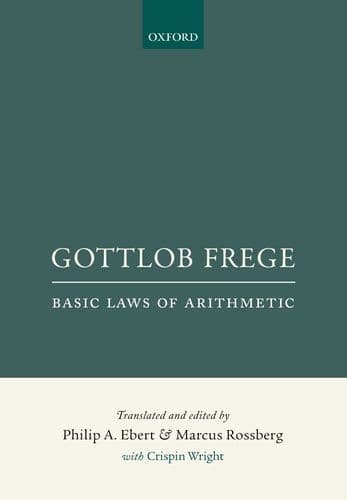
The Basic Laws of Arithmetic: Derived Using Concept-Script (Grundgesetze der Arithmetik)
Frege's central thesis is that arithmetic and analysis are reducible to logic, and that this reduction can be demonstrated through gapless formal proofs in his concept-script. The work presents his mature logical system, including the notorious Basic Law V governing value-ranges, and derives the basic laws of cardinal number from purely logical principles. The project's collapse came when Russell's letter revealed that Basic Law V generates contradiction. The book is thus both the pinnacle of Frege's logicist ambition and the site of its dramatic unraveling.
Key Insights
✦What is the central claim of The Basic Laws of Arithmetic, and what does it reject?
Frege's central claim is that arithmetic and analysis are reducible to logic, and that this reduction can be demonstrated by deriving the basic laws of cardinal number from purely logical axioms using his formal concept-script . The work rejects the view that arithmetic requires irreducible mathematical intuitions or empirical foundations. It is the final, mature stage of Frege's logicist project, intended to provide gapless proofs that show mathematical theorems to be logical theorems. The book thus aims to demonstrate the logical nature of mathematics through the most rigorous formal apparatus Frege had yet devised, including his hierarchy of functions and the controversial Basic Law V governing value-ranges.
✦What is Basic Law V, and why did it destroy the system?
Basic Law V is the axiom governing the identity of value-ranges: it states that two functions have the same value-range if and only if they yield the same value for every argument. This law was essential to Frege's derivation of arithmetic, because it allowed him to treat value-ranges as logical objects and to define cardinal numbers in terms of them. However, Russell's letter of June 1902 demonstrated that Basic Law V generates a contradiction—the class of all classes not belonging to themselves both belongs and does not belong to itself . Frege recognized the contradiction immediately and wrote a hasty afterword to the second volume acknowledging that the foundation of his system had been destroyed.
✦How did Frege respond to Russell's paradox in the second volume?
Frege received Russell's letter in June 1902, while the second volume was already in production. He replied almost immediately and composed an afterword for the volume acknowledging the contradiction and proposing a revision to Basic Law V . The proposed fix was widely regarded, including by Frege himself later, as inadequate and ad hoc. The speed of his response and the fact that the volume was already at the printer meant that Frege could not revise the system itself; he could only append a note. This afterword is one of the most famous documents in the history of logic, a philosopher conceding that the foundation of his life's work had collapsed just as it was being published.
✦How faithful are the English translations, and why are there two different editions?
The first English edition, translated and edited by Montgomery Furth and published by the University of California Press in 1964, is partial: it translates approximately one-fifth of the German original, mainly the exposition of the concept-script and the afterword on Russell's paradox . The first complete English translation of both volumes was published by Oxford University Press in 2013, translated by Philip Ebert and Marcus Rossberg, preserving the original formalism and pagination and including a foreword by Crispin Wright and an appendix on Frege's logic by Roy T. Cook . Readers working on Frege's system should use the complete Ebert-Rossberg edition; the Furth edition remains useful for its long introduction but does not represent the whole work.
✦How does The Basic Laws of Arithmetic relate to Frege's earlier Begriffsschrift and Grundlagen?
The Basic Laws is the mature realization of the project announced in the Begriffsschrift (1879) and philosophically argued in the Grundlagen der Arithmetik (1884). The Begriffsschrift introduced the function-argument analysis and quantification theory but lacked the type distinctions and formal apparatus needed for rigorous derivation . The Grundlagen presented the logicist thesis informally and sketched the derivation of arithmetic. The Basic Laws provides the full formal execution, with a revised and expanded concept-script, explicit axioms, and gapless proofs. It also contains Frege's mature philosophy of logic, including his distinction between sense and reference, which was absent from the earlier works.
✦What is a common misreading of the book's failure?
A common misreading treats Russell's paradox as a simple error that Frege could have corrected with a minor adjustment, or conversely as a refutation of logicism as such. Neither is accurate. Frege's proposed revision to Basic Law V in the afterword was indeed inadequate, but later work—most notably by Crispin Wright and Bob Hale—has shown that a consistent fragment of Frege's system, known as Frege's Theorem, can derive the basic laws of arithmetic from a principle known as Hume's Principle, without invoking the inconsistent Basic Law V. The book's failure was the failure of one specific axiom, not of the logicist project in every possible form. This distinction is crucial for understanding the work's continuing philosophical significance.
✦What role does the concept-script play in the book's argument?
The concept-script is not merely a notational convenience; it is essential to Frege's claim that his proofs are gapless. Ordinary language, Frege argues, obscures logical structure and allows unstated premises to slip into reasoning. The concept-script, with its explicit notation for functions, arguments, quantifiers, and value-ranges, is designed to make every step of inference visible and every premise explicit. This is why the Basic Laws opens with an exposition of the formal system before proceeding to the derivations of arithmetic. The rigor of the proofs depends on the transparency of the notation, and Frege's insistence on this point is a defining feature of his philosophical method.
Wealthy Psyche is an intellectual archive. We do not host, distribute, or sell book copies — physical or digital. We provide structured knowledge to help you think better, faster.