


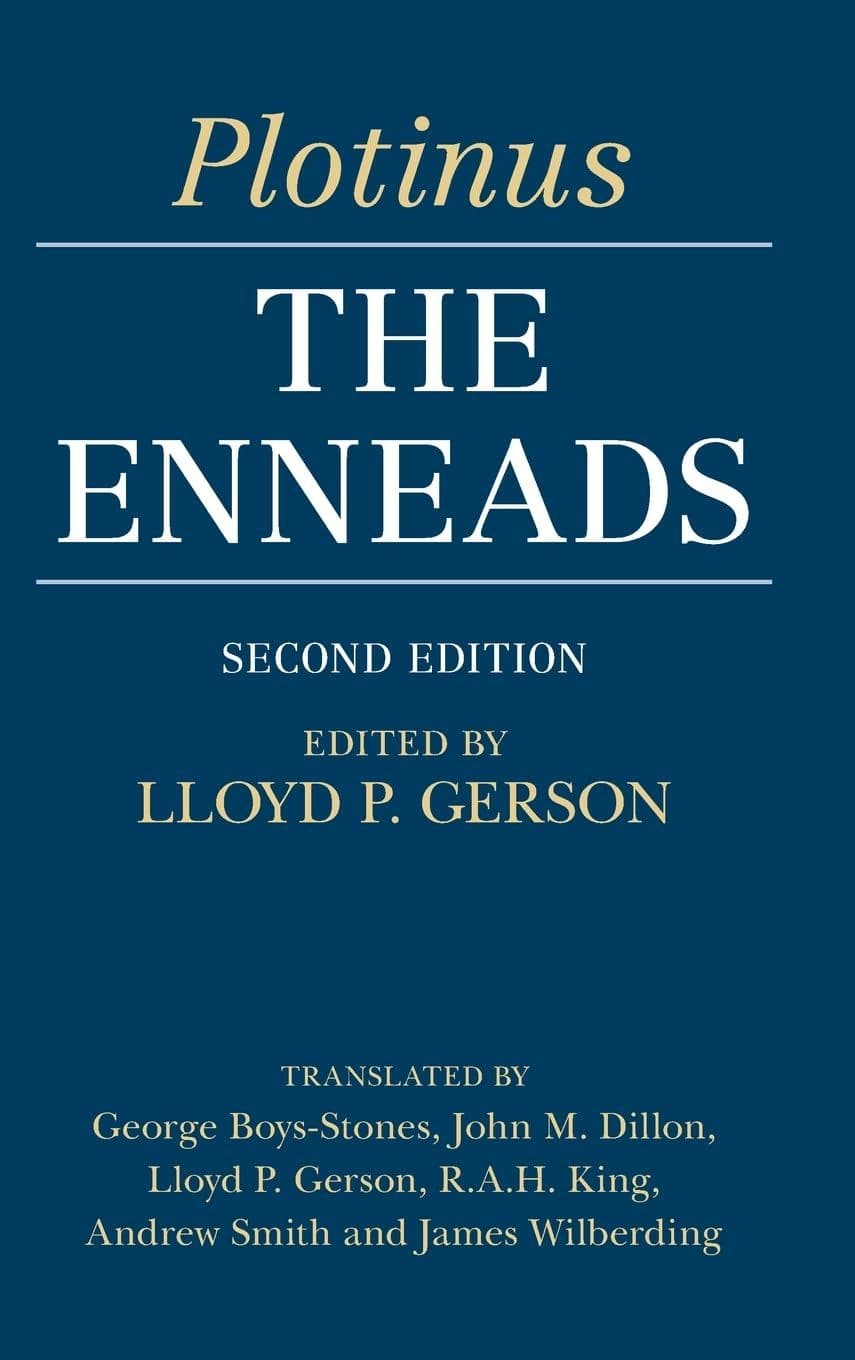
The Enneads

The Enneads is not a single treatise but a curated collection of fifty-four philosophical writings by Plotinus, arranged by his student Porphyry into six groups of nine. Its central framework is a hierarchical metaphysics of emanation: all reality derives from a transcendent, utterly simple first principle called the One, proceeds through Intellect and Soul, and culminates in the material cosmos. Plotinus argues that the human soul can reverse this descent through philosophical contemplation, ultimately achieving union with the One. The work is less a systematic summa than a series of probing, often aporetic investigations into being, soul, beauty, and the limits of language.
Key Insights
✦What is the central metaphysical claim of the Enneads, and what does it reject?
The Enneads argues that all reality derives from a single, transcendent principle called the One, which is beyond being and intellect. From the One emanates Intellect (which contains the Forms), then Soul, and finally the material world. This framework rejects any dualism that posits matter as an independent, co-eternal principle, as well as Gnostic views that condemn the material cosmos as evil. For Plotinus, matter is not an equal opposing force but the furthest, most attenuated point of the emanative process. The soul’s task is not to escape creation but to reorient itself inward and upward through contemplation, reversing the descent without denying the goodness of the whole.
✦How did Porphyry’s editorial decisions shape the Enneads as we read it today?
Porphyry arranged Plotinus’s writings roughly thirty years after his teacher’s death, organizing fifty-four treatises into six groups of nine to match the number nine (ennea). This symmetry was imposed artificially: Porphyry admits dividing some continuous discussions and elevating minor notes to reach the desired count . He also provided a chronological order of composition alongside the thematic arrangement, which modern scholars often prefer for tracing Plotinus’s development. The titles of individual treatises are Porphyry’s, not Plotinus’s. This editorial mediation means that the Enneads is less a book Plotinus wrote than a collection Porphyry constructed, and any reading must reckon with that gap between author and editor.
✦Which English translation should a serious reader use, and why do they differ?
The most widely read English version remains Stephen MacKenna’s, begun in 1917 and completed in 1930, praised for its literary fluency but criticized for occasional looseness. For scholarly precision, the standard is Hilary Armstrong’s seven-volume Loeb Classical Library edition (1966–1988), which includes the Greek text facing the translation. A more recent alternative is the 2018 Cambridge edition edited by Lloyd P. Gerson, the first complete English translation in over seventy-five years, based on the Henry-Schwyzer critical text and produced by a team of specialists for terminological consistency . The choice depends on purpose: MacKenna for readability, Armstrong for close study of the Greek, Gerson for a modern, unified scholarly apparatus.
✦How does Plotinus’s project relate to Plato’s dialogues, and where does it depart from them?
Plotinus presents himself as an interpreter of Plato rather than an original philosopher, and the Enneads is saturated with Platonic vocabulary and references. However, he develops positions that go beyond anything in the dialogues, most notably the explicit hypostasis of the One as a principle beyond being, distinct from Intellect and the realm of Forms. Plato’s Good in the Republic is famously “beyond being,” but Plotinus systematizes this into a full metaphysical hierarchy with emanation as its mechanism. He also engages critically with Aristotle and the Stoics, incorporating and transforming their concepts. The result is a creative synthesis that later readers, from Augustine to Hegel, treated as Platonism itself, even though Plato would not have recognized the system as his own.
✦Is the Enneads a mystical text, a philosophical treatise, or both?
Both, but the distinction is modern rather than ancient. Plotinus argues rigorously about logic, causation, and the structure of reality, yet he also describes contemplation as the soul’s ascent toward union with the One, an experience he reportedly attained several times according to Porphyry. The treatises on Beauty and on the Good culminate in accounts of a union that surpasses discursive thought. Some readers, following a tradition that treats Plotinus primarily as a mystic, emphasize these passages; others, particularly analytic interpreters, stress the argumentative density of his treatments of substance, soul, and knowledge. The most accurate reading holds that the mystical goal is the motivation for the philosophical arguments, not a separate domain from them.
✦What is the most common misreading of the Enneads, and what does it obscure?
The most persistent misreading treats “emanation” as a literal, temporal process—as if the One chose to create the world at some moment, or as if reality cascaded downward like water from a fountain. Plotinus insists that emanation is eternal and necessary, not a deliberate act or an event in time. The metaphor of light radiating from the sun, which he uses, is meant to convey dependence without diminution: the source remains undiminished while what derives from it exists at a lower degree of unity. This misreading obscures the crucial point that for Plotinus, the material world is not a punishment or a fall into evil but a necessary expression of the One’s superabundant goodness, however faint.
Wealthy Psyche is an intellectual archive. We do not host, distribute, or sell book copies — physical or digital. We provide structured knowledge to help you think better, faster.