


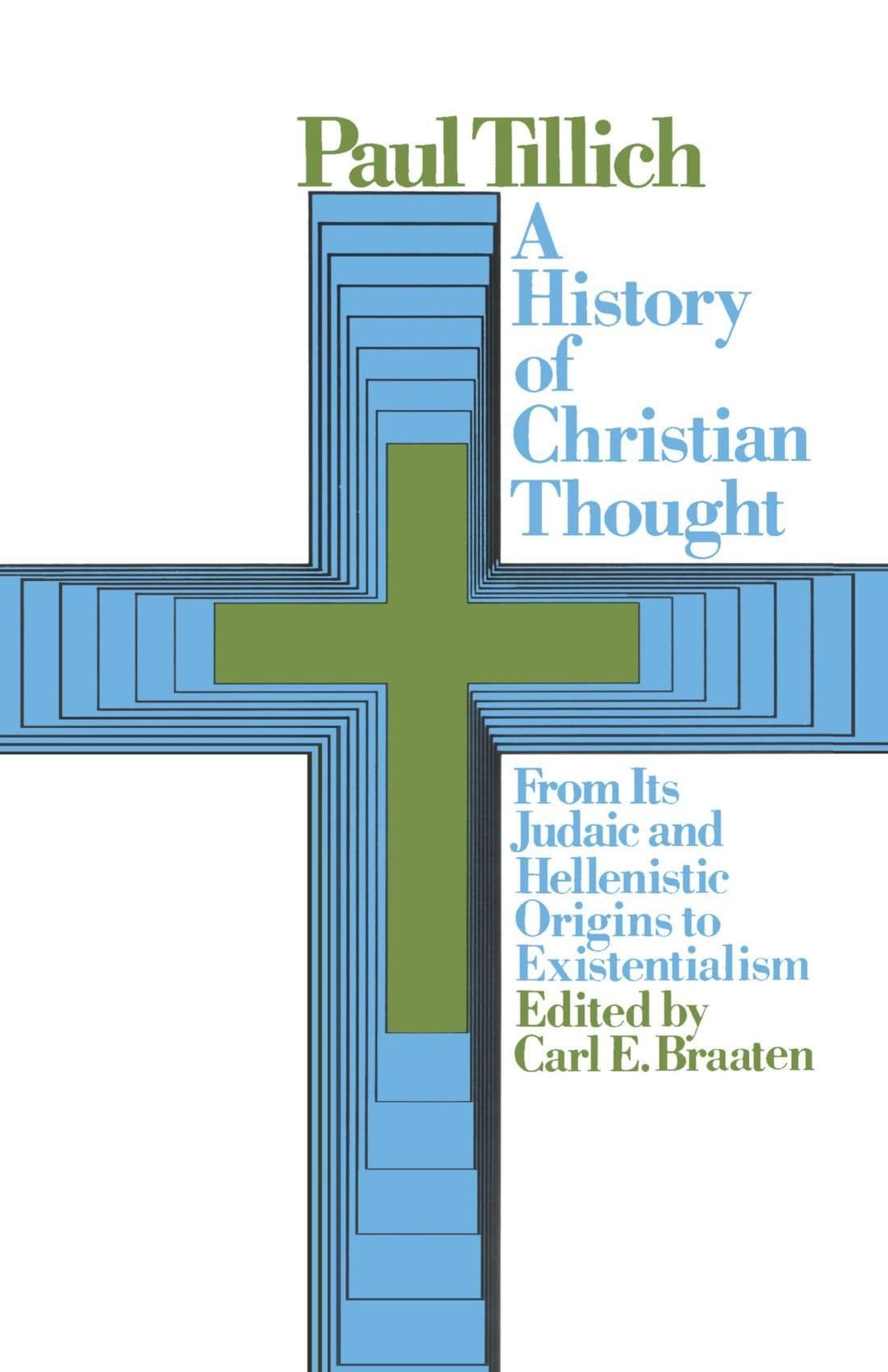
A History of Christian Thought
This is not a treatise Tillich wrote but a course of lectures he delivered at Union Theological Seminary in 1953, recorded and later edited for publication. Its central framework is an interpretative history of Christian doctrine from its Judaic and Hellenistic origins to existentialism, read through the lens of Tillich's own systematic theology. He treats the history of Christian thought not as a neutral chronicle but as a correlation between the questions of human existence and the answers of revelation, finding in each era the struggle between heteronomy, autonomy, and the quest for theonomy. The lectures serve as a historical companion to his Systematic Theology.
Key Insights
✦What is the origin of this book, and how does its lecture format shape its argument?
The book consists of lectures Tillich delivered in 1953 at Union Theological Seminary in New York, recorded and originally edited by Peter H. John before being revised and edited for publication by Carl E. Braaten . Because the material began as spoken lectures, it has a different texture from Tillich's written works: it is more direct, more willing to make provocative comparisons, and less burdened by the technical apparatus of the Systematic Theology. A contemporary reviewer noted that the lectures were 'recorded on tape and have been excellently and modestly edited' by Braaten, and that they read as 'footnotes to his systematic work' . The oral origin means the book preserves Tillich's pedagogical voice, not his final written corrections.
✦How does Tillich's history relate to his Systematic Theology?
The relationship is intimate and interpretative. A reviewer in the Scottish Journal of Theology observed that the lectures 'interpret history from a particular point of view'—the point of view already expressed in the Systematic Theology—and that they can be read as footnotes to that systematic work . Tillich's Systematic Theology was criticized for its sparse historical references, offering only hints of the tradition upon which it drew. These lectures supply what the system withheld: a sustained engagement with the classical traditions of Christian thought, showing how Tillich's ontological concepts emerged from and responded to the history of doctrine. They are thus not an independent history but a historical companion to the system.
✦What is Tillich's interpretative method in these lectures, and how does it differ from a neutral chronicle?
Tillich does not aim at detached, objective history. He treats the history of Christian thought as a correlation between existential questions and theological answers, reading each era through the lens of his own systematic concerns. The reviewer notes that Tillich 'never did have much patience with the detached, objective style of writing history,' and that his interpretation is 'also a form of self-interpretation' . This means the lectures are highly selective in the facts they mention and highly interpretative in their treatment. The method is consistent with Tillich's theology of culture: history is not a catalogue of events but a struggle between heteronomy, autonomy, and the quest for theonomy, and Tillich reads the tradition to discern that struggle.
✦How was the book assembled from Tillich's lectures, and what does the editorial history reveal?
The textual history is layered. The lectures were delivered in 1953 and recorded; Peter H. John produced an initial edited version, and Carl E. Braaten later revised and edited the text for publication by Harper & Row in 1968 . The book was also published in two separate volumes—A History of Christian Thought and Perspectives on 19th and 20th Century Protestant Theology—before being combined into a single Touchstone edition by Simon and Schuster in 1972 . This means readers encounter a mediated text: Tillich's spoken words, filtered through a recording, an initial editor, and a later revising editor. The lectures were never prepared by Tillich himself for publication, so the book is a posthumous construction in the precise sense.
✦What are the most provocative judgments Tillich makes in these lectures, and how were they received?
The reviewer singles out Tillich's comparison of Marcion with Karl Barth, finding in both 'the same depreciation of the created order' . The reviewer calls this 'rash and provocative to the point of irritation,' noting that such a thesis would require far more qualification than the lecture format allows. This is characteristic of the book: Tillich's pedagogical boldness produces insights that are penetrating but sometimes under-defended. The same reviewer acknowledges that 'in the main his insights are penetrating,' and that even where one disagrees with his reading, there is pleasure in sharing 'the sheer delight which Tillich takes in the transfiguration of Hellenistic genius which took place within the Christian faith' . The lectures are best read as provocations to thought, not as definitive historical judgments.
✦What is the most common misunderstanding of this book's status?
The most common misunderstanding is that it is a work Tillich wrote as a standalone history. It is not. It is a transcription of lectures, edited posthumously by others, and it presupposes the theological framework of the Systematic Theology. Readers who approach it expecting a neutral historical survey will be surprised by its interpretative density and its constant correlation of past doctrines with existential questions. A related misunderstanding is that the lectures are introductory or elementary. While they are more accessible than the Systematic Theology, a reader notes that 'this may well be Tillich's most accessible work,' but that 'that speaks more to the difficulty of Tillich's other works than to the ease of working through this treatise' . The book is accessible only relative to Tillich's own corpus.
Wealthy Psyche is an intellectual archive. We do not host, distribute, or sell book copies — physical or digital. We provide structured knowledge to help you think better, faster.