


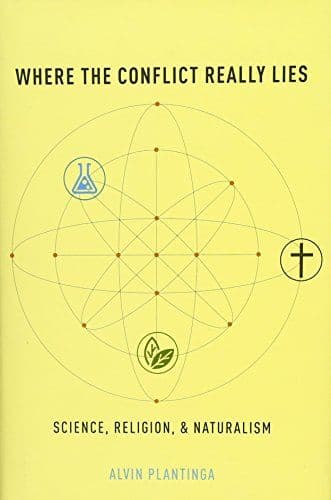
Where the Conflict Really Lies: Science, Religion, and Naturalism
Plantinga's central thesis is that the perceived conflict between science and theistic religion is superficial, while the real, deep conflict lies between science and naturalism. He argues that methodological naturalism—science's provisional exclusion of divine agency—does not entail metaphysical naturalism, and that theistic belief can coexist with evolution, provided the evidence base includes more than what science alone permits. The book's culminating move is the evolutionary argument against naturalism: if our cognitive faculties evolved solely for reproductive fitness, and fitness does not guarantee truth, then naturalism undermines the warrant for trusting any belief, including naturalism itself.
Key Insights
✦What is the central claim of Where the Conflict Really Lies, and what does it reject?
The book argues that the supposed conflict between science and theistic religion is superficial, while the genuine, deep conflict is between science and naturalism. Plantinga rejects the New Atheist claim—associated with Dawkins, Dennett, and Kitcher—that evolution or scientific methodology renders theistic belief irrational. He argues that methodological naturalism, the practice of explaining phenomena without invoking God, is a procedural constraint on science, not a metaphysical conclusion that God does not act . The real problem, on his view, is that naturalism cannot account for the reliability of the cognitive faculties that produce scientific reasoning itself. The book thus inverts the standard narrative: science is not the enemy of theism, but naturalism is the enemy of science's own epistemic foundations.
✦What is the evolutionary argument against naturalism (EAAN), and why is it the book's culminating argument?
The EAAN holds that if metaphysical naturalism and contemporary evolutionary theory are both true, then our cognitive faculties have been selected solely for reproductive fitness, not for producing true beliefs. Since fitness and truth are not necessarily correlated—a belief that leads to survival behavior can be entirely false—naturalism provides an undefeated defeater for trusting our faculties in general. This includes the faculties that produced the belief in naturalism itself . Plantinga therefore concludes that naturalism is self-referentially incoherent: it cannot be rationally affirmed because it undermines the warrant for all beliefs, including itself. The argument appears in the book's final chapter because it is the payoff of the distinction between superficial conflict (science vs. theism) and deep conflict (science vs. naturalism) .
✦How does Plantinga respond to the claim that evolution and Christian belief are incompatible?
Plantinga argues that evolution and Christian belief are not inherently incompatible because evolution describes a mechanism, not a metaphysical commitment. Even if natural selection is the means by which species developed, it is entirely possible that God guided and superintended the process . The conflict arises only if one assumes that evolution must be purposeless or unguided, which is a philosophical addition to the biological theory, not a component of it. Plantinga also addresses evolutionary psychology and historical biblical criticism, conceding that some claims from these fields may conflict with specific Christian doctrines, but arguing that they do not constitute defeaters for Christian belief because the Christian's evidence base includes beliefs that science's methodological naturalism excludes . The conflict is real but superficial, not deep.
✦What role does 'deep concord' play in the book's argument, and what evidence does Plantinga offer for it?
The 'deep concord' thesis holds that Christian theism provides a metaphysical framework uniquely hospitable to science. Plantinga argues that theism explains why the universe is intelligible, why mathematics is applicable to nature, why inductive reasoning works, and why human cognitive faculties are attuned to the world. The doctrine of the imago Dei—that humans are created in God's image—grounds the expectation that our minds can grasp the laws governing creation . He also discusses fine-tuning arguments and biological design discourse, though he treats the fine-tuning argument as offering only 'mild support' for theism and interprets Behe's intelligent design work as phenomenological design perception rather than a formal proof . The cumulative case is that theism and science are not merely compatible but mutually reinforcing, while naturalism lacks the resources to explain science's success.
✦How was the book received by critics, and what were the main objections?
The reception was mixed but serious. Reviewers acknowledged Plantinga's rigor and wit, and the book won a 2013 Christianity Today Book Award . Rodney Holder, writing in the Journal of Theological Studies, praised Plantinga's refutation of New Atheist arguments but noted that some features of the book 'will puzzle many participants in the science–religion dialogue' . Robert Deltete, in Philosophy in Review, offered a more critical assessment, questioning Plantinga's handling of intelligent design and the evidentiary standards he applies . The most persistent objection concerns the EAAN: critics argue that evolutionary pressures do select for true beliefs in many domains, or that the argument proves too much by undermining all beliefs, including theistic ones. Plantinga's defenders reply that the argument targets naturalism specifically, not theism.
✦What is the most common misunderstanding of this book's argument?
The most common misunderstanding is that Plantinga is arguing for the truth of Christianity or against evolution. He is doing neither. The book is a work of epistemology and metaphysics: its target is naturalism as a philosophical position, and its method is to examine whether naturalism can account for the warrant of belief. Plantinga explicitly accepts that evolution may be true and that science is a legitimate enterprise; his objection is to the inference from scientific practice to metaphysical naturalism . A related misunderstanding is that the EAAN is a proof of God's existence. It is not: it is a defeater argument, intended to show that naturalism is rationally untenable, not that theism is true. Readers expecting a natural theology will find instead a sustained critique of naturalism's epistemic self-sufficiency.
Wealthy Psyche is an intellectual archive. We do not host, distribute, or sell book copies — physical or digital. We provide structured knowledge to help you think better, faster.