


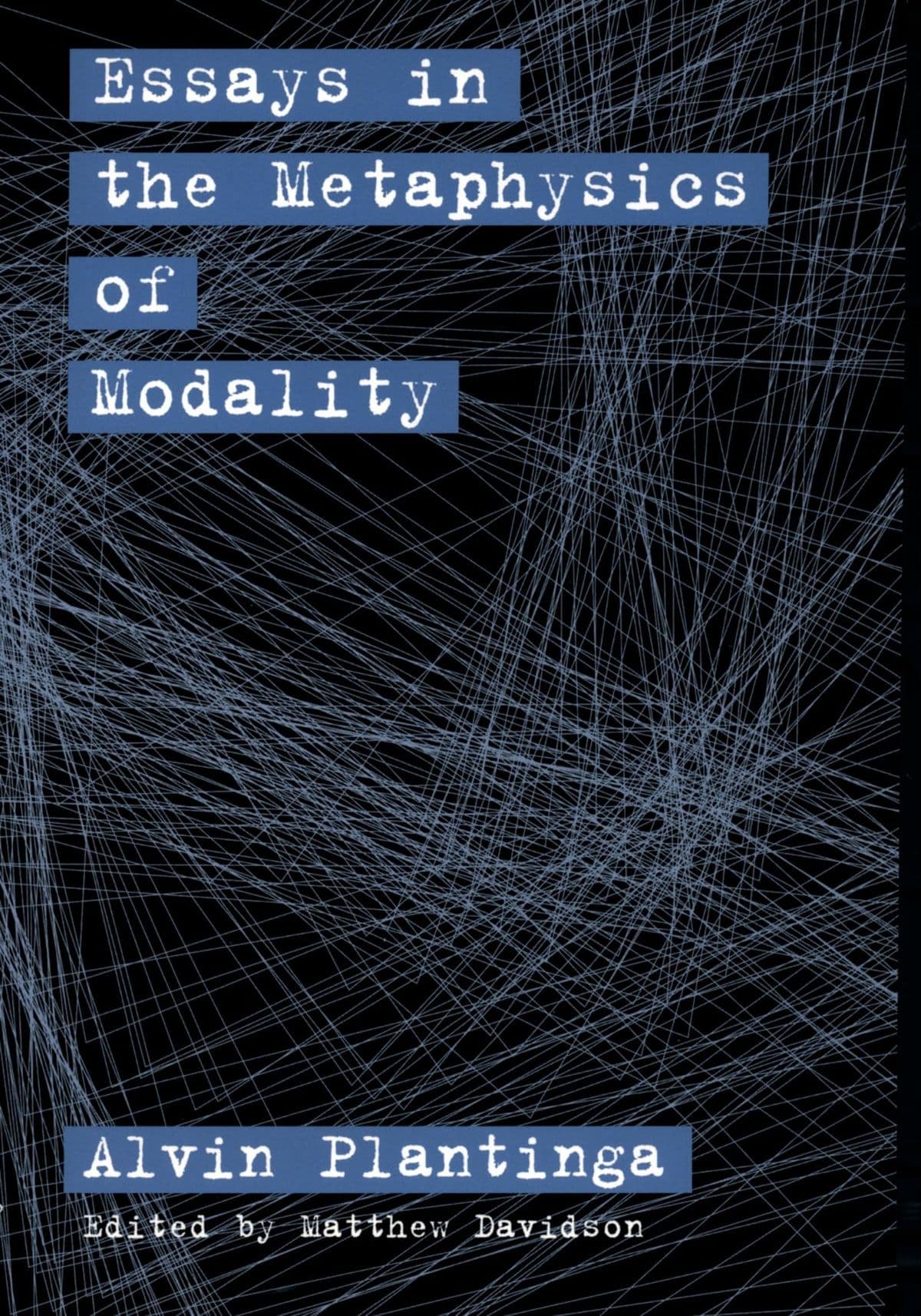
Essays in the Metaphysics of Modality
This volume is not a new treatise but a curated retrospective: eleven essays and book chapters, published between 1969 and 1993, that trace Plantinga's development of a rigorous de re modal metaphysics against Quinean scepticism. Edited and introduced by Matthew Davidson, the collection assembles Plantinga's core machinery—states of affairs as primitive entities, possible worlds as maximal states of affairs, essences or haecceities as individual natures, and actualism as the thesis that there are no nonexistent objects. The result is a compact dossier of the arguments that made essentialism respectable again in analytic philosophy, culminating in the case against modal realism and modal reductionism.
Key Insights
✦Is this a new book by Plantinga or a collection of previously published material?
It is a collection of previously published material, not a new treatise. All eleven essays and chapters were published between 1969 and 1993, and the volume was edited by Matthew Davidson, who also provides an introduction summarizing each piece . The contents are arranged chronologically, beginning with 'De Re et De Dicto' (1969) and ending with 'Why Propositions Cannot Be Concrete' (1993). A review in Ars Disputandi notes that the book 'seems to be intended for use in graduate courses or by those who are not interested in working through Plantinga's entire corpus' . Readers seeking Plantinga's newest arguments will not find them here; the value lies in having his scattered modal essays assembled in one place with a helpful editorial guide.
✦What is the central metaphysical framework that unifies these essays?
The unifying framework is a de re modal metaphysics built on states of affairs, essences, and possible worlds. Plantinga treats states of affairs as abstract entities—things like 'Socrates being a philosopher'—and defines a possible world as a maximal state of affairs that either includes or precludes every other state of affairs . An object's essence or haeccty is the property that is essential to it and unique to it, such as 'being identical to Socrates' . This machinery allows Plantinga to defend essentialism against Quine's scepticism about quantified modal logic: de re necessity is respectable because objects genuinely have properties in every world in which they exist. The essays apply this framework to problems of proper names, transworld identity, and the ontology of nonexistent objects.
✦How does Plantinga's actualism differ from David Lewis's modal realism, as argued in this collection?
The essay 'Two Concepts of Modality: Modal Realism and Modal Reductionism' (1987) is the collection's most direct engagement with Lewis. Plantinga defends actualism: the thesis that there neither are nor could be any nonexistent objects, and that possible worlds are not concrete universes existing alongside our own but abstract states of affairs that obtain or fail to obtain . Lewis's modal realism treats possible worlds as concrete entities of the same kind as the actual world, and treats individuals as 'worldbound'—existing in only one world, with counterparts in others. Plantinga rejects this on the grounds that it multiplies concrete realities without necessity and fails to capture the intuitive notion that Socrates himself could have failed to be a philosopher. The earlier essay 'Transworld Identity or Worldbound Individuals?' (1973) prepares the ground by attacking counterpart theory directly .
✦Why does Plantinga include a reply to John Pollock in this collection?
The inclusion of 'Reply to John L. Pollock' (1985) reflects the importance of Pollock's critique to Plantinga's development. Pollock had challenged aspects of Plantinga's actualism, particularly the claim that there are no nonexistent objects and the treatment of singular negative existentials. Plantinga's reply defends the actualist position by refining his account of what it means for a state of affairs to obtain and how propositions about nonexistent subjects are to be understood . Including the reply in the collection serves a dual purpose: it shows Plantinga engaging directly with a named critic, and it clarifies his position on the ontology of possible but unactual objects, a theme that runs through the fourth essay (Chapter VIII of The Nature of Necessity) and the eighth ('On Existentialism'). Readers interested in the debate over actualism will find the exchange instructive.
✦What does Matthew Davidson's editorial introduction contribute, and what are its limitations?
Davidson provides a summary of each chapter, stating Plantinga's views and his main reasons for holding them. Allan Bäck's review in Ars Disputandi praises Davidson for rendering accessible a thinker with a 'byzantine, Chisholming style,' noting that he has done many readers a service by clarifying the arguments . However, Bäck also notes two limitations: Davidson writes as an 'acolyte' of Plantinga, so there is little critique of the doctrines presented, and the introduction would be more useful if it included page numbers pointing to where Plantinga makes specific claims in the essays . The introduction is thus best used as a guide to the arguments, not as a critical assessment of them. Readers seeking evaluation of Plantinga's modal system should consult the essays themselves alongside independent secondary literature.
✦What is the most common misunderstanding of this book's relationship to The Nature of Necessity?
The most common misunderstanding is that this collection supersedes or replaces The Nature of Necessity. It does not. The 1974 book is a sustained, systematic treatise with its own argumentative arc, including the Free Will Defense and the modal ontological argument in its final chapters. This collection reprints only Chapter VIII of that book, the chapter concerned with possible but unactual objects, and surrounds it with journal articles and other chapters that address related but distinct problems . The collection is a supplement and a guide, not a substitute. Readers who want Plantinga's full modal system, including its theological applications, must read The Nature of Necessity itself. The collection is best understood as a chronological companion that shows the development of the ideas that culminated in that book and continued after it.
Wealthy Psyche is an intellectual archive. We do not host, distribute, or sell book copies — physical or digital. We provide structured knowledge to help you think better, faster.