


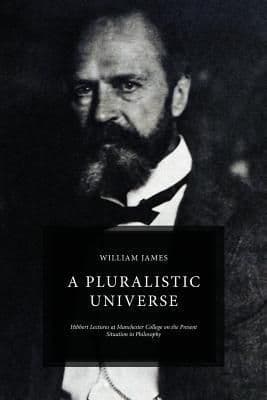
A Pluralistic Universe
This book collects James's Hibbert Lectures, delivered at Oxford in 1908, and develops his most mature metaphysical position. Its central framework is pluralism: reality is not a single, unified, rational system but a multiverse of finite centers of experience, loosely connected and open to novelty. James argues against monism and intellectualism, contending that the universe is more like a federal republic than an empire, and that the absolute of idealist philosophy is a fiction. He draws on Bergson's intuition of duration and on Fechner's panpsychism to argue that experience goes all the way down, and that the divine is finite, plural, and intimately involved in a world that is still growing.
Key Insights
✦What is the central thesis of A Pluralistic Universe, and what does it reject?
The central thesis is that reality is a pluralistic universe: a multiverse of finite centers of experience, loosely connected and open to novelty, rather than a single, unified, rational system. James rejects monism and intellectualism, arguing that the universe is more like a federal republic than an empire . He also rejects the absolute of idealist philosophy, which he regards as a fiction that does violence to the concrete richness of experience. The book develops the radical empiricism of his earlier essays into a full metaphysical vision, drawing on Bergson's intuition of duration and on Fechner's panpsychism to argue that experience goes all the way down. The divine, on this view, is finite, plural, and intimately involved in a world that is still growing.
✦How does James's pluralism differ from the monism he attacks?
James's pluralism holds that the world is composed of many separate, finite realities that are connected in various ways but not reducible to a single principle. Monism, by contrast, holds that reality is ultimately one, whether as a single substance, a single process, or a single absolute mind. James argues that monism cannot account for the reality of novelty, freedom, and individuality, and that it reduces the rich plurality of experience to an abstract unity . He also argues that monism has pernicious moral and religious consequences: it makes evil and suffering merely apparent, and it absorbs the individual into an impersonal absolute. Pluralism, by contrast, affirms the reality of finite persons and their struggles, and it leaves room for a God who is not omnipotent but is nonetheless a genuine ally in the work of redemption.
✦What is the role of Bergson and Fechner in the book's argument?
Bergson and Fechner are the two thinkers on whom James most relies in developing his pluralistic metaphysics. From Bergson, he takes the idea of duration—the immediate data of consciousness as a continuous, qualitative flow—and the critique of intellectualism, which he uses to argue that concepts distort the flow of experience . From Fechner, he takes the idea of panpsychism—that all things have an inner, experiential dimension—and the suggestion that the universe is composed of many finite consciousnesses, each a center of experience in its own right. James uses Fechner's analogy of the plant and the tree to suggest that individual consciousnesses are related to a larger, inclusive consciousness as the parts of a plant are related to the whole . Neither Bergson nor Fechner is treated as an authority; both are used as resources for James's own argument.
✦How was the book received, and what were the main criticisms?
The book was received with respect but also with significant criticism. Reviewers praised James's originality and his vivid style, but many argued that his pluralism was not a coherent philosophical position. The main criticisms were that pluralism cannot account for the unity of experience, that it dissolves the world into a chaos of disconnected fragments, and that it is a form of subjectivism . Some critics also argued that James's treatment of the absolute was a caricature, and that he did not engage seriously with the strongest versions of idealism. Defenders of James replied that his critics had missed the point: pluralism is not a denial of unity but an affirmation that unity is achieved rather than given, and that the world is still in the making. The book remains a classic statement of pluralistic metaphysics.
✦What is the relationship between the book's metaphysics and its religious implications?
The book's metaphysics has direct religious implications. James argues that the God of pluralism is finite, not omnipotent, and that this is a religiously more adequate conception than the absolute of monism. A finite God is one who struggles alongside us, who is not responsible for evil, and who can be genuinely helped by our efforts . This is a God who is intimately involved in a world that is still growing, a God who is not the whole but a part, and a God who is plural rather than singular. The book is thus a contribution to philosophical theology as well as to metaphysics. It argues that the religious life is more at home in a pluralistic universe than in a monistic one, because it preserves the reality of individuals, of freedom, and of a genuine struggle against evil.
✦What is the most common misunderstanding of James's pluralism?
The most common misunderstanding is that pluralism means that anything goes, that there is no unity or connection in the world. James does not deny that things are connected; he denies that they are connected in a single, all-encompassing system. The world is a network of relations, not a heap of disconnected fragments . A related misunderstanding is that pluralism is a form of subjectivism, in which each person's reality is as good as any other's. James is a realist: he believes there is a world that exists independently of our beliefs, even if that world is plural and unfinished. Pluralism is a metaphysical thesis about the structure of reality, not a license for arbitrary belief. The book is a serious contribution to metaphysics, not a manifesto for relativism.
Wealthy Psyche is an intellectual archive. We do not host, distribute, or sell book copies — physical or digital. We provide structured knowledge to help you think better, faster.