


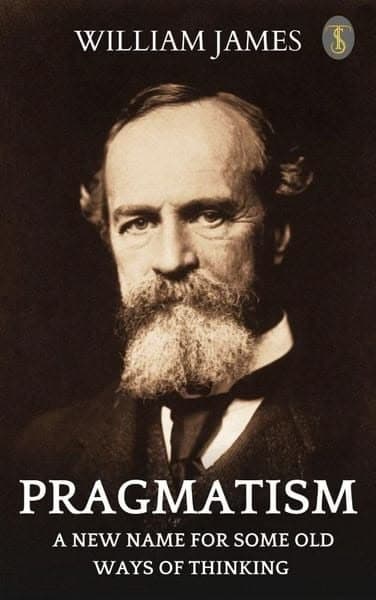
Pragmatism: A New Name for Some Old Ways of Thinking
This book collects James's 1906–1907 Lowell Lectures and is the classic statement of pragmatism as a philosophical method. Its central framework is the pragmatic method: the meaning of any idea is to be found in its practical consequences, and the test of a belief is whether it works in experience. James applies this method to metaphysics, religion, and morality, arguing that the disputes between rationalists and empiricists, monists and pluralists, theists and atheists, can often be resolved by asking what practical difference the competing positions would make. Truth itself, he argues, is a species of the good: true ideas are those that successfully guide action.
Key Insights
✦What is the pragmatic method, and how does James apply it?
The pragmatic method is the method of settling metaphysical disputes by tracing the practical consequences of each position. If two positions make no difference in practice, James argues, the dispute between them is idle and should be dismissed. The method is not a theory of truth but a way of clarifying meaning: the meaning of an idea is to be found in the conduct it produces . James applies this method to a range of philosophical disputes: between materialism and theism, between determinism and free will, between monism and pluralism, and between rationalism and empiricism. In each case, he argues that the competing positions can be assessed by asking what practical difference they make for how we live. The method is thus both a tool of clarification and a way of mediating between philosophical temperaments.
✦What is James's theory of truth, and how does it differ from the correspondence theory?
James's theory of truth holds that true ideas are those that can be verified in experience, that work, and that successfully guide action. Truth is not a static relation of copying between an idea and a reality external to it; it is a process, a becoming, a relation between an idea and its consequences . The correspondence theory, by contrast, holds that truth is a fixed relation of agreement between a proposition and the world. James argues that the correspondence theory is empty: it tells us that truth is agreement with reality, but it does not tell us what agreement means or how it is tested. Pragmatism fills this gap by showing that agreement means verifiability in practice. This does not mean that truth is whatever is useful in the short term; it means that truth is what can be verified in the long run of experience.
✦How does Pragmatism relate to The Meaning of Truth, and why did James write a sequel?
Pragmatism was published in 1907 and provoked a storm of criticism. James wrote The Meaning of Truth (1909) as a sequel to defend and clarify the theory of truth presented in the earlier book. The relationship is one of defence rather than extension: Pragmatism presents the theory, and The Meaning of Truth answers the critics . James states in the preface to the sequel that the essays collected there are intended to answer the criticisms that Pragmatism had provoked. The two books are intimately connected and should be read together. Readers who want the full picture should read Pragmatism first and then The Meaning of Truth. The earlier book is the classic statement; the later book is the sustained defence.
✦How was Pragmatism received, and what were the main criticisms?
The book was a popular and critical success, but it also provoked fierce criticism. The main criticisms were that pragmatism reduces truth to utility, that it makes truth subjective or relative, and that it cannot account for the difference between a belief that works and a belief that is true . Critics such as Bertrand Russell and F. H. Bradley argued that pragmatism confuses the criterion of truth with the nature of truth. James responded to these criticisms in The Meaning of Truth, but the debate continued. Some critics argued that pragmatism was a form of subjectivism or relativism; others argued that it was a defence of religious belief that sacrificed intellectual rigor. James's defenders argue that these criticisms rest on a misreading of his position, and that his theory is more subtle than the caricature suggests.
✦What role does the 'tough-minded' versus 'tender-minded' distinction play in the book?
James introduces the distinction between the tough-minded and the tender-minded temperaments as a way of explaining why philosophers disagree. The tough-minded are empiricists, materialists, determinists, and sceptics; they value facts, sensation, and scepticism. The tender-minded are rationalists, idealists, free-willists, and religious believers; they value principles, reason, and faith . James argues that most philosophers are one or the other, and that the history of philosophy is largely a history of the conflict between these two temperaments. Pragmatism is offered as a mediator: it can satisfy the tough-minded demand for facts and the tender-minded demand for meaning, because it tests beliefs by their practical consequences. The distinction is a rhetorical device, but it captures James's conviction that philosophical disputes are often rooted in temperament as much as in argument.
✦What is the most common misunderstanding of Pragmatism?
The most common misunderstanding is that James equates truth with whatever is useful or comforting. This is a caricature. James does not say that a belief is true because it makes us feel good; he says that a belief is true if it can be verified in experience and if it successfully guides action . A belief that is useful in the short term but fails to connect with experience is not true on James's account. A related misunderstanding is that pragmatism is a form of relativism, in which each person's truth is as good as any other's. James is a realist: he believes there is a world that exists independently of our beliefs, even if our knowledge of it is always partial and provisional. Pragmatism is a method for clarifying meaning and testing belief, not a license for arbitrary belief.
Wealthy Psyche is an intellectual archive. We do not host, distribute, or sell book copies — physical or digital. We provide structured knowledge to help you think better, faster.