


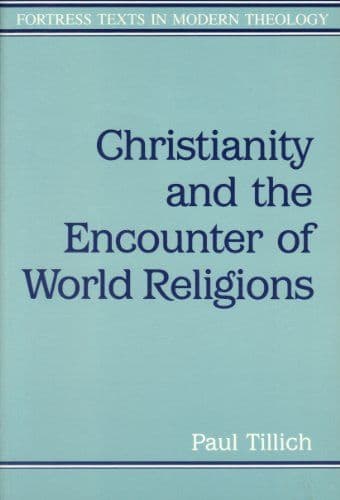
Christianity and the Encounter of the World Religions
These four Bampton Lectures, delivered in 1961, apply Tillich's theology of culture to the meeting of religions. His central framework is a dynamic typology: every religion mixes elements of sacramental, prophetic, and mystical types, and no religion is simply superior to another. Tillich extends the concept of religion to include quasi-religions like Communism and Fascism, which are grasped by ultimate concerns of nation or science. The Christian principle for judging religions is not doctrinal correctness but the prophetic protest against idolatry—a judgment Christianity must first apply to itself. The encounter is thus dialogical, not missionary.
Key Insights
✦What is the central framework of these lectures, and what does it reject?
The central framework is a dynamic typology of religions. Tillich argues that every religion—including Christianity—contains a mixture of sacramental, prophetic, and mystical elements, with one type usually dominant and the others present as counterpoints . This framework rejects the static classification of religions as simply true or false, superior or inferior. It also rejects the assumption that Christianity is inherently the highest religion. Instead, Tillich proposes that the proper criterion for judging any religion is the prophetic protest against idolatry—the refusal to absolutize any finite reality. Christianity, judged by this criterion, must first judge itself before it can encounter other religions. The encounter is therefore dialogical, not a one-way missionary proclamation.
✦What are 'quasi-religions,' and why does Tillich include them in the encounter?
Quasi-religions are movements that are not conventionally religious but are nonetheless grasped by an ultimate concern. Tillich identifies Fascism, Communism, and liberal humanism as examples: they are devoted to the nation, the class, science, progress, or a particular stage of society with a devotion that functions religiously . Including them in the encounter expands the scope of the lectures beyond the classical world religions. Tillich's point is that the religious dimension of human existence cannot be confined to institutions that call themselves religious; the state of being ultimately concerned appears wherever a finite reality is treated as unconditional. The New York Times review of the book noted that this discussion of quasi-religions was of 'special value and timeliness' . The concept also implies that the encounter between religions must include the encounter with secular faiths.
✦How did Tillich's treatment of Christianity's self-judgment differ from the standard missionary approach?
Tillich argues that Christianity must apply its own prophetic principle to itself before it can judge other religions. The prophetic principle is the protest against every attempt to absolutize a finite reality—including the church, its doctrines, and its historical achievements. If Christians claim that Jesus is the Christ and reject what denies this, Tillich acknowledges that this rejection is natural and inevitable . But the nature of the rejection matters: it can be total, partial, or dialectical. Tillich advocates the third path, in which both religions place their own claims in question and accept being judged. This is a significant departure from the missionary model, which presumes the superiority of the evangelizing religion. Tillich opposes attempts to convert others and denies that Christianity is inherently or decisively superior . The encounter is a conversation, not a conquest.
✦How have scholars assessed whether these lectures make Tillich a pluralist, an inclusivist, or something else?
The question is genuinely contested. Many representatives of pluralistic theology of religions have claimed Tillich as a precursor, relying on his last book . But Julija Prpić's 2016 study asks whether Tillich is truly a 'proclaimer of the pluralist paradigm' or an 'apologist of the inclusivistic model' . The difficulty is that Tillich's typology acknowledges the validity of other religions while still affirming a normative criterion—the prophetic protest against idolatry—that is derived from the biblical tradition. A 2016 essay argues that Tillich's contribution lies precisely in combining a methodologically sensitive theory of religion with a normative perspective, rather than fitting him into the tripartite scheme of exclusivism, inclusivism, and pluralism . The most accurate reading may be that Tillich is a progressive inclusivist whose criterion is formal (anti-idolatry) rather than doctrinal.
✦What was Tillich's treatment of Islam in these lectures, and how has it been criticized?
Tillich's treatment of Islam is widely regarded as the weakest part of the book. A scholarly analysis notes that Islam 'gets short shrift as a simplified religion attractive to primitives' . Tillich does not engage the complexity and richness of Islamic philosophy, theology, or Sufi mysticism, and he claims that Islam has not developed the kind of self-critical attitude that segments of Christianity developed after the Enlightenment. The same analysis notes, more positively, that Tillich later acknowledged that Islam's lack of emphasis on sin, taken alongside the Christian emphasis, 'can enlarge our understanding of man' . The criticism is not that Tillich is hostile to Islam but that his typological framework led him to a superficial and inadequately researched characterization. This is a significant limitation in a book that claims to inaugurate a genuine encounter.
✦What is the most common misunderstanding of these lectures?
The most common misunderstanding is that Tillich is arguing for the equality of all religions or that he has abandoned Christian commitment. He does neither. Tillich explicitly states that it is natural and inevitable for Christians to affirm that Jesus is the Christ and to reject what denies this assertion . What he opposes is the absolutization of this affirmation into a claim of total superiority that forecloses dialogue. The lectures are an exercise in Christian self-criticism, not a surrender of Christian identity. A related misunderstanding is that Tillich's typology is a neutral comparative framework. It is not: the criterion of anti-idolatry is derived from the prophetic tradition, and Tillich applies it first and most rigorously to Christianity itself. The book is a work of Christian theology engaging other religions, not a secular study of comparative religion.
Wealthy Psyche is an intellectual archive. We do not host, distribute, or sell book copies — physical or digital. We provide structured knowledge to help you think better, faster.