


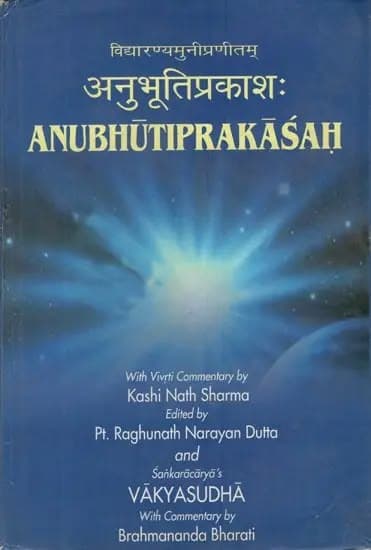
Anubhuti Prakasha

Vidyaranya's Anubhuti Prakasha is not a standalone philosophical treatise but a metrical paraphrase and interpretive exposition of twelve principal Upanishads, designed to make their Advaitic teachings accessible to seekers unable to study Shankara's bhashyas directly. Its central mechanism is pedagogical compression: Vidyaranya distills the Upanishads' discussions of Atman into approximately 2,800 verses across twenty chapters, integrating his distinctive Bimba-Pratibimba-vada (reflection theory) to explain the relationship between the individual self and Brahman. The text is a practical Vedanta manual, not a systematic commentary.
Book Archives
Detailed research articles, summaries and analyses from this book.
 Archive
The Mechanics of Liberation: Understanding Jivanmukti
 Archive
Consciousness and the Quantum Vacuum: A Vedantic Perspective
 Archive
Refuting The External World: Gaudapada’s Karika Analyzed
 Archive
Vichara-Sagara: A Deep Dive into Non-Dual Enquiry
 Archive
The Silence of the Sages: Understanding Dattatreya's Avadhuta Gita
 Archive
The Role of Negation (Neti Neti) in Absolute Realization
 Archive
The Secret Logic Behind Advaita's Theory of Maya
 Archive
Why Shankaracharya Rejected Buddhist Emptiness
 Archive
Brahma Sutra Bhashya: Decoding the Bhashyakara's Method
 Archive
The Hidden Meaning of Turiya in the Mandukya Upanishad
Key Insights
✦What is the Anubhuti Prakasha, and what does it reject?
The Anubhuti Prakasha is a metrical paraphrase and interpretive exposition of twelve principal Upanishads, composed by Vidyaranya in approximately 2,800 verses across twenty chapters [citation:4]. It is not a commentary in the style of Shankara's bhashyas, nor is it an independent philosophical treatise. Its purpose is pedagogical: to make the Upanishads' teachings on Atman accessible to serious seekers who cannot undertake the study of Shankara's commentaries directly [citation:4]. The text rejects the assumption that advanced Sanskrit philosophical commentary is the only path to Vedantic understanding. It also integrates Vidyaranya's distinctive Bimba-Pratibimba-vada (reflection theory) into its exposition, a doctrinal contribution not found in Shankara's authentic works .
✦What is the Bimba-Pratibimba-vada, and why is it significant in this text?
The Bimba-Pratibimba-vada is Vidyaranya's theory of reflection, which explains the relationship between the individual self (jiva) and Brahman by analogy to an object and its reflected image. According to V. V. Bapat, this theory is regarded as a major contribution of Vidyaranya and is discussed in the Anubhuti Prakasha . The theory addresses a central Advaita problem: how the unitary Brahman appears as the multiplicity of individual selves without being altered by this appearance. Vidyaranya's solution, developed in this text and elsewhere in his corpus, became a defining feature of the Vivarana school of Advaita with which he is associated. The Anubhuti Prakasha is thus not merely a paraphrase but a vehicle for Vidyaranya's own philosophical innovations.
✦What is the textual history and structure of the Anubhuti Prakasha?
The text consists of twenty chapters covering twelve Upanishads: Aitareya, Taittiriya, Chandogya, Mundaka, Prashna, Kaushitaki, Maitrayani, Katha, Shvetashvatara, Brihadaranyaka, Kena, and Nrisimhottara-tapaniya [citation:4]. The first seven chapters are sometimes called Chaturveda Vidyaprakasha, while the remaining chapters constitute the Anubhuti-Prakasha proper, though the entire work is now known by the latter name [citation:4]. A 1914 edition of the second chapter was published in Poona by V.V. Bapat [citation:2]. A 1983 edition is available through the Internet Archive [citation:11]. A Hindi exposition of four Upanishads within the text was published in Varanasi in 2013 . A comprehensive four-volume English commentary by Swami Shuddhabodhananda was released in 2024.
✦How does the Anubhuti Prakasha relate to Vidyaranya's better-known Panchadasi?
Both texts are works of Advaita Vedanta by Vidyaranya, but they differ in genre and purpose. The Panchadasi is a systematic instructional manual in fifteen chapters, organized around the three aspects of Brahman—sat, cit, and ananda—and is intended as an advanced introduction to Vedanta [citation:9][citation:12]. The Anubhuti Prakasha, by contrast, is an exposition of the Upanishads themselves, following their sequence rather than a systematic philosophical outline. Scholars have noted that Vidyaranya presents different prakriyas (methods) in the two works: the Panchadasi employs Srishti-Drishti-Vada (creation-first), while the Anubhuti Prakasha employs Drishti-Srishti-Vada (perception-first) [citation:14]. This does not indicate inconsistency but rather Vidyaranya's pedagogical flexibility in adapting method to context.
✦What is the significance of the text's neglect in Vedantic circles, and how has it been addressed?
Swami Shuddhabodhananda, who authored a four-volume commentary on the text released in 2024, observed that the Anubhuti Prakasha had been neglected in Vedantic circles despite its value for seekers who cannot study Shankara's bhashyas [citation:4]. To address this, he first taught all twenty chapters and then wrote an exhaustive commentary that includes word meanings, translations, chapter summaries, and discussions of allied Vedantic topics. The publishers, Sri Visweswar Trust, made the e-book available for free download, and the four-volume print edition runs to approximately 2,250 A4-sized pages [citation:4]. This recent attention suggests a revival of interest in Vidyaranya's pedagogical works beyond the more commonly studied Panchadasi.
✦What is a common misconception about the Anubhuti Prakasha's relationship to Shankara's commentaries?
A common misconception is that the Anubhuti Prakasha is a substitute for Shankara's bhashyas or a simplified summary of them. In fact, it is an independent exposition that follows the Upanishads' sequence but does not reproduce Shankara's arguments. Vidyaranya integrates his own doctrinal contributions, particularly the Bimba-Pratibimba-vada, which is not found in Shankara's authentic works . The text is better understood as a later Advaita pedagogical work that presupposes the authority of Shankara's commentaries while offering a different route into the Upanishads. Readers seeking Shankara's own interpretations should consult his bhashyas directly; the Anubhuti Prakasha is valuable precisely because it offers Vidyaranya's distinctive perspective on the same scriptural material.
Wealthy Psyche is an intellectual archive. We do not host, distribute, or sell book copies — physical or digital. We provide structured knowledge to help you think better, faster.