


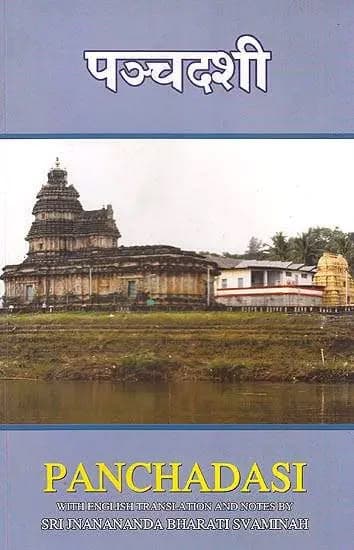
Panchadasi
Vidyaranya's Panchadasi is a systematic manual of Advaita Vedanta in fifteen chapters, organized around the three aspects of Brahman: existence (sat), consciousness (cit), and bliss (ananda). Its central mechanism is pedagogical structure: the first five chapters use discrimination (viveka) to distinguish the real self from the five sheaths and the external elements, the second five illuminate (dipa) the nature of pure consciousness through analyses of Isvara, the world, and the individual, and the final five unfold the bliss-nature of the self, arguing that all worldly pleasure is a reflected fragment of Brahman's ananda.
Book Archives
Detailed research articles, summaries and analyses from this book.
 Archive
The Mechanics of Liberation: Understanding Jivanmukti
 Archive
Consciousness and the Quantum Vacuum: A Vedantic Perspective
 Archive
Refuting The External World: Gaudapada’s Karika Analyzed
 Archive
Vichara-Sagara: A Deep Dive into Non-Dual Enquiry
 Archive
The Silence of the Sages: Understanding Dattatreya's Avadhuta Gita
 Archive
The Role of Negation (Neti Neti) in Absolute Realization
 Archive
The Secret Logic Behind Advaita's Theory of Maya
 Archive
Why Shankaracharya Rejected Buddhist Emptiness
 Archive
Brahma Sutra Bhashya: Decoding the Bhashyakara's Method
 Archive
The Hidden Meaning of Turiya in the Mandukya Upanishad
Key Insights
✦What is the central argument of the Panchadasi, and what does it reject?
The Panchadasi argues that the self (Atman) is identical with Brahman, and that this identity can be realized through a threefold inquiry corresponding to Brahman's nature as existence (sat), consciousness (cit), and bliss (ananda). The text rejects the identification of the self with the body, mind, and five sheaths, which is the root of bondage. It also rejects the view that liberation is something to be produced through action or ritual; rather, it is the direct recognition of what one already is. The first five chapters use discrimination (viveka) to separate the real from the unreal; the second five illuminate (dipa) the nature of consciousness; the final five unfold the bliss-nature of the self, arguing that all worldly pleasures are reflections of Brahman's ananda [citation:4][citation:7].
✦What is the structure of the Panchadasi, and how do its three sections correspond to Brahman's nature?
The Panchadasi's fifteen chapters are grouped into three quintads (panchaka), each corresponding to one aspect of Brahman as sat-chit-ananda. The Viveka Panchaka (chapters 1–5) deals with discrimination, analyzing the five elements and five sheaths to distinguish the real self from mere appearance, corresponding to sat (existence). The Dipa Panchaka (chapters 6–10) illuminates the nature of pure consciousness, with detailed analyses of Isvara, the world, the individual, and perception, corresponding to cit (consciousness). The Ananda Panchaka (chapters 11–15) unfolds the bliss-nature of Brahman, arguing that the self is the seat of supreme love and that all happiness is a reflection of the self's ananda [citation:4][citation:7][citation:11].
✦Is the Panchadasi entirely by Vidyaranya, or was it a collaborative work?
This is a documented scholarly uncertainty. Some sources hold that the later nine chapters were written by Bharatitirtha, Vidyaranya's predecessor at Sringeri, while the first six chapters are Vidyaranya's own [citation:5][citation:14]. Other accounts suggest the first five chapters are directly from Vidyaranya and the remaining ten were composed by learned pundits of the royal court [citation:12]. The Srisharadapeetham tradition presents the Panchadasi as Vidyaranya's crowning achievement without qualification [citation:6]. The Motilal Banarsidass edition acknowledges the authorship debate but treats the text as a unified compendium [citation:4]. This uncertainty means that readers should be cautious about treating every chapter as expressing Vidyaranya's personal philosophical position without further evidence.
✦What English translations of the Panchadasi exist, and how do they differ?
The first English translation was by Nandalal Dhole, published in Calcutta in 1899–1900 by the Society for the Resuscitation of Indian Literature [citation:5][citation:14]. A translation by M. Srinivasa Rau and K.A. Krishnaswamy Aiyar was published in 1912 at Srirangam [citation:9]. Hari Prasad Shastri's translation was published by Shanti Sadan, London, in 1954, with a second edition in 1965 [citation:2]. Swami Krishnananda's commentary, based on discourses given in 1989, is available online and is particularly useful for the sixth chapter, Chitradipa, which he considered philosophically the most important [citation:13][citation:15]. These translations vary in fidelity and accessibility; the 1912 edition includes explanatory notes and chapter summaries, making it a useful scholarly resource.
✦How does the Panchadasi relate to Vidyaranya's other works, such as the Anubhuti Prakasha?
Both texts are Advaita works by Vidyaranya, but they serve different functions. The Panchadasi is a systematic Prakarana Grantha (book of categories) that organizes Vedantic teaching around the three aspects of Brahman, while the Anubhuti Prakasha is a metrical exposition of twelve Upanishads [citation:12]. Scholars have noted that Vidyaranya employs different prakriyas (methods) in the two works: the Panchadasi uses Srishti-Drishti-Vada (creation-first), while the Anubhuti Prakasha uses Drishti-Srishti-Vada (perception-first). This does not indicate inconsistency but rather pedagogical flexibility. The Panchadasi is generally regarded as the more systematic and accessible of the two, while the Anubhuti Prakasha remains less studied [citation:6].
✦What is the significance of the sixth chapter, Chitradipa, and why is it considered central?
The sixth chapter, Chitradipa (Light on the Analogy of a Painted Picture), is widely regarded as the philosophical foundation of the entire Panchadasi. Swami Krishnananda described it as 'philosophically the most important of all the chapters' and devoted extensive commentary to it [citation:15]. The chapter uses the analogy of painting a picture—canvas, starch, outline, and coloring—to explain the four stages of creation: Brahman as the unchanging background, Ishvara as the concentrated will, Hiranyagarbha as the subtle outline of the cosmos, and the gross universe as the filled-in picture. This analogy allows Vidyaranya to explain how the world emerges from Brahman without compromising Brahman's immutability, a central problem for Advaita metaphysics [citation:15].
Wealthy Psyche is an intellectual archive. We do not host, distribute, or sell book copies — physical or digital. We provide structured knowledge to help you think better, faster.