



Vivekachudamani
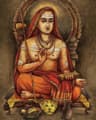
Traditionally attributed to Shankara but widely regarded by modern scholarship as the work of a later author, the Vivekachudamani is a pedagogical manual of Advaita Vedanta in 580 verses. Its central mechanism is the systematic cultivation of viveka—discrimination between the real (Atman/Brahman) and the unreal (body, mind, world)—as the precondition for liberation. The text presents this teaching as a dialogue between a qualified disciple and a guru, moving from the qualifications of a seeker through the analysis of the five sheaths and three states to the direct recognition of the self as pure consciousness, identical with Brahman.
Book Archives
Detailed research articles, summaries and analyses from this book.
 Archive
The Mechanics of Liberation: Understanding Jivanmukti
 Archive
Consciousness and the Quantum Vacuum: A Vedantic Perspective
 Archive
Refuting The External World: Gaudapada’s Karika Analyzed
 Archive
Vichara-Sagara: A Deep Dive into Non-Dual Enquiry
 Archive
The Silence of the Sages: Understanding Dattatreya's Avadhuta Gita
 Archive
The Role of Negation (Neti Neti) in Absolute Realization
 Archive
The Secret Logic Behind Advaita's Theory of Maya
 Archive
Why Shankaracharya Rejected Buddhist Emptiness
 Archive
Brahma Sutra Bhashya: Decoding the Bhashyakara's Method
 Archive
The Hidden Meaning of Turiya in the Mandukya Upanishad
Key Insights
✦What is the central teaching of the Vivekachudamani, and what does it reject?
The text's central teaching is that liberation (moksha) is attained through viveka—discrimination between the eternal self (Atman) and the non-self (body, mind, intellect, and world)—followed by the direct recognition that Atman is none other than Brahman. It presents this as a step-by-step pedagogy: a qualified disciple approaches a guru, receives instruction, and progressively detaches from false identifications through analysis of the five sheaths and the three states of consciousness. The text rejects the view that liberation can be achieved through ritual action or mere intellectual study without realization. It also criticizes attachment to the body and the mistaken identification of the self with the mind and senses, treating these as the root cause of bondage.
✦Why do modern scholars doubt that Adi Shankara wrote the Vivekachudamani?
Michael Comans, a scholar of Advaita Vedanta, argues that the attribution to Adi Shankara is 'most probably erroneous' for three reasons: the highly poetic style differs from Shankara's genuine works; there is a lack of extensive commentaries (bhashyas) on it, unusual given the many commentaries on his authentic works; and unlike Shankara's genuine writings, which give minimal importance to samadhi practices, the Vivekachudamani emphasizes them [citation:1]. Reza Shah-Kazemi also considers the authorship doubtful but notes that the text is 'so closely interwoven into the spiritual heritage of Shankara' that any analysis of his perspective must consider it [citation:1]. Berger suggests it may be a corporately authored work of Advaita monasteries that underwent revisions [citation:1].
✦How is the text structured, and what is its pedagogical method?
The Vivekachudamani consists of 580 verses in the Shardula Vikridita metre, structured as a dialogue between a disciple and a guru [citation:4]. It begins with salutations to Govinda (interpretable as God or Shankara's guru Govindapada), then proceeds through the qualifications of a seeker, the nature of the guru, the analysis of the non-self (body, senses, pranas, mind, intellect), the five sheaths (pancha kosha), the three states of consciousness (waking, dream, deep sleep), and finally the nature of the self and the characteristics of a liberated being (jivanmukta) [citation:4]. The method is progressive negation (neti neti) combined with positive instruction, designed to lead the disciple from mistaken identification to direct recognition of Atman as Brahman.
✦What is the textual and translation history of the Vivekachudamani in English?
The first widely used English translation was by Swami Madhavananda, published by Advaita Ashrama in Mayavati in 1921, with Sanskrit text, English translation, notes, and an index [citation:3]. This edition was reprinted multiple times, including a 1966 edition from Calcutta . Other translations include Charles Johnston's 1946 version and John Grimes's 2004 rendering . The 1921 Madhavananda translation remains the most cited and is available through Wikisource and the Internet Archive. A 1947 Advaita Ashrama edition is also listed in library catalogs [citation:2]. These translations matter because the text's popularity in the West has been mediated largely through the Ramakrishna Mission's publication tradition.
✦How does the Vivekachudamani relate to Shankara's authentic works, such as the Brahma Sutra Bhashya?
The relationship is contested precisely because the Vivekachudamani's authorship is disputed. If it is not by Adi Shankara, then it cannot be treated as an expression of his philosophical position but must be read as a later Advaita manual that may differ from his authentic views. Comans's point about samadhi is significant: Shankara's genuine bhashyas give minimal importance to samadhi practices, while the Vivekachudamani gives them special importance [citation:1]. This suggests that the text may reflect a later development in Advaita pedagogy rather than Shankara's own teaching. Readers seeking Shankara's authentic position should consult the Brahma Sutra Bhashya and the Upanishad bhashyas, while the Vivekachudamani remains valuable as a popular manual of Advaita practice.
✦What is the significance of the text's opening salutation to Govinda?
The opening verse salutes Govinda, whose nature is supreme bliss, who is the sadguru, who can be known only from the import of all Vedanta, and who is beyond speech and mind . The name Govinda is ingeniously composed to admit two interpretations: it may refer to God, or to Shankara's own guru, Govindapada . This double meaning is characteristic of the text's literary sophistication and its integration of devotional salutation with philosophical instruction. The salutation also establishes the text's pedagogical frame: the guru is identified with the absolute, and the teaching that follows is presented as a transmission from that non-dual source. Traditional commentators often read the verse as evidence of Shankara's authorship, though modern scholars treat it as a literary device.
✦What is a common misconception about the Vivekachudamani's status in Advaita Vedanta?
A common misconception is that because the text is traditionally attributed to Adi Shankara and is widely used in Advaita teaching, it must be an authentic work of the eighth-century philosopher. Modern scholarship has largely rejected this attribution, but the text's popularity and its integration into Advaita monastic curricula have kept the traditional attribution alive in devotional and pedagogical contexts [citation:1]. The misconception matters because it can lead readers to treat the Vivekachudamani as a reliable guide to Shankara's own philosophy, when in fact it may represent a later, more practice-oriented development. The text is valuable in its own right, but conflating it with Shankara's authentic works obscures important differences in emphasis and doctrine.
Wealthy Psyche is an intellectual archive. We do not host, distribute, or sell book copies — physical or digital. We provide structured knowledge to help you think better, faster.