



Kathopanishad Bhashya
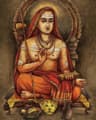
Shankara's commentary on the Katha Upanishad reads the dialogue between the boy Nachiketa and Yama, the god of death, as a systematic exposition of Advaita Vedanta's central claim: the self (Atman) is not the body, mind, or intellect but pure consciousness, identical with Brahman. The bhashya's distinctive mechanism is the sublation of the 'two paths'—the path of pleasantness (preyas) and the path of the good (shreyas)—into a rigorous analysis of what can and cannot be known through action, ritual, or intellectual effort alone. Shankara argues that liberation is attained solely through knowledge of the self's identity with Brahman, not through works.
Book Archives
Detailed research articles, summaries and analyses from this book.
 Archive
The Mechanics of Liberation: Understanding Jivanmukti
 Archive
Consciousness and the Quantum Vacuum: A Vedantic Perspective
 Archive
Refuting The External World: Gaudapada’s Karika Analyzed
 Archive
Vichara-Sagara: A Deep Dive into Non-Dual Enquiry
 Archive
The Silence of the Sages: Understanding Dattatreya's Avadhuta Gita
 Archive
The Role of Negation (Neti Neti) in Absolute Realization
 Archive
The Secret Logic Behind Advaita's Theory of Maya
 Archive
Why Shankaracharya Rejected Buddhist Emptiness
 Archive
Brahma Sutra Bhashya: Decoding the Bhashyakara's Method
 Archive
The Hidden Meaning of Turiya in the Mandukya Upanishad
Key Insights
✦What is the central argument of Shankara's Kathopanishad Bhashya, and what does it reject?
Shankara reads the Katha Upanishad as a sustained argument that the self (Atman) is eternal, unconditioned consciousness, distinct from the body, senses, mind, and intellect, and ultimately identical with Brahman. The bhashya rejects the view that liberation can be attained through ritual action, austerities, or intellectual study alone. Nachiketa's three boons and his dialogue with Yama are interpreted as stages in the progressive detachment from all that is perishable. Shankara's commentary consistently subordinated the Upanishad's narrative and poetic elements to the doctrinal claim that only knowledge (jnana) of the self's identity with Brahman removes ignorance (avidya) and thereby ends the cycle of rebirth.
✦How does Shankara interpret the distinction between shreyas and preyas in the Katha Upanishad?
Shankara treats the Upanishad's distinction between the good (shreyas) and the pleasant (preyas) as the fundamental ethical and soteriological divide. Preyas is what appears immediately agreeable and draws the senses outward; shreyas is what leads to the highest good, even when it is difficult or unpleasant. Nachiketa's choice of shreyas over the riches and pleasures Yama offers him is presented as a model for the aspirant: the refusal of transient goods is a precondition for knowledge of the eternal. Shankara uses this distinction to argue that the path to liberation is not a matter of maximizing pleasant experiences but of cultivating discrimination (viveka) between the real and the unreal.
✦What is the scholarly status of the attribution of this bhashya to Shankara?
The Kathopanishad Bhashya is traditionally attributed to Adi Shankara and is generally accepted as authentic, though its authorship has been examined with modern methods. Ivan Andrijanić published a study in the International Journal of Hindu Studies (2020) that applied Paul Hacker's criteria—specific usage of terms such as avidya, namarupa, maya, and ishvara—and found no grounds to disprove the traditional attribution . The same study reported that computational authorship verification using the General Imposters framework affirmed Shankara's authorship . This places the Kathopanishad Bhashya among the works whose attribution to Shankara has survived both traditional acceptance and modern stylometric scrutiny, unlike the many spurious works ascribed to him.
✦How does this bhashya relate to Shankara's other commentaries and independent works?
The Kathopanishad Bhashya belongs to Shankara's series of commentaries on the principal Upanishads, which together with the Brahma Sutra Bhashya and the Bhagavad Gita Bhashya form the foundation of Advaita Vedanta. Shankara's independent treatise Upadesa Sahasri develops the same non-dualist arguments in a more pedagogical form, and the Kathopanishad Bhashya's treatment of the self's distinction from the five sheaths (pancha kosha) and the three states of consciousness is echoed there. The bhashya also anticipates the method of the Brahma Sutra Bhashya in its insistence that the Upanishads' apparently conflicting statements must be reconciled through the principle of unity, with injunctive and ritual passages subordinated to the knowledge of Brahman.
✦What does Shankara mean when he says the self is 'not this, not this' (neti neti) in this context?
Shankara's commentary on the Katha Upanishad repeatedly employs the method of negation to distinguish the self from everything objectifiable. The self cannot be the body because the body is perishable and known; it cannot be the vital breath, the mind, or the intellect for the same reason—each is an object of awareness, not the awareness itself. The 'neti neti' formula is not a denial of the self's existence but a stripping away of false identifications. What remains after all negation is not nothing but pure consciousness, which Shankara identifies with Brahman. This method is central to his interpretation of the Upanishad's teaching that the self is 'subtler than the subtle and greater than the great.'
✦How has the Kathopanishad Bhashya been transmitted, and what English translations exist?
The Sanskrit text of the bhashya has been preserved in manuscript traditions and is available in printed editions, including the Sringeri Sharada Peetham's digital edition [citation:19]. English translations of Shankara's commentary on the Katha Upanishad are most readily accessible through Swami Gambhirananda's translation, published by Advaita Ashrama as part of a two-volume set of Eight Upanishads with Shankara's commentary [citation:6][citation:21]. Gambhirananda (1899–1988), the 11th President of the Ramakrishna Math, translated eight Upanishads with Shankara's commentaries into English [citation:16]. His translation includes the Devanagari text, a rendering of the commentary, notes, and references, and remains the standard accessible English version for students of Advaita Vedanta.
Wealthy Psyche is an intellectual archive. We do not host, distribute, or sell book copies — physical or digital. We provide structured knowledge to help you think better, faster.