


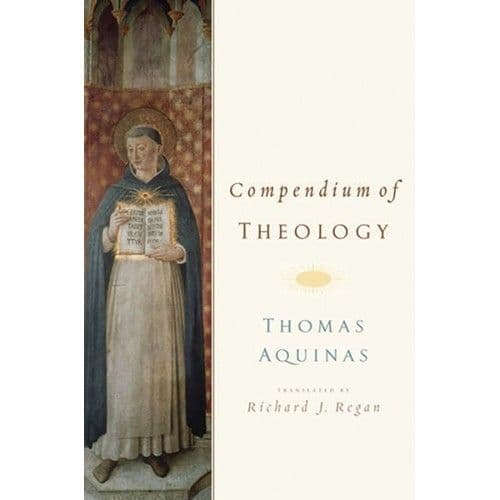
Compendium of Theology

Aquinas's Compendium of Theology is a short, systematic summary of Christian doctrine written for a friend who asked for a concise handbook. Its central framework is the return of creatures to God as their final end, treated through the three theological virtues of faith, hope, and charity. Part I, on faith, covers God, the Trinity, creation, and the incarnation; Part II, on hope and charity, treats the last things and the beatific vision. The work is incomplete, breaking off in the middle of a treatment of the resurrection, and its brevity makes it one of the most accessible entries into Aquinas's mature thought.
Key Insights
✦What is the purpose of the Compendium of Theology, and for whom was it written?
The Compendium was written at the request of a friend, Reginald of Piperno, who asked Aquinas for a concise handbook of Christian doctrine . The prologue states that the work is intended to provide a brief summary of the essential truths of the faith, for the benefit of those who cannot undertake the study of larger works. Its structure is organized around the return of creatures to God as their final end, treated through the three theological virtues of faith, hope, and charity . The work is thus both a summary and a guide: it presents the whole of theology in a compact form, ordered toward the practical end of directing the reader toward God. Its brevity makes it one of the most accessible entries into Aquinas's mature thought.
✦How does the Compendium relate to the Summa Theologica?
The Compendium is a later work, written around 1272–1273, near the end of Aquinas's life, and it is closely related to the Summa Theologica, which was left incomplete at his death in 1273 . The Compendium is much shorter and more compact, intended as a summary rather than a comprehensive treatment. It follows a similar structure, organized around the exitus-reditus pattern, but it is more focused on the theological virtues as the means of return. The work is incomplete, breaking off in the middle of a treatment of the resurrection, and it was left unfinished when Aquinas ceased writing. It is not a substitute for the Summa but a companion to it, useful for readers who want a concise overview of the same material.
✦How was the Compendium transmitted, and what does its textual history reveal?
The Compendium survives in numerous manuscripts and was first printed in the late fifteenth century. The standard Latin text is found in the Leonine edition, and the English translation by Cyril Vollert, published by Herder in 1949, is the most widely used English version . The work was left incomplete, and the text breaks off in the middle of a treatment of the resurrection. The work's textual history is relatively straightforward, with no major controversies about authenticity or transmission. The main scholarly issue concerns the relationship between the Compendium and the Summa: some scholars have argued that the Compendium represents a later stage in Aquinas's thought, while others see it as a summary of positions already established in the Summa.
✦How does the English translation by Cyril Vollert hold up, and what are its limitations?
Vollert's translation, published by Herder in 1949, is a serviceable and generally accurate rendering of the Latin. It is not a critical edition: it does not include the Latin text, and its notes are minimal. It reflects the Thomistic idiom of its time, tending toward literal rendering of technical terms. The translation has been widely used and is still the standard English version, though more recent translations of individual sections exist. Readers who want to engage the text seriously should consult the Latin alongside the translation, and should be aware that Vollert's terminology may not always match contemporary usage. The translation is best used as an introduction to the text, not as a substitute for it.
✦What is the most common misunderstanding of the Compendium's status?
The most common misunderstanding is that it is a complete summary of Aquinas's theology, a convenient substitute for the Summa. It is not: the work is incomplete, breaking off in the middle of a treatment of the resurrection, and it is much shorter and more selective than the Summa . A related misunderstanding is that it is a work of popular theology, written for a general audience. It is not: it is a technical summary, written for a friend who was already educated in theology, and it presupposes familiarity with the scholastic vocabulary. Readers who expect a simple introduction will find instead a compressed and demanding text, useful for those who already know the outlines of Aquinas's thought. It is an entry point, not a substitute.
Wealthy Psyche is an intellectual archive. We do not host, distribute, or sell book copies — physical or digital. We provide structured knowledge to help you think better, faster.