


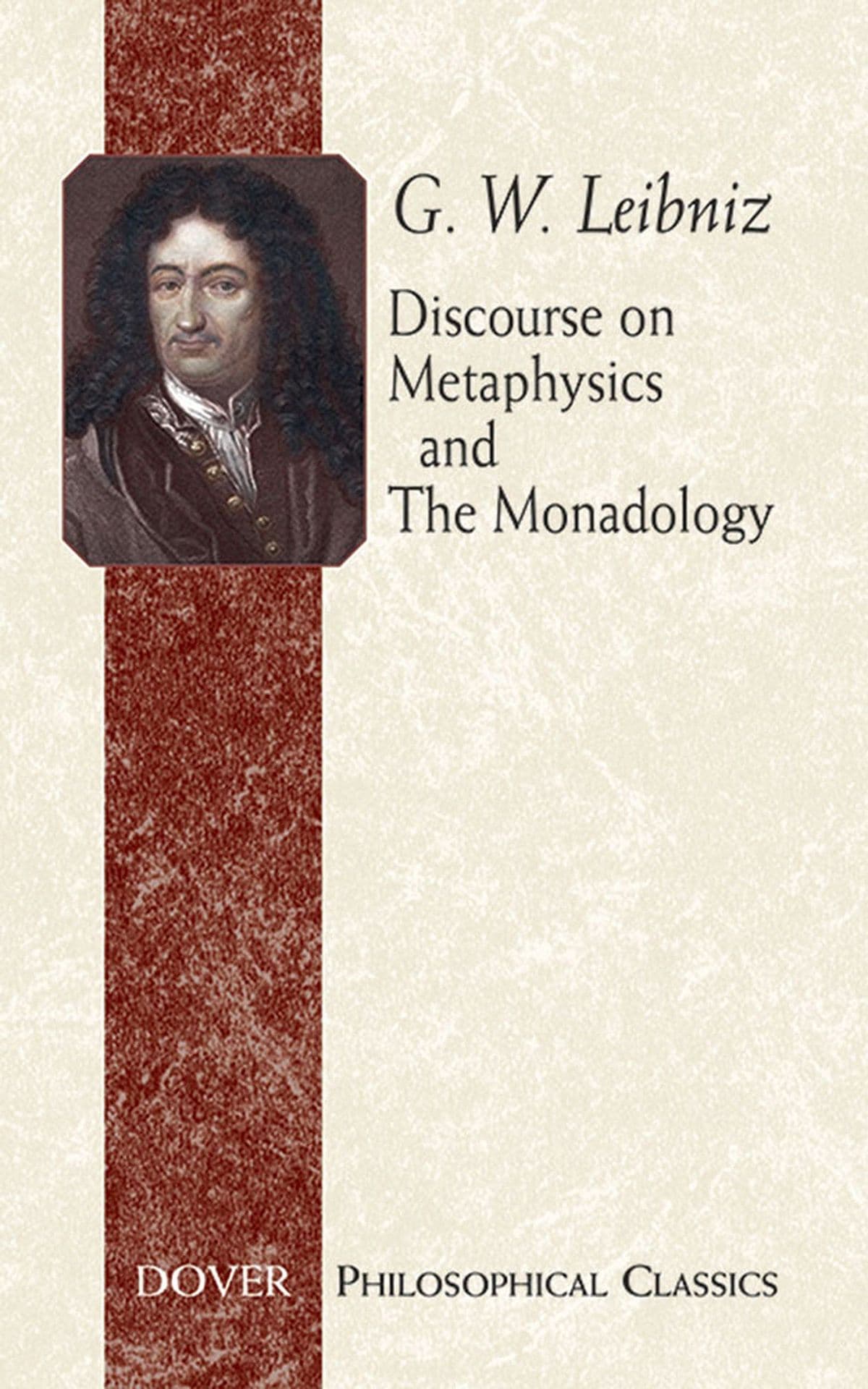
Discourse on Metaphysics

Written in 1686 but unpublished until the nineteenth century, this short treatise is the first mature statement of Leibniz's philosophical system. Its central mechanism is the doctrine that every substance has a complete concept that contains all its predicates, so that the whole history of a substance is logically contained in its notion from eternity. The book's distinctive argument is that this doctrine, which seems to entail fatalism, is in fact compatible with human freedom, and that it grounds a comprehensive rationalism in which God's choice of the best possible world, the pre-established harmony of body and soul, and the reality of individual substances are all integrated into a single system.
Key Insights
✦What is the central argument of the Discourse on Metaphysics, and what does it reject?
The central argument is that every substance has a complete concept that contains all its predicates, past, present, and future, so that the entire history of a substance is logically contained in its notion. Leibniz rejects the Cartesian and atomist views that substances are defined by extension or by indivisible material parts, and he rejects the occasionalist view that God intervenes at every moment to coordinate body and soul. Against these, he argues that substances are active, self-determining unities whose states unfold according to their own internal laws, and that the apparent interaction between them is a pre-established harmony . The book also rejects the view that God's will is arbitrary; God chooses the best possible world according to reasons, and the complete-concept theory is meant to show that this choice is compatible with the reality of individual substances.
✦What is the complete-concept theory, and why is it central to the Discourse?
The complete-concept theory is the claim that the notion of any individual substance contains all its predicates: everything that is true of Alexander the Great, for example, is contained in the complete concept of Alexander. This follows from Leibniz's principle of sufficient reason and his identity of indiscernibles: if two substances differed in any predicate, they would not be the same substance . The theory is central because it grounds Leibniz's account of truth, of substance, and of divine omniscience. If every predicate is contained in the subject, then truth is a matter of conceptual containment, and God's knowledge of the world is the knowledge of all complete concepts. The theory also generates the book's central problem: if all of Alexander's actions are contained in his concept, how can he be free?
✦How does the Discourse reconcile the complete-concept theory with human freedom?
Leibniz's solution is to distinguish between certainty and necessity. The complete concept of an individual contains all its predicates with certainty, but this certainty is not logical necessity. The concept of Judas, for example, contains the predicate 'betrays Jesus,' but Judas's betrayal is not logically necessary in the way that 'a triangle has three sides' is necessary. It is certain because God foresees it, but it is free because it follows from Judas's own nature and choices, not from an external constraint. Leibniz calls this 'hypothetical necessity' or 'moral necessity': God's choice of the best world makes the betrayal certain, but it does not compel Judas's will . This distinction is the crux of the book's reconciliation, and it has been widely criticized as a distinction without a difference.
✦Why was the Discourse unpublished during Leibniz's lifetime, and how did it become public?
Leibniz wrote the Discourse in 1686 but did not publish it, apparently because he was dissatisfied with it or because he feared that its doctrine of the complete concept would be misunderstood as fatalism. The text remained in manuscript until the nineteenth century, when it was discovered and published by Henri Lestrienne in 1846, and it was not translated into English until the twentieth century . The publication history explains why the Discourse has been less widely read than the Monadology or the Theodicy: it was not part of the public Leibnizian corpus until the modern period. Its importance for scholars is nonetheless immense, because it is the earliest full statement of the system that the later works presuppose, and it provides the clearest account of the complete-concept theory and its implications.
✦What is the most common misreading of the complete-concept theory?
The most persistent misreading treats it as a form of fatalism, as if Leibniz were claiming that whatever happens must happen and that human agency is an illusion. But Leibniz insists that the complete concept contains the predicates of a free agent, including the agent's own deliberations and choices. The concept of Alexander contains the predicate 'conquers Darius,' but it also contains the predicate 'deliberates about whether to conquer Darius and chooses to do so.' The necessity involved is the necessity of a concept's internal coherence, not the necessity of external constraint. A related error treats the complete concept as a blueprint that exists independently of the substance, when it is rather the substance's own notion—what God understands when God understands that substance .
✦What are the main English translations of the Discourse, and how do they differ?
The first English translation was by Peter G. Lucas and Leslie Grint, published by Manchester University Press in 1953 and reprinted in 1961. A widely used translation is by Roger Ariew and Daniel Garber in their Philosophical Essays (Hackett, 1989), which is the standard scholarly edition for many Anglophone philosophers. The Discourse has also been translated in older collections, including the Philosophical Papers and Letters edited by Leroy Loemker (1969). Readers should be aware that the text is short—thirty-seven sections—but dense, and that its central concepts are technical and interconnected. The translation choices about terms such as 'complete concept,' 'predicate,' and 'hypothetical necessity' significantly shape how the argument is understood.
Wealthy Psyche is an intellectual archive. We do not host, distribute, or sell book copies — physical or digital. We provide structured knowledge to help you think better, faster.