


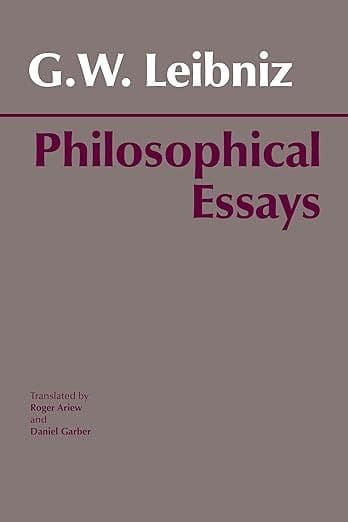
Philosophical Essays (Ariew/Garber ed.)

This 1989 Hackett volume is not a work by Leibniz but a scholarly reconstruction: a selection of his letters, published papers, and fragments spanning five decades, edited and translated by Roger Ariew and Daniel Garber. Its central mechanism is editorial rather than authorial—it demonstrates that Leibniz never produced a single canonical statement of his philosophy, and that his system must be assembled from dispersed texts. The anthology's distinctive argument is implicit in its arrangement: the Discourse on Metaphysics, the correspondence with Arnauld, the papers on force, and the Monadology trace a coherent development from substance to monad, making reconstruction possible despite the absence of a masterwork.
Key Insights
✦What is this volume, and why is it not a 'book' in the ordinary sense?
This is an anthology of Leibniz's shorter philosophical writings, edited and translated by Roger Ariew and Daniel Garber and published by Hackett in 1989. It is not a work Leibniz conceived or authorized as a unified book. As the publisher's description notes, Leibniz's writing forms an enormous corpus, and 'no single work stands as a canonical expression of his whole philosophy' . The volume therefore performs an editorial function: it selects from letters, published papers, and fragments written over a fifty-year period and arranges them to make Leibniz's philosophical development intelligible. Its unity is imposed by its editors, not given by its author, and this editorial mediation is essential to understanding what the volume is and does.
✦What does the volume contain, and how is it organized?
The anthology is divided into two parts. Part I, 'Basic Works,' includes the Discourse on Metaphysics, the correspondence with Arnauld, the papers on freedom and contingency, the New System of Nature, On Nature Itself, the Principles of Nature and Grace, and the Monadology, along with letters to de Volder, Bernoulli, and Wolff . Part II, 'Leibniz on His Contemporaries,' gathers texts responding to Descartes, Malebranche, Hobbes, Spinoza, Locke, Berkeley, and Newton, including the letters to Clarke . This arrangement is argumentative: it shows Leibniz's philosophy emerging through engagement with rivals and interlocutors, not in isolation. The volume thus presents his thought as a series of interventions in specific debates rather than as a system deduced from first principles.
✦Why is this edition considered the standard English-language anthology of Leibniz?
The Ariew and Garber volume has become the standard scholarly anthology for several reasons. It is comprehensive enough to include the major short works and the most important correspondence, yet selective enough to be usable in a semester. The translations are generally reliable and have been widely adopted in philosophy programs; the Hackett edition of the Discourse and Monadology, for instance, explicitly states that its translations are taken from Ariew and Garber's Philosophical Essays . The volume also includes a substantial introduction covering Leibniz's life and works, a rationale for the selection, and bibliographies of primary and secondary sources, making it a self-contained scholarly resource rather than a bare translation.
✦What criticisms have been made of the translations in this volume?
The translations have not escaped criticism. One reviewer noted that 'some of the word choices lend themselves to serious misinterpretation in the English,' though the same reviewer conceded that their understanding of Leibniz's metaphysics was not substantially affected . A more specific complaint concerns the editorial apparatus: the prefaces to individual texts sometimes fail to explain the historical problems Leibniz is responding to, leaving readers without the context needed to grasp the argument's stakes . These criticisms do not undermine the volume's status as the standard edition, but they suggest that readers working on specific texts should supplement it with more detailed commentaries or editions of individual works.
✦How does this anthology relate to the individual works it contains, such as the Discourse on Metaphysics and the Monadology?
The anthology is the textual basis for how most Anglophone readers encounter these works, but it does not replace them. The Discourse and the Monadology are available in separate editions, and the anthology's translations of these texts are the same ones used in Hackett's standalone volumes . What the anthology adds is context: reading the Discourse alongside the correspondence with Arnauld and the later Monadology reveals the development of Leibniz's thought and the problems that drove it. The anthology's value is therefore reconstructive rather than authoritative. It does not give us Leibniz's book, because there was no such book; it gives us the materials from which his philosophy can be understood.
✦What is the most common misreading of this volume's status?
The most persistent misreading treats the anthology as if it were a systematic work by Leibniz, a substitute for the masterwork he never wrote. This leads readers to assume that the arrangement of texts reflects Leibniz's own conception of his philosophy, when in fact it reflects his editors' judgment about how best to present it. A related error treats the absence of a canonical work as a deficiency in Leibniz's thought, when it is better understood as a feature of his philosophical practice: he worked through correspondence, occasional essays, and interventions in specific debates rather than through the construction of a system. The anthology's editorial framing—its selection, arrangement, and introductions—is what makes his philosophy reconstructable, and that framing should be kept in view.
Wealthy Psyche is an intellectual archive. We do not host, distribute, or sell book copies — physical or digital. We provide structured knowledge to help you think better, faster.