


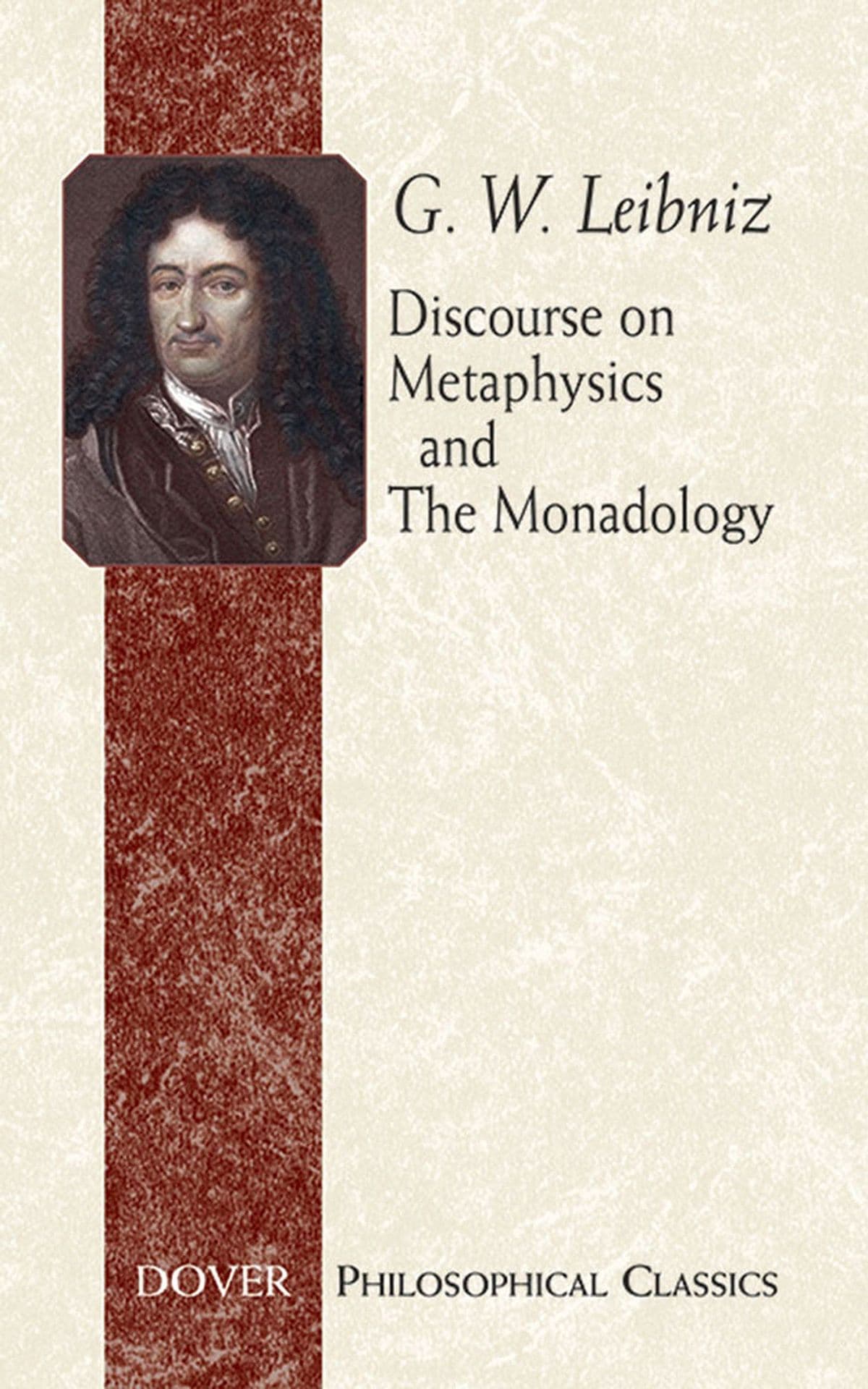
Monadology

Leibniz's 1714 text is a compressed metaphysical system in ninety short sections, arguing that reality consists of simple, immaterial substances called monads, each of which perceives the entire universe from its own perspective. Its central mechanism is pre-established harmony: monads have no windows and cannot interact, so their apparent coordination is orchestrated by God from the outset. The book's distinctive argument is that this windowless plurality is not a fragmentation but a unified expression of a single universe, and that the hierarchy of monads culminates in rational minds that mirror God and constitute a moral kingdom within the natural world.
Key Insights
✦What is the central argument of the Monadology, and what does it reject?
The central argument is that reality consists of simple, immaterial substances called monads, which are indivisible, indestructible, and endowed with perception and appetite. Leibniz rejects both Cartesian dualism and materialist atomism: there are no atoms of matter, only metaphysical points, and bodies are aggregates of monads rather than substances in their own right. The apparent interaction between substances is explained by pre-established harmony, the doctrine that God has coordinated all monads from the outset so that their internal states unfold in perfect correspondence without any causal commerce . What the book rejects is the ordinary assumption that things influence one another through contact or efficient causation; monads 'have no windows' through which anything could enter or leave.
✦Why did Leibniz write the Monadology in French and leave it untitled, and how did it acquire its name?
Leibniz composed the text in French in 1714, likely during his stay in Vienna, and did not give it a title. It was first published in 1720 in a German translation by Heinrich Köhler, who coined the title 'Monadology' (Monadologie) and published it from an earlier draft rather than Leibniz's final version . The original French text did not appear in print until 1840, in an anthology edited by Johann Eduard Erdman, over a century after it was written . The text is also known by the title 'The Principles of Philosophy' (Principes de la philosophie), and the title 'Monadology' only became standard in the nineteenth century. This editorial history means that the text we read today is a reconstruction, not a publication Leibniz himself supervised.
✦What is the 'no windows' doctrine, and how does pre-established harmony respond to the problem it creates?
The 'no windows' doctrine is Leibniz's claim that monads are completely self-contained: nothing can enter or leave them, and they cannot interact causally with one another. This creates an obvious problem: if monads cannot communicate, how is their apparent coordination—the fact that my mind and my body seem to act in concert, or that the world appears orderly—to be explained? Leibniz's answer is pre-established harmony: God created all monads with a complete series of internal states, and arranged them so that their unfoldings correspond perfectly, like two clocks synchronized by a master clockmaker . Critics found this unsatisfying, arguing that it replaces explanation with divine assertion. The doctrine remains one of the most contested elements of Leibniz's system, and it has been read both as a profound solution to the mind-body problem and as a desperate expedient.
✦What is the most common misreading of the Monadology's claim that monads are 'simple'?
The most persistent misreading takes 'simple' to mean 'elementary' or 'small,' as if monads were tiny particles or atoms. But simplicity in Leibniz is metaphysical, not physical: a simple substance has no parts, and therefore cannot be divided or composed. Monads are not spatial points but metaphysical unities, and they are immaterial. A related error treats monads as isolated individuals, when in fact each monad perceives the entire universe from its own perspective—it is a 'living mirror' of the whole . The isolation is causal, not epistemic: monads cannot interact, but they represent everything. This misreading leads to the false conclusion that Leibniz's universe is a collection of disconnected fragments, when his aim is precisely to show that plurality and unity are compatible.
✦How has the Monadology's argument been received and criticized by later philosophers?
The reception has been deeply divided. T. S. Eliot, in a 1916 essay, argued that Leibniz's monadology contains unresolvable gaps between his scientific and theological orientations, and that his project of restoring Christian belief in the immortality of the soul ultimately failed . Bertrand Russell took a different approach, treating Leibniz's metaphysics as a logical system to be reconstructed rather than a theological apologetic. More recently, the doctrine of pre-established harmony has been criticized as ad hoc, and the monadology as a whole has been seen as a brilliant but ultimately untenable attempt to reconcile mechanism with teleology. Defenders argue that the system's ambition and coherence remain unmatched, and that its problems are instructive even where its solutions fail.
✦What are the main English translations of the Monadology, and how do they differ?
Robert Latta's translation, first published by Oxford University Press in 1898 and reprinted in 1925, was the standard English version for much of the twentieth century and remains readable . Leroy Loemker's Philosophical Papers and Letters (1969) includes a widely used translation, and Roger Ariew and Daniel Garber's Philosophical Essays (1989) is the standard scholarly edition for many Anglophone philosophers. The text is short—approximately 6,000 words in ninety sections—and the translation differences often concern key terms: 'perception,' 'appetition,' 'entelechy,' and 'pre-established harmony' . Readers should be aware that the Monadology was not prepared for publication by Leibniz, and that different editions may reflect different drafts or editorial decisions about the arrangement of sections.
Wealthy Psyche is an intellectual archive. We do not host, distribute, or sell book copies — physical or digital. We provide structured knowledge to help you think better, faster.