


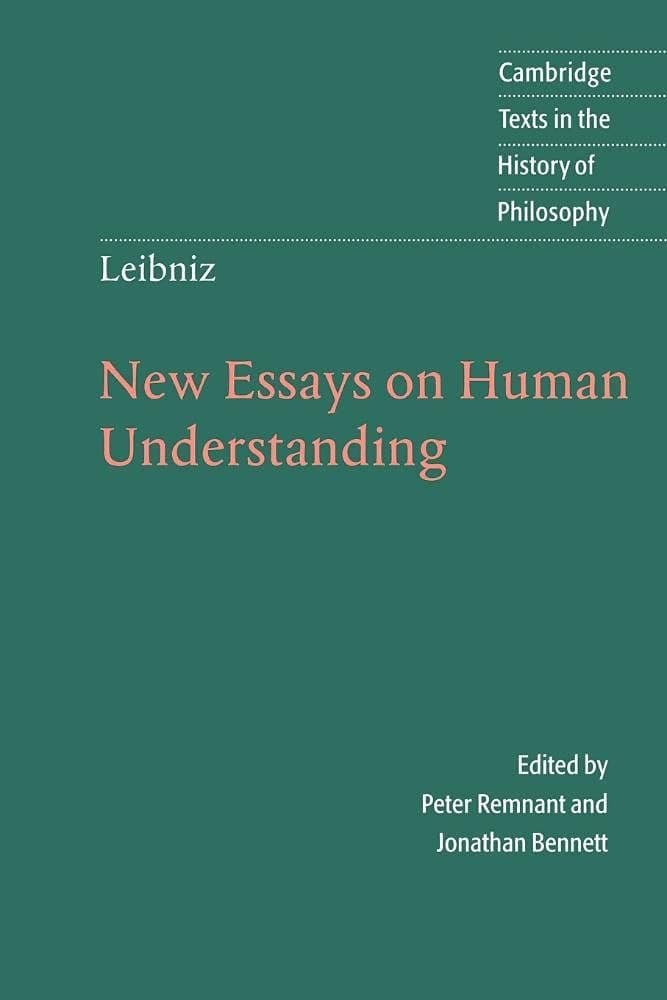
New Essays on Human Understanding

Completed in 1704 but withheld from publication until 1765, this book-length commentary on Locke's Essay Concerning Human Understanding is Leibniz's most sustained engagement with empiricism. Its central mechanism is a dialogue between Philalethes, who speaks for Locke, and Theophilus, who speaks for Leibniz, allowing the rationalist case to be made through direct confrontation with the empiricist text. The book's distinctive argument is that the mind is not a blank slate but contains innate principles and dispositions that experience awakens rather than creates, and that this doctrine of innate ideas is compatible with a thoroughgoing account of how the senses contribute to knowledge.
Key Insights
✦What is the central argument of the New Essays, and what does it reject?
The central argument is that the mind is not a blank slate but contains innate principles and dispositions that experience awakens rather than creates. Leibniz rejects Locke's empiricist claim that all knowledge derives from sensation and reflection, and he rejects the tabula rasa as an inadequate account of how the mind comes to have the ideas it has . The book's positive doctrine is that there are innate ideas and principles, but Leibniz is careful to distinguish his view from the crude innatism that Locke attacked: innate ideas are not fully formed propositions present at birth, but dispositions, tendencies, and virtual knowledge that experience brings to consciousness . The dialogue form allows Leibniz to make this case by responding point by point to Locke's text.
✦Why was the New Essays withheld from publication until 1765, and what does that reveal?
Leibniz completed the New Essays in 1704, but when Locke died in the same year, he decided not to publish it. The reason he gave was that he did not wish to attack a man who could no longer defend himself . The manuscript remained unpublished for over sixty years, until Raspe issued it in 1765, long after Leibniz's own death. This decision reveals something important about Leibniz's character and his conception of philosophical controversy: he was willing to engage in vigorous debate with living interlocutors, but he declined to publish a sustained critique of a dead opponent. The delay also meant that the New Essays had no influence on the development of empiricism in the eighteenth century, and it was read only retrospectively, as a document of the rationalist alternative to Locke.
✦What is the significance of the dialogue form, and who are Philalethes and Theophilus?
The dialogue form is not merely a literary device; it is a philosophical strategy. Philalethes—'lover of truth'—speaks for Locke, often quoting or paraphrasing the Essay directly. Theophilus—'lover of God'—speaks for Leibniz, responding to Philalethes's positions and developing the rationalist alternative . The form allows Leibniz to present his philosophy as a conversation rather than a system, and it enables him to acknowledge the force of Locke's objections while arguing that they can be accommodated within a rationalist framework. Theophilus is not a straw man; he is a serious interlocutor who takes Locke's empiricism seriously. The dialogue thus enacts the book's central claim: that rationalism and empiricism are not simply opposed but can be brought into a productive confrontation.
✦How does the New Essays relate to Locke's Essay Concerning Human Understanding?
The New Essays is a commentary on Locke's Essay, and its structure follows Locke's text chapter by chapter. But the relationship is not merely one of commentary; it is a sustained critique. Leibniz accepts much of Locke's empirical psychology—the account of how ideas are formed, the role of sensation and reflection—while rejecting the foundational claim that all knowledge derives from experience . The book's most famous disagreement is over innate ideas: Locke had argued that there are no innate principles, since children and idiots do not possess them, and Leibniz responds that innate ideas are dispositions that may not be consciously realized . The New Essays thus presents a rationalism that is more accommodating to empiricist insights than the Discourse on Metaphysics had been.
✦What is the most common misreading of Leibniz's doctrine of innate ideas?
The most persistent misreading treats innate ideas as fully formed propositions that are present in the mind at birth, and then concludes that Leibniz's position is obviously false because infants do not possess such propositions. But Leibniz explicitly rejects this crude innatism. For Leibniz, innate ideas are dispositions, tendencies, and virtual knowledge—they are 'in' the mind as inclinations rather than as explicit contents, and experience is required to bring them to consciousness . A related error treats the doctrine as a denial of the senses' contribution to knowledge, when Leibniz insists that experience is necessary for the actualization of innate dispositions. The misreading is encouraged by Locke's caricature of innatism, which Leibniz is concerned to refute as much as he is concerned to refute Locke's empiricism.
✦What are the main English translations of the New Essays, and how do they differ?
The first English translation was by Alfred Gideon Langley, published by Macmillan in 1896. The standard modern translation is by Peter Remnant and Jonathan Bennett, published by Cambridge University Press in 1981 and reissued in 1996 . The Remnant and Bennett translation is generally preferred by scholars for its accuracy and its extensive notes, and it has largely displaced Langley's version. The Cambridge edition includes a substantial introduction and a table of correspondences between the New Essays and Locke's Essay, making it a useful scholarly resource. Readers should be aware that the book is long and detailed, and that its dialogue form means that Leibniz's positions must be reconstructed from Theophilus's responses rather than found in a single systematic statement.
Wealthy Psyche is an intellectual archive. We do not host, distribute, or sell book copies — physical or digital. We provide structured knowledge to help you think better, faster.