


Elucidations of the Search After Truth

The Elucidations are Malebranche's series of clarifications and defenses appended to the third edition of The Search After Truth, written in response to critics who challenged his theories of ideas and causation. Rather than a standalone treatise, they function as a systematic supplement: Malebranche restates and sharpens his doctrines of the vision in God and occasionalism, addresses specific objections, and extends his arguments into new territory. The text is essential for understanding how Malebranche's mature system took shape through controversy, and it remains a primary source for his epistemology and metaphysics.
Key Insights
✦What exactly are the Elucidations, and why did Malebranche write them?
The Elucidations are a set of seventeen clarifications and defenses that Malebranche appended to the third edition of The Search After Truth, published in 1678. The French national library catalogue describes them as a philosophical work responding to criticisms provoked by the Search . Malebranche had solicited comments on his original work, and the Elucidations represent his systematic attempt to address objections, clarify ambiguous passages, and reinforce his central doctrines. They are not a separate treatise but an integrated supplement: Cambridge University Press's edition notes that the Elucidations accompanied the third edition and together with the Search constitute "the complete expression of his mature thought" . The text is therefore indispensable for anyone seeking Malebranche's own understanding of his philosophy.
✦Which doctrines do the Elucidations defend most extensively, and against what objections?
The Elucidations focus heavily on the two doctrines for which Malebranche is best known: the vision in God and occasionalism. Regarding the vision in God, critics objected that locating ideas in the divine mind compromises divine simplicity or makes God the immediate object of every thought in a way that blurs the creator-creature distinction. Malebranche responds by refining his account of how the mind's union with God operates. On occasionalism, the objection was that denying genuine causal power to created things makes God the direct author of sin and evil. The Elucidations address this by distinguishing God's general wills from particular volitions. Cambridge's description identifies them as "an important repository of his theories of ideas and causation," signaling their centrality to his epistemology and metaphysics .
✦How do the Elucidations relate to the Search After Truth as a philosophical project?
The relationship is one of revision and consolidation rather than straightforward continuation. The Search After Truth, first published in 1674–75, was Malebranche's first and longest work, covering sense perception, imagination, understanding, inclination, passion, and method. The Elucidations, composed after years of criticism, are more narrowly focused and polemical. The Ohio State University Press edition of 1980, the first English translation, presents them together and notes that Malebranche "revised it several times during his life and, in later editions, appended to it a series of responses to his critics under the title 'Elucidations'" . Reading the Elucidations alongside the Search reveals how Malebranche's positions sharpened under pressure, and how his responses to critics shaped the systematic presentations found in later works like the Dialogues.
✦What is the translation history of the Elucidations in English, and how reliable are the available editions?
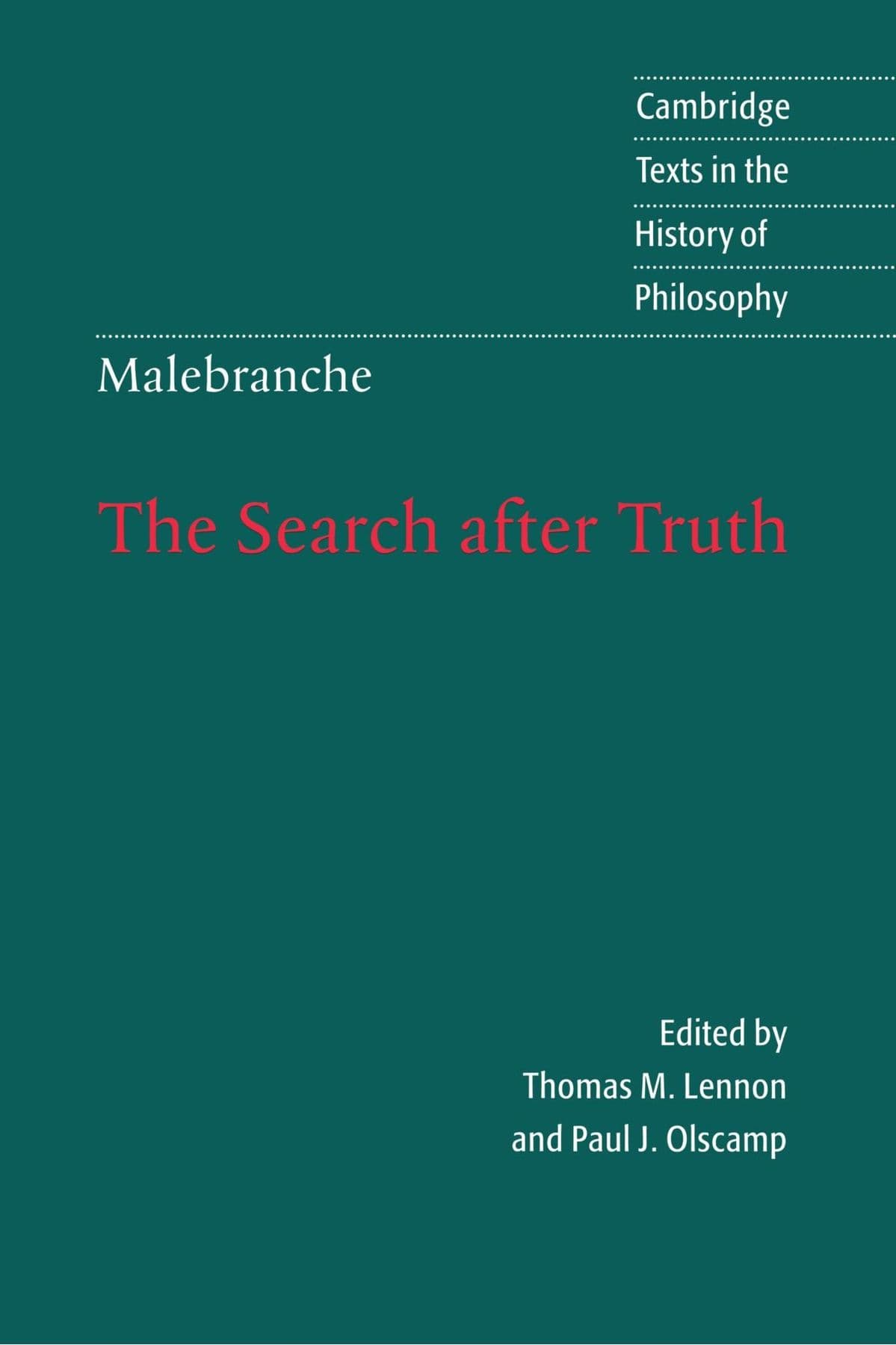
The standard English translation is by Thomas M. Lennon and Paul J. Olscamp, first published by Ohio State University Press in 1980 and reprinted by Cambridge University Press in 1997 as part of the Cambridge Texts in the History of Philosophy series . The Cambridge edition presents the Search and Elucidations together in a single volume, translated and edited by Lennon and Olscamp, with Lennon handling the Elucidations. A review in Dialogue praised the translations as being in "a fluent style" and noted that the editor supplied "a good store of scholarly help" . The French text has been re-edited more recently by Jean-Christophe Bardout for Vrin (2006), based on the 1712 edition with modernized orthography, but no corresponding English update has appeared .
✦Did Malebranche's critics ever respond directly to the Elucidations, and what came of the dispute?
The most significant critic was Antoine Arnauld, the Jansenist theologian who had already attacked Malebranche's theory of ideas in Des vraies et des fausses idées (1683). The Elucidations were written before Arnauld's major assault, but the ongoing controversy shaped Malebranche's later defenses. A further response came from Pierre-Sylvain Régis, a Cartesian who disagreed with Malebranche's departures from Descartes. Malebranche wrote a Réponse à Régis, which the Vrin edition of the Éclaircissements includes as an annex . The disputes were not merely academic: Malebranche's Treatise on Nature and Grace was placed on the Index of Forbidden Books in 1690, and the Elucidations must be read in the context of a philosopher under sustained theological and philosophical attack.
✦Is there a common misconception about the Elucidations that readers should avoid?
A frequent misconception is that the Elucidations are a mere appendix or afterthought, of interest only to specialists comparing editions. In fact, they are where Malebranche does some of his most important philosophical work. The clarifications on ideas and causation are not repetitions but refinements that respond to specific objections and sharpen doctrines that were stated more tentatively in the original Search. Cambridge's edition explicitly frames the two texts together as constituting "the complete expression of his mature thought" . Readers who skip the Elucidations miss Malebranche's own account of what his philosophy really means—an account developed under intellectual pressure and therefore more precise than the original formulations.
Wealthy Psyche is an intellectual archive. We do not host, distribute, or sell book copies — physical or digital. We provide structured knowledge to help you think better, faster.