


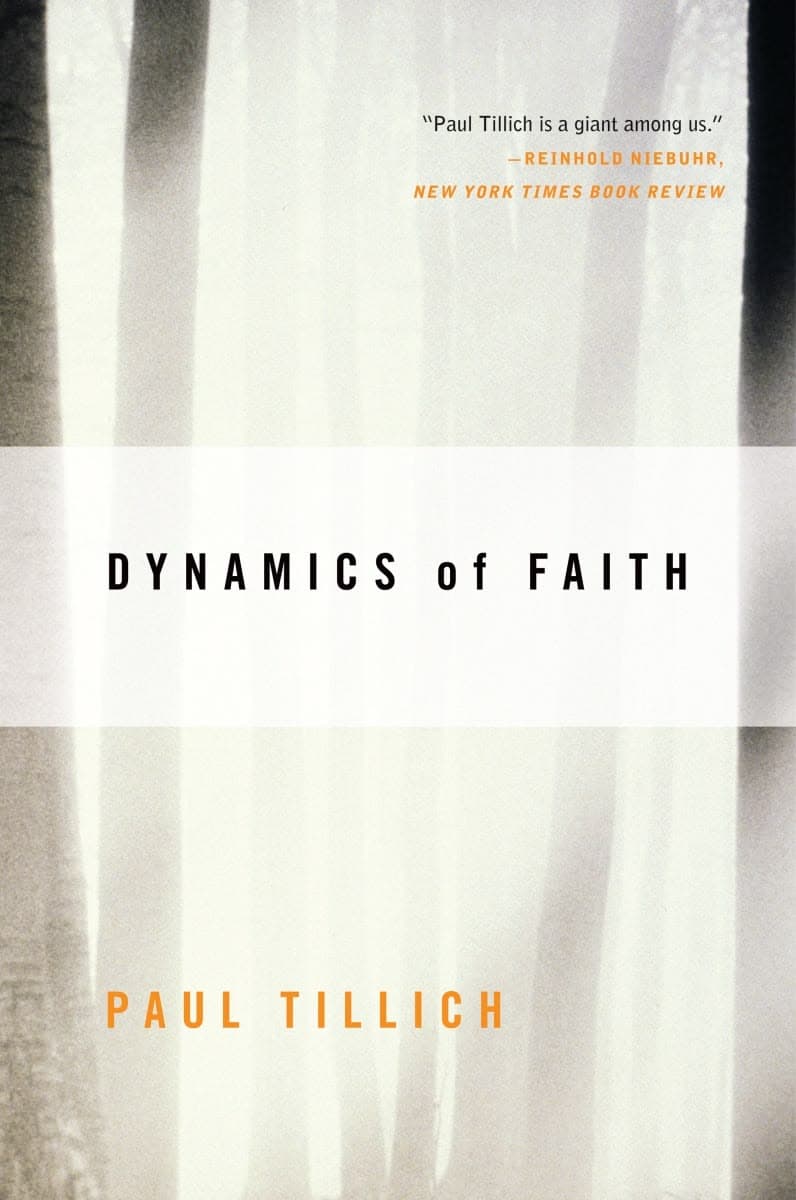
Dynamics of Faith
Tillich's central framework defines faith as the state of being ultimately concerned: faith is not the belief in uncertain propositions but the act of being grasped by an unconditional concern that demands total surrender. The book analyzes the dynamics of this concern—its symbols, its types, its risks of idolatry and doubt—and argues that faith and doubt are not opposites but coexist, because the unconditional cannot be captured in any finite formulation. Tillich distinguishes ontological, moral, and spiritual types of faith, and he warns that every faith risks demonization when it absolutizes its own symbols. Faith is the courage to accept acceptance despite the threat of nonbeing.
Key Insights
✦What is Tillich's definition of faith, and what does it reject?
Tillich defines faith as the state of being ultimately concerned: faith is the act of being grasped by an unconditional concern that demands total surrender . He rejects the widespread modern definition of faith as belief in something for which there is no evidence, or as the acceptance of improbable propositions. Faith is not a cognitive act that supplements knowledge with unprovable claims; it is an existential orientation toward the Unconditional. The most momentous question, Tillich writes, is not how to prove or disprove the existence of God, but what concerns us ultimately . This definition shifts the locus of faith from belief to being: faith is not something we possess but something that possesses us.
✦How does Tillich understand the relationship between faith and doubt?
Tillich argues that faith and doubt are not opposites but coexist. Doubt is not the absence of faith; it is an inherent element of faith itself. Because the unconditional cannot be captured in any finite formulation, every expression of faith is inadequate, and this inadequacy produces doubt. The certainty of faith does not exclude risk; it includes it, because faith is the acceptance of the unconditionally real in the midst of the uncertainties of existence . Tillich distinguishes between doubt as a methodological principle and doubt as existential anxiety, but in both cases he insists that a faith without doubt would be idolatrous—a belief in a finite object that has been absolutized. The courageous acceptance of doubt is itself an act of faith.
✦What are the three types of faith Tillich distinguishes, and how do they differ?
Tillich distinguishes ontological faith, moral faith, and spiritual faith . Ontological faith is the individual's personal actualization of the unconditional, realized in the courage to affirm one's existence in the face of nonbeing. Moral faith is a community's particular, concrete actualization of the unconditional, expressed in rituals and doctrines. Spiritual faith is the awareness of the presence of the unconditional in a given historical moment, the principle of justice and truth that transcends a community's finite forms. Each type has a role to play, and each can become demonic when it absolutizes its own finite expression. The distinction is not a hierarchy of value but an analysis of the dimensions of faith's manifestation in history.
✦What does Tillich mean by the 'demonic' or 'idolatrous' risk of faith, and why is it central to the book?
For Tillich, faith becomes demonic when it absolutizes the finite object through which it is expressed. Idolatry is not merely the worship of a false god; it is the elevation of a particular expression of ultimate concern—a nation, an ideology, a religious institution, a doctrine—to the status of the unconditional. This is demonic because the finite cannot bear the weight of the infinite: it must destroy itself and others in the attempt to be what it is not. A review of the book's 2001 edition summarizes Tillich's claim that these symbolic elements can become demonic when they are elevated to the status of the unconditional . The risk of idolatry is not external to faith but inherent in it, because faith must express itself in finite symbols.
✦How did reviewers respond to the book, and what criticisms were raised?
The book was widely reviewed and became one of Tillich's most popular works. A review in the Journal of Bible and Religion noted that Tillich defines faith as ultimate concern and that he 'attempts to make honest and unbiased an examination of a concept confusedly employed both inside and outside of the churches' . But the reviewer also identified a tension: Tillich seems to equate faith with the 'state of being grasped by an ultimate concern,' which means that everyone is a believer, whether their concern is truth, success, or nation. The question that vexed critics was whether this is an adequate definition of biblical faith, which seems to require a specific content. Tillich's defenders reply that the definition does not eliminate content; it specifies the structure within which all content is held.
✦What is the most common misunderstanding of Tillich's claim that 'faith is ultimate concern'?
The most common misunderstanding is that Tillich is saying all faiths are equal or that any intense interest counts as genuine faith. He is not. Faith is the state of being ultimately concerned, but the object of that concern can be true or false, adequate or idolatrous. When Tillich says that if a person is ultimately concerned with success or with a nation, that person is a believer, he is making a phenomenological claim, not a normative endorsement . A related misunderstanding is that Tillich reduces faith to a purely subjective attitude. For him, the unconditional is not a projection of the mind; it is the power of being that grasps us. Faith is the act of being grasped, not the act of grasping. This distinction is crucial to understanding why he can say that faith includes doubt without collapsing into relativism.
Wealthy Psyche is an intellectual archive. We do not host, distribute, or sell book copies — physical or digital. We provide structured knowledge to help you think better, faster.