


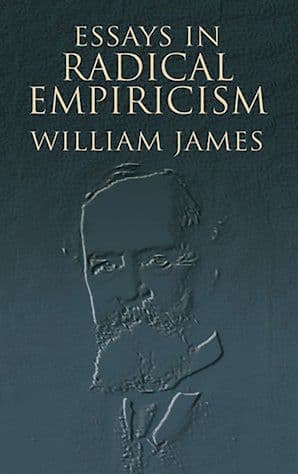
Essays in Radical Empiricism
This posthumous collection, edited by Ralph Barton Perry in 1912, sets out James's most radical metaphysical position: that experience itself is the sole reality, and that the relations between experiences are as directly given as the things they relate. Its central framework is 'pure experience'—a neutral stuff prior to the subject-object distinction, out of which both consciousness and physical objects are constructed. James argues that consciousness is not an entity but a function, and that the same piece of pure experience can enter into different contexts as a thought or as a thing. The essays are the foundation of neutral monism and process philosophy.
Key Insights
✦What is radical empiricism, and how does it differ from classical empiricism?
Radical empiricism is James's attempt to take experience seriously in its fullness. Classical empiricism, from Hume onward, treated experience as a series of discrete impressions and ideas, and dismissed relations as mental additions. James argues that relations are themselves directly experienced: we feel the connections between things, not just the things themselves. A radical empiricism must be 'radical' in that it admits relations into the fabric of experience, and it must be 'empiricist' in that it refuses to appeal to anything beyond experience . The position is set out in the opening essay as a postulate (that only what can be experienced is real), a statement of fact (that relations are experienced), and a generalization (that experience is the sole reality). This makes it a more thoroughgoing empiricism than Hume's.
✦What is 'pure experience,' and how does it relate to the subject-object distinction?
Pure experience is the name James gives to the immediate flux of life before it is divided into subjects and objects, knowers and things known. It is not a substance or a thing; it is the neutral stuff out of which both mental and physical realities are constructed. In the essay 'Does Consciousness Exist?' James argues that consciousness is not an entity but a function: the same piece of pure experience can be called a thought when considered in one context (as part of a personal biography) and a thing when considered in another (as part of a physical system) . The subject-object distinction is thus not fundamental; it is a distinction that arises when we take a segment of pure experience and relate it to other segments. This is the foundation of neutral monism.
✦How do these essays relate to James's earlier work, and why were they published posthumously?
The essays were written between 1904 and 1906 and published in journals during James's lifetime, but they were collected and published as a book only after his death in 1910, edited by Ralph Barton Perry in 1912 . They represent James's most radical metaphysical position, developing the pragmatist and pluralist themes of his earlier work into a full-fledged ontology of pure experience. James had intended to write a systematic book on the subject but never completed it. The posthumous publication means that the collection lacks the unity and final polish James would have given it. Some essays overlap, and the order is Perry's, not James's. But the collection is essential for understanding the metaphysical foundation of James's pragmatism.
✦How did contemporary philosophers respond to James's radical empiricism?
The reception was mixed and often critical. Some philosophers saw the essays as a bold and original contribution to metaphysics; others dismissed them as confused or incoherent. The most influential critique came from the new realists and from later analytic philosophers, who argued that pure experience is an unstable concept: if it is neutral, how does it give rise to the distinction between mind and matter? James's answer—that the distinction arises from the different contexts in which experience is taken—was seen by many as a verbal solution to a real problem. Despite these criticisms, the essays were influential on subsequent thinkers, including Bertrand Russell (who developed his own neutral monism), the American pragmatists, and the process philosophers who followed Whitehead.
✦How does the 1996 University of Nebraska edition differ from earlier editions, and what does it add?
The 1996 Bison Books edition, published by the University of Nebraska Press, includes an introduction by Ellen Kappy Suckiel that situates the essays in the context of James's philosophical development and explains their significance for his wider project. It also includes a note on the text and a bibliography. The essays themselves are reprinted from the 1912 Longmans edition, which is in the public domain. The main advantage of the Nebraska edition is the introduction and the editorial apparatus, which make the essays accessible to contemporary readers. The essays are also available in the standard Harvard edition of James's works, which includes more extensive notes and textual apparatus. Readers who want the full scholarly treatment should use the Harvard edition; readers who want a convenient and affordable introduction should use the Nebraska edition.
✦What is the most common misunderstanding of radical empiricism?
The most common misunderstanding is that radical empiricism is a form of idealism or that it denies the reality of the physical world. Neither is correct. James insists that pure experience is the sole reality, but he does not say that experience is mental. The physical world is real; it is just not fundamentally different in kind from the mental world. Both are constructions out of the neutral stuff of pure experience . A related misunderstanding is that radical empiricism is a form of subjective idealism, in which the world is a projection of the mind. James explicitly rejects this: pure experience is prior to the mind, not a product of it. The position is a form of neutral monism, not idealism, and it is meant to do justice to the reality of both mind and matter without reducing one to the other.
Wealthy Psyche is an intellectual archive. We do not host, distribute, or sell book copies — physical or digital. We provide structured knowledge to help you think better, faster.