


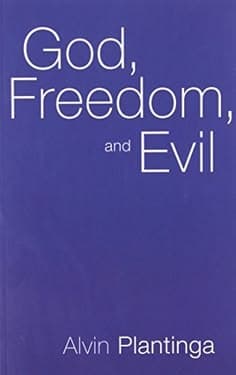
God, Freedom, and Evil
This short book is Plantinga's accessible restatement of two decisive moves in analytic philosophy of religion. Its central framework is the Free Will Defense: the logical problem of evil—the claim that God and evil cannot coexist—fails because it is possible that every free creature suffers from transworld depravity, meaning God could not actualize a world with free creatures who never do wrong. The book also examines the ontological argument as the strongest specimen of natural theology. Together, these analyses show that neither theistic proofs nor atheological objections achieve decisive victory, leaving theism rationally respectable.
Key Insights
✦What is the Free Will Defense, and how does it differ from a theodicy?
The Free Will Defense is a logical response to the problem of evil: it aims only to show that God's existence is logically compatible with evil, not to identify God's actual reasons for permitting specific evils. Plantinga is explicit that he is offering a defense, not a theodicy . A theodicy claims to know why God allows evil; a defense claims only that the existence of evil does not contradict theism. The key move is transworld depravity: if it is possible that every free creature would do at least one wrong action in every world in which God could actualize them, then God could not create a world with free creatures who never sin, no matter how powerful he is. This dissolves the logical problem of evil without explaining the origin of any particular suffering.
✦What is 'transworld depravity,' and why is it central to the argument?
Transworld depravity is a property of a creaturely essence: it means that for every possible world in which that creature is significantly free and always does what is right, there is some action such that, if God had actualized that world, the creature would have gone wrong with respect to it . In simpler terms, a person with transworld depravity would sin in every feasible world in which they exist. Plantinga's defense requires only the possibility that all creaturely essences suffer from transworld depravity. If that possibility obtains, then God could not have actualized a world containing moral good without moral evil, and the logical problem of evil collapses. Critics like Sean Meslar have argued that the notion is internally inconsistent, but it remains the most influential response to the logical problem .
✦How does this book relate to Plantinga's more technical treatment in The Nature of Necessity?
God, Freedom, and Evil covers some of the same ground as The Nature of Necessity, published the same year, but aims at the general reader rather than the specialist . The technical apparatus—possible worlds, essences, transworld depravity—is simplified and presented without the full modal ontology. Stephen T. Davis notes that the book is 'aimed at the general reader' and that students can understand it if they are willing to think hard . Readers who want the rigorous formulation should consult The Nature of Necessity; those seeking a clear introduction to the argument should start here. The 1974 book is the popular statement; the 1974 treatise is the technical one.
✦What does Plantinga conclude about the ontological argument in this book?
Plantinga treats the ontological argument as the most promising specimen of natural theology, and he devotes a chapter to a modal version of it. His conclusion is not that the argument proves God's existence, but that it is valid and that its key premise—that a maximally great being is possibly instantiated—cannot be decisively refuted. He does not claim to establish the premise; his point is that the argument deserves serious attention and that its rejection by many philosophers has been too hasty. This treatment reflects the book's broader strategy: natural theology and natural atheology both fail to achieve decisive victory, leaving theism as a rationally permissible option rather than a rationally mandatory one.
✦Why is this book considered so influential, and what did it change in philosophy of religion?
Before Plantinga, the logical problem of evil was widely regarded as a decisive refutation of classical theism. God, Freedom, and Evil, together with The Nature of Necessity, is credited with turning the tide. Kevin Timpe calls it 'the single most influential text on the problem of evil in the past fifty years' . Harry Gensler notes that Plantinga 'has done more than anyone else to restore in analytic circles the respectability of belief in God' . The book demonstrated that rigorous analytic philosophy could be used to defend traditional Christian belief, and it helped establish philosophy of religion as a serious subdiscipline in secular departments. Its influence is visible in the subsequent literature on transworld depravity, skeptical theism, and evidential arguments from evil.
✦What is the most common misconception about this book's argument?
The most common misconception is that Plantinga claims to have solved the problem of evil or explained why God permits suffering. He does not. The Free Will Defense is a minimal logical argument: it shows only that God and evil are not logically incompatible. It does not address the evidential problem of evil—the claim that the amount and distribution of suffering make God's existence improbable—and Plantinga does not claim that it does. A related misconception is that transworld depravity is an empirical claim about human psychology. It is a modal claim about what is possible for creaturely essences, and Plantinga asserts only its possibility, not its actuality. Readers who expect a pastoral or theological answer to suffering will not find it here; they will find a rigorous logical defense.
Wealthy Psyche is an intellectual archive. We do not host, distribute, or sell book copies — physical or digital. We provide structured knowledge to help you think better, faster.