


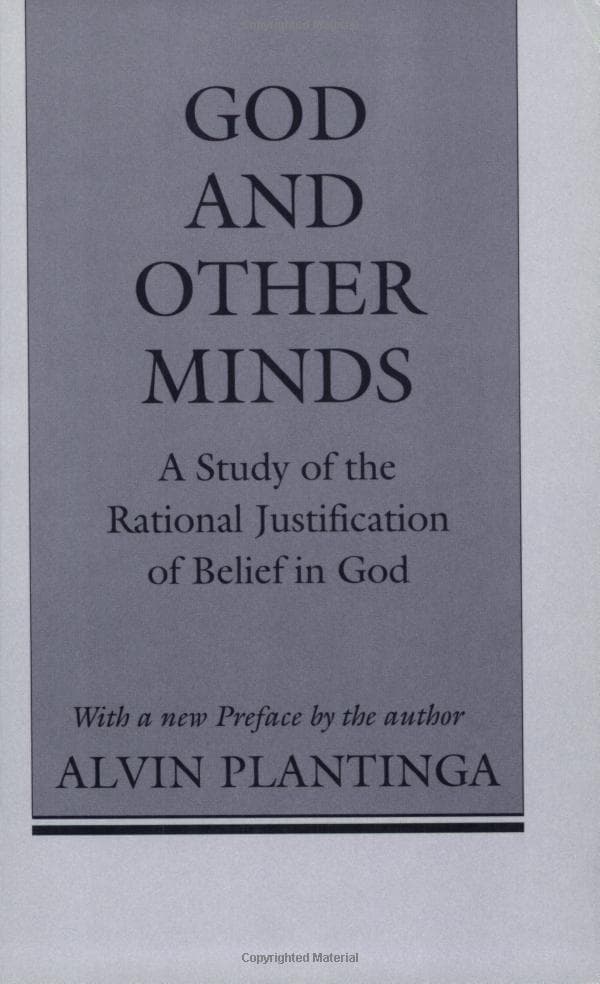
God and Other Minds: A Study of the Rational Justification of Belief in God
Plantinga's central framework is an analogical parity argument: belief in God and belief in other minds stand in the same epistemic boat. He first dismantles the traditional theistic proofs and the major atheological objections, showing that neither side can achieve decisive victory. Then he argues that the analogical inference to other minds, though philosophically contested, is rationally acceptable; if it is, then by parallel reasoning, so is belief in God. The book does not claim to prove God's existence but to establish that theistic belief is rationally justified without demonstrative proof.
Key Insights
✦What is the central argument of God and Other Minds, and what does it reject?
The book's central argument is that belief in God is rationally justified in the same way that belief in other minds is rationally justified: neither can be demonstrated against a determined sceptic, yet both are fundamentally rational. Plantinga rejects the evidentialist assumption that theistic belief requires propositional evidence to be rational. He first examines the cosmological, ontological, and teleological arguments and finds them all wanting; then he examines the major atheological objections—the problem of evil, verificationism, the paradox of omnipotence—and finds them equally unsuccessful . The conclusion is not that God exists, but that theism is not irrational simply because it lacks proof. The parallel with other minds is designed to show that a belief can be rational even when its grounds are not discursively available to the believer.
✦How does Plantinga's treatment of the problem of evil in this book relate to his later Free Will Defense?
Chapter 6, 'The Free Will Defense,' contains the initial formulation of the argument that Plantinga would develop and refine in later works, most notably The Nature of Necessity (1974) and God, Freedom, and Evil (1974). In God and Other Minds, the Free Will Defense is deployed as part of the 'natural atheology' section: Plantinga is examining whether the problem of evil succeeds as an argument against theism, and he concludes that it does not, because the Free Will Defense shows that God's existence is logically compatible with evil . The Templeton Prize citation notes that the final version of the Free Will Defense was published later, after this initial formulation in the 1967 book . Readers interested in the mature version should consult the later works, but the 1967 chapter marks the argument's first appearance in print.
✦What is the analogical argument for other minds, and why does Plantinga think it is crucial?
The analogical argument reasons from one's own case: I know that my own behavior is associated with a mind, and I observe similar behavior in others, so I infer by analogy that others have minds too. Plantinga defends this argument against criticisms from Strawson, Wittgenstein, and others, arguing that it provides the best reasons we have for belief in other minds . Its importance for the book's overall thesis is that it serves as the comparison case. If the analogical inference to other minds is rationally acceptable—as most people tacitly assume—then the analogical inference to God, which Plantinga argues is structurally similar, should be equally acceptable. The argument does not depend on the analogy being perfect; it depends on the claim that both beliefs face the same kind of sceptical challenge and both survive it in the same way.
✦How did critics respond to the analogy between God and other minds?
The reception was mixed, and the third section of the book—the analogy itself—was widely regarded as its weakest part. A contemporary review in the Scottish Journal of Theology noted that the book's conclusion rests on the analogy between belief in other minds and belief in God, but judged this section less compelling than the rigorous dismantling of the traditional proofs and atheological objections . Marie-Louise Friquegnon argued in Religious Studies that even if Plantinga's claims about the similarities between the two arguments were sound, they would at most support pantheism, not the traditional Judaeo-Christian theism he intended to defend; she also argued that the alleged similarities do not in fact hold, because the inference to other minds is grounded on behavioral resemblance, while the teleological argument is grounded on resemblance between human artifacts and the world . Plantinga himself later moved away from reliance on the analogy in his subsequent work.
✦How does this book fit into the development of Plantinga's thought, and did he later abandon its approach?
God and Other Minds is Plantinga's first book and the beginning of a lifelong epistemological project. Mark J. Boone has argued that this book, the Reformed epistemology articles, and the Warrant trilogy are all part of the same Reidian particularist project: they use Thomas Reid's common-sense principles as clear cases of rational belief and apply that criterion to belief in God . However, Plantinga's approach did shift significantly. The contemporary review noted that in a more recent work Plantinga had 'changed his whole approach,' abandoning reliance on the analogy with other minds in favor of restoring primacy to the ontological argument . Graham Oppy has traced a trajectory from a strict conception of natural theology in 1967, through a less stringent view in the 1974 works, to an even more permissive attitude in later writings . The book is thus foundational but not definitive of his mature position.
✦What is the most common misunderstanding of what God and Other Minds attempts to establish?
The most common misunderstanding is that Plantinga is offering a proof or argument for God's existence. He is not. The book explicitly concludes that the traditional theistic proofs fail and that the atheological objections also fail; the result is a stalemate at the level of demonstration . What Plantinga argues is that theism can be rationally justified without demonstration, in the same way that belief in other minds is rationally justified without demonstration. A related misunderstanding is that the book defends the teleological argument, because it draws an analogy between the argument from design and the argument from other minds. In fact, Plantinga rejects the teleological argument as a proof; the analogy is between the epistemic status of two beliefs, not between two arguments for God's existence. The book is a contribution to religious epistemology, not to natural theology in the traditional sense.
Wealthy Psyche is an intellectual archive. We do not host, distribute, or sell book copies — physical or digital. We provide structured knowledge to help you think better, faster.