



Mandukya Upanishad Bhashya
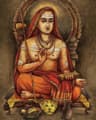
Shankara's commentary on the Mandukya Upanishad is unique among his bhashyas because it is inseparable from Gaudapada's Karika, which it follows and interprets. Its central mechanism is the analysis of the four states of consciousness—waking, dream, deep sleep, and Turiya—to demonstrate that the witness (sakshi) underlying all states is none other than Brahman. Shankara argues that Turiya is not a fourth state alongside the others but their very substratum, and he deploys the method of negation (neti neti) to strip away each state until only the ever-present witness remains. The text's deepest teaching, following Gaudapada, is ajativada: nothing is ever truly born.
Book Archives
Detailed research articles, summaries and analyses from this book.
 Archive
The Mechanics of Liberation: Understanding Jivanmukti
 Archive
Consciousness and the Quantum Vacuum: A Vedantic Perspective
 Archive
Refuting The External World: Gaudapada’s Karika Analyzed
 Archive
Vichara-Sagara: A Deep Dive into Non-Dual Enquiry
 Archive
The Silence of the Sages: Understanding Dattatreya's Avadhuta Gita
 Archive
The Role of Negation (Neti Neti) in Absolute Realization
 Archive
The Secret Logic Behind Advaita's Theory of Maya
 Archive
Why Shankaracharya Rejected Buddhist Emptiness
 Archive
Brahma Sutra Bhashya: Decoding the Bhashyakara's Method
 Archive
The Hidden Meaning of Turiya in the Mandukya Upanishad
Key Insights
✦What is the central argument of Shankara's Mandukya Bhashya, and what does it reject?
Shankara's commentary argues that the self (Atman), analyzed through the four states of consciousness—waking (Vishva), dream (Taijasa), deep sleep (Prajna), and Turiya—is ultimately identical with Brahman. The bhashya rejects the view that Turiya is merely a fourth state alongside the other three; instead, Turiya is the witness consciousness that underlies and illumines all states while remaining untouched by them [citation:10][citation:27]. Shankara also rejects any dualistic reading of the Mandukya Upanishad, insisting that the Upanishad's declaration of non-duality (advaita) is the final truth. Following Gaudapada, he argues that the world of multiplicity is an appearance (mithya) superimposed on the non-dual reality, and that the highest teaching is ajativada—nothing is ever truly born [citation:10].
✦Why is this bhashya inseparable from Gaudapada's Mandukya Karika?
Unlike Shankara's commentaries on other Upanishads, his Mandukya Bhashya is not a standalone commentary on the twelve verses of the Upanishad alone. It comments on both the Upanishad and Gaudapada's four chapters of Karikas, which are traditionally appended to the Upanishad [citation:8][citation:10]. Gaudapada was Shankara's teacher's teacher, and the Karika is the foundational text of Advaita's philosophical articulation, particularly its doctrine of ajativada (non-origination) [citation:2][citation:11]. Shankara's bhashya thus serves to systematize and defend Gaudapada's teachings. This means that reading Shankara's Mandukya commentary without the Karika is impossible; the two are transmitted and studied as a single unit in the Advaita tradition.
✦What does Shankara mean by Turiya, and how does it differ from the other three states?
Shankara explains that Turiya (the Fourth) is not a state of consciousness that comes and goes like waking, dreaming, or deep sleep. It is the witnessing awareness (sakshi) that is present in all three states but is itself never modified by them [citation:10][citation:27]. In waking, it illumines the external world; in dream, the internal world; in deep sleep, it illumines the absence of objects. Shankara emphasizes that Turiya is not to be attained or produced; it is the ever-present substratum of all experience, obscured only by ignorance (avidya). The Upanishad's identification of Turiya with AUM's silence, and with Atman, is interpreted by Shankara as the direct teaching of non-duality: the self is Brahman, and there is nothing other than it.
✦How does Shankara handle the apparent contradiction between the Upanishad's teaching of creation and Gaudapada's ajativada?
Shankara acknowledges that the Mandukya Upanishad and other scriptures speak of creation, but he follows Gaudapada in treating this as a provisional teaching (vyavaharika) intended for those who still perceive a world. The highest teaching (paramarthika) is ajativada: nothing is ever born [citation:10]. Shankara's method is to show that the language of creation is a concession to ignorance, not a description of ultimate reality. Just as a rope is mistaken for a snake in the dark, Brahman is mistaken for the world of multiplicity. When knowledge arises, the appearance is sublated, and only Brahman remains. This hierarchical hermeneutic allows Shankara to affirm the authority of scripture while denying that its creation narratives are literally true at the highest level of understanding.
✦What English translations of the Mandukya Bhashya with the Karika are most widely used?
The standard English translation for over a century has been that of Manilal N. Dvivedi, published in the Sacred Books of the East series (volume 15) and later reprinted by various publishers . This edition includes the Upanishad, Gaudapada's Karika, and Shankara's Bhashya, making it the most complete single-volume resource in English. Swami Gambhirananda's translation, published by Advaita Ashrama, is also widely used in the Ramakrishna Mission tradition. More recent translations include those by Swami Nikhilananda and Charles Johnston. For scholarly study, the Dvivedi edition remains essential because of its historical influence and its inclusion of the full Karika, which is indispensable for understanding Shankara's commentary.
✦How does the Mandukya Bhashya relate to Shankara's other commentaries, particularly the Brahma Sutra Bhashya?
The Mandukya Bhashya occupies a unique position in Shankara's corpus because of its dependence on Gaudapada's Karika. The Brahma Sutra Bhashya is Shankara's systematic exposition of Vedanta, engaging with rival schools and establishing the principles of Advaita interpretation. The Mandukya Bhashya, by contrast, is a focused analysis of consciousness and the self, working closely with Gaudapada's more radical formulations of ajativada [citation:8][citation:10]. While the Brahma Sutra Bhashya defends Advaita against dualist and Buddhist critiques, the Mandukya Bhashya explores the experiential dimensions of non-duality through the analysis of the four states. Together, they show Shankara working both as a systematic philosopher and as a commentator on the tradition's most profound psychological and metaphysical text.
Wealthy Psyche is an intellectual archive. We do not host, distribute, or sell book copies — physical or digital. We provide structured knowledge to help you think better, faster.