


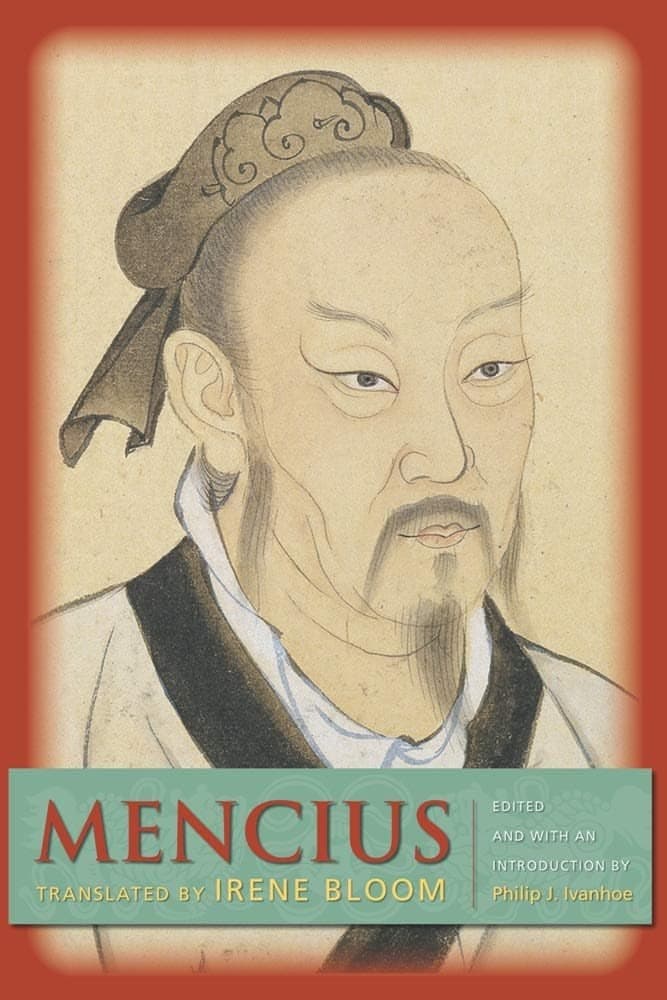
Mencius (Mengzi)

The Mengzi is a collection of anecdotes, dialogues, and arguments attributed to the fourth-century BCE Confucian thinker Mencius and compiled by his followers, and its distinctive contribution is the sustained defense of the claim that human nature tends toward goodness. Unlike the Analects' fragmentary aphorisms, the Mengzi develops extended arguments—most famously against Gaozi's view that morality is external—grounding ethical cultivation in innate 'sprouts' of virtue. The text's central mechanism is the analogy between moral failure and environmental damage: humans are naturally good, but negligence and bad conditions cause them to deviate from their nature.
Key Insights
✦What is the Mengzi's central argument about human nature, and what does it reject?
The Mengzi's governing claim is that human nature tends toward goodness, grounded in four innate 'sprouts' (siduan): commiseration, shame, reverence, and the sense of right and wrong. Mencius argues that these predispositions are universal—even a child about to fall into a well evokes instant compassion in any observer—and that ethical cultivation consists in nurturing and extending them. What the text rejects is Gaozi's view that human nature is morally neutral and that righteousness is external, as well as the implication that moral failure reflects a defect in human nature itself. For Mencius, wrongdoing results from neglect, environmental damage, or failure to develop the sprouts, not from an inherently flawed nature.
✦How does the Mengzi differ from the Analects in form and argumentative method?
The difference is one of genre and philosophical ambition. The Analects is a collection of brief, occasion-specific sayings of Confucius, often without explicit argument, that demand the reader to infer a coherent ethical vision. The Mengzi, by contrast, contains extended dialogues and sustained arguments, most notably the debates with Gaozi over human nature and with the Mohists and Yangists over the nature of ethical commitment. Mencius engages in explicit reasoning, offers analogies (the ox mountain, the child at the well), and defends positions against named opponents. This argumentative structure reflects the text's Warring States context, where competing schools demanded philosophical justification rather than authoritative pronouncement.
✦What is the textual history of the Mengzi, and who wrote it?
The Mengzi was compiled by Mencius's followers after his death, though the exact authorship is debated. Sima Qian held that Mencius wrote it with his disciples Wan Zhang and Gongsun Chou; Zhu Xi and others believed Mencius wrote it alone; and some Tang and Song scholars argued that the disciples compiled it from their own records after his death [citation:11]. Like many Warring States texts, it contains material composed over a long period [citation:3]. The work dates from the second half of the fourth century BCE and was elevated to canonical status by Zhu Xi in the Song dynasty, who made it one of the Four Books and the core of civil service examinations [citation:11].
✦How did the Mengzi become one of the Four Books, and why does this matter for interpretation?
The Mengzi did not initially enjoy preeminent status; in the Han dynasty's Book of Han, it was listed only among miscellaneous minor works [citation:11]. Its elevation was the work of Zhu Xi in the twelfth century, who declared the Four Books—the Mengzi, Analects, Great Learning, and Doctrine of the Mean—as the canon all students should learn [citation:11]. This canonization shaped interpretation for centuries: readers approached the Mengzi through Zhu Xi's commentary, and the text's arguments were read as systematic philosophy rather than occasional interventions. Modern translations that include Zhu Xi's commentary, such as Bryan Van Norden's 2008 edition, make this interpretive mediation explicit [citation:1][citation:10].
✦What is the most common misreading of Mencius's claim that human nature is good?
The most persistent misreading treats the claim as an assertion that people are born morally perfect or that evil is unreal. In the Mengzi, the claim is that humans possess innate sprouts of virtue that require cultivation and protection, and that failure to develop them—through negligence, bad environment, or lack of effort—produces vice. Mencius does not deny the reality of wrongdoing; he denies that it is the fundamental expression of human nature. The ox mountain analogy makes this clear: the mountain's vegetation is repeatedly cut and grazed, leaving it barren, but its nature is not inherently barren—it has been damaged. Reading Mencius as an optimist who ignores evil misses the text's emphasis on cultivation and responsibility.
✦Which English translations of the Mengzi are most useful, and how do they differ?
The major translations serve different purposes. James Legge's 1861 version, revised in 1895, was the foundational scholarly rendering and is based on Zhu Xi's commentary, making it valuable for understanding the text as read in the imperial tradition, though its Victorian idiom can obscure philosophical precision. Bryan Van Norden's 2008 Hackett edition is philosophically nuanced and includes selected passages from Zhu Xi's commentary alongside the translation, providing a parallel to traditional Chinese reading practices [citation:1][citation:10]. Irene Bloom's 2009 translation, edited by Philip Ivanhoe for Columbia University Press, is noted for its accuracy and accessibility [citation:2]. D.C. Lau's Penguin edition remains widely used for its clarity.
Wealthy Psyche is an intellectual archive. We do not host, distribute, or sell book copies — physical or digital. We provide structured knowledge to help you think better, faster.