


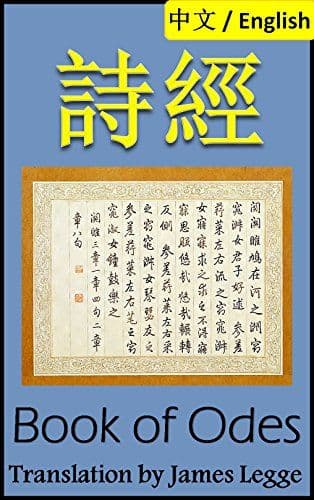
The Book of Odes (Shijing)
The Shijing is an anthology of 305 poems dating from roughly the 11th to 7th centuries BCE, and its distinctive mechanism is the transformation of anonymous folk songs, court lyrics, and temple hymns into a canonical repository of moral and political wisdom. The collection's four sections—Airs of the States, Minor Court Songs, Major Court Songs, and Temple Hymns—were read by Confucian interpreters not as literature but as evidence of the ruler's virtue and the state of governance. Its central claim, as canonized, is that poetry reflects and reforms the polity, making the Odes a foundation of Confucian education and diplomatic speech.
Key Insights
✦What are the four sections of the Shijing, and how do they differ in content and function?
The Shijing is divided into four sections: the Guofeng (Airs of the States), 160 songs collected from fifteen ancient states, depicting the lives and sentiments of common people; the Xiaoya (Minor Court Songs), 74 poems created for various ceremonial occasions at court; the Daya (Major Court Songs), 31 larger poems tied to specific historical events and the deeds of ancient heroes; and the Song (Temple Hymns), 40 hymns addressed to deities and sage rulers . This structure moves from local folk expression to courtly ceremony to sacred ritual, and the interpretive tradition read each section as offering different kinds of evidence about the moral health of the polity.
✦Did Confucius actually compile or edit the Shijing, as tradition claims?
The traditional attribution of the Shijing's compilation to Confucius is historically untenable. Sima Qian's account that Confucius selected 305 poems from over 3,000 is a Han dynasty claim, with no textual evidence prior to about 100 BCE asserting Confucian editorship . James Legge, the first major English translator, concluded from the evidence that the Book of Poetry was current in China long before Confucius, arranged much as we have it, and that while Confucius may have made a copy for his disciples and reformed the music to which the poems were sung, he did not reject or admit pieces from the collection . The attribution reflects the text's canonical status, not its compositional history.
✦What do archaeological discoveries reveal about the Shijing's early textual history?
Excavated manuscripts have transformed scholarly understanding of the Shijing's formation. The Anhui University bamboo slips, the Shanghai Museum's 'Confucius' Discussion of the Songs' (Kongzi shi lun, c. 375 BCE), and the Fuyang Han slips show significant variations from the received Mao edition in wording, stanza divisions, titles, and even the number of stanzas in individual poems . The Kongzi shi lun divides the songs into the same four categories as the received text but includes poems not in the anthology, indicating that the canon was not yet closed. These finds confirm that the Shijing circulated in multiple versions and that the received Mao text is one strand of a complex transmission, not the original.
✦How did the Mao edition become the standard version of the Shijing?
During the Han dynasty, four versions of the Shijing circulated: the Lu, Qi, and Han versions, which were officially recognized, and the Mao version, which was initially private . The Mao text, with its prefaces and commentary attributed to Mao Heng and Mao Chang, gradually gained prominence and became the primary version during the reign of Emperor Ping (1 BCE–6 CE). Zheng Xuan added further commentary in the second century, and by the Tang dynasty, the Mao-Zheng interpretation was enshrined in the imperial 'Correct Meaning of the Five Classics' compiled by Kong Yingda . The Lu, Qi, and Han versions were eventually lost, leaving the Mao edition as the sole surviving complete recension.
✦What is the most common misreading of the Shijing in modern scholarship?
A persistent misreading treats the Shijing as a work of literature to be appreciated for its poetic qualities alone, detaching it from the interpretive framework that made it canonical. In the Confucian tradition, the Odes were not read as aesthetic objects but as moral and political evidence: the Airs of the States were understood to reveal the virtue or decadence of a ruler, and the court songs to embody proper ceremonial order. Confucius himself, in the Analects, urged his disciples to study the Odes for their practical use in diplomacy and their capacity to stimulate moral reflection. Reading the Shijing as an ancient Chinese poetry anthology, without the commentarial tradition that assigned each poem a moral meaning, misses its function as a canonical text.
✦Which English translations of the Shijing are most useful, and how do they differ?
James Legge's 1876 translation, The She King, remains the foundational complete English rendering and is widely reprinted . Legge worked from the Mao text with traditional commentaries, and his Victorian prose, while formal, is careful and extensively annotated. Arthur Waley's 1937 The Book of Songs deliberately broke with Legge, stripping away the moralizing commentary and presenting the poems as literature, though his selection is incomplete. Bernhard Karlgren's 1950 The Book of Odes offers a more philologically precise rendering. For readers seeking the text as Confucians read it, Legge remains indispensable; for those interested in the poems as poetry, Waley is the standard.
Wealthy Psyche is an intellectual archive. We do not host, distribute, or sell book copies — physical or digital. We provide structured knowledge to help you think better, faster.