



The Analects (Lunyu)
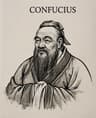
The Analects is a collection of aphorisms and brief dialogues attributed to Confucius and his disciples, and its distinctive mechanism is the presentation of ethical teaching through concrete exemplars rather than systematic doctrine. The text's central concern is the cultivation of the junzi (exemplary person) through ritual propriety (li), humaneness (ren), and learning, with the ruler's moral character serving as the foundation of social order. Unlike the Great Learning's graduated sequence, the Analects teaches through fragmentary encounters, demanding that the reader assemble a coherent ethical vision from dispersed sayings.
Key Insights
✦What is the Analects' central ethical framework, and how does it differ from systematic philosophy?
The Analects' governing concern is the cultivation of the junzi—the exemplary or noble person—through the intertwined practices of li (ritual propriety) and ren (humaneness). What distinguishes the text is its refusal to define these terms systematically. Ren is described differently in response to different disciples, suggesting that it is a disposition cultivated through practice rather than a concept to be analyzed . The text teaches through concrete examples: Confucius's own behavior, his judgments of historical figures, and his responses to disciples' questions. This fragmentary, occasion-specific mode means the reader must assemble the ethical vision from dispersed sayings, a feature that has generated centuries of commentary and interpretive disagreement.
✦What is the textual history of the Analects, and how was the received version established?
The Analects was composed over the Spring and Autumn and Warring States periods, probably by multiple Confucian scholars and disciples rather than by Confucius himself . In the late Western Han dynasty, the scholar Zhang Yu combined the Lu and Qi versions of the text to create the Marquis Zhang Analects, which is the version commonly used today . A manuscript written on bamboo strips before 55 BCE, discovered in a tomb at Dingzhou in Hebei in 1973 and published in 1997, has helped illuminate the text's transmission, though it contains only portions of the received version . The text thus has a layered history, with the canonical form emerging centuries after the Master's death.
✦How does the Analects' teaching on governance differ from a legal or institutional approach?
The Analects consistently locates the basis of political order in the ruler's moral character rather than in laws or institutions. Confucius tells Duke Jing that good government requires that 'the prince be a prince, the minister a minister, the father a father and the son a son'—a formulation that makes social harmony depend on each person fulfilling their relational role . Elsewhere he argues that if the ruler himself is upright, affairs will go well even without orders, but if he is not upright, orders will not be obeyed . This is not a rejection of institutions but a claim about their limits: external regulations cannot substitute for the exemplification of virtue by those in authority.
✦What are the major English translations of the Analects, and how do they differ?
The translation history is extensive and contentious. James Legge's 1861 version remains a foundational scholarly rendering with extensive notes, though its Victorian idiom can obscure the text's philosophical precision . D. C. Lau's 1979 Penguin Classics translation is widely used for its clarity and accessibility . Edward Slingerland's 2003 Hackett edition is distinctive for including selections from traditional Chinese commentaries alongside the translation, giving readers access to the interpretive tradition that shaped the text's reception . Roger Ames and Henry Rosemont's 1998 philosophical translation deliberately defamiliarizes key terms—rendering ren as 'authoritative conduct' rather than 'benevolence'—to challenge Western assumptions about the text's meaning .
✦What is the most common misreading of the Analects in Western scholarship?
A persistent misreading treats Confucius as a purveyor of simple moral platitudes or as a defender of rigid social hierarchy, ignoring the text's emphasis on reciprocal obligation and the ruler's accountability. The Analects does not advocate blind obedience: it insists that ministers should remonstrate with a wayward ruler, and it defines the exemplary person by ethical conduct rather than birth . Another common error is to read the text as a unified philosophical system when it is a collection of occasion-specific responses that often resist systematization. The Analects is better understood as a pedagogical record—showing Confucius teaching through example and provocation—than as a treatise to be decoded.
✦How did the Analects become central to the Confucian canon, and how did that status shape its interpretation?
The Analects was not always the preeminent Confucian text. Its elevation to canonical centrality was the work of Zhu Xi and the Neo-Confucian movement in the Song dynasty, who made it one of the Four Books and placed it at the foundation of the examination curriculum. This canonization shaped interpretation for centuries: readers approached the Analects through Zhu Xi's commentary, and the text's fragmentary sayings were read as a coherent philosophical system. Modern scholarship has attempted to recover the text's earlier history, recognizing that the Analects we read is both a Warring States compilation and a Song dynasty construction, with the interpretive tradition mediating between the two.
Wealthy Psyche is an intellectual archive. We do not host, distribute, or sell book copies — physical or digital. We provide structured knowledge to help you think better, faster.