


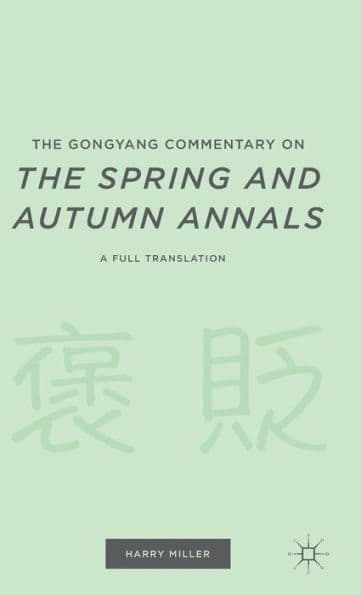
The Spring and Autumn Annals (Chunqiu)
The Chunqiu is the terse official chronicle of the State of Lu covering 722–481 BCE, and its distinctive mechanism is the claim—advanced by Mencius and elaborated by Han commentators—that Confucius edited its seemingly neutral entries to encode moral judgments through subtle diction. Modern scholarship generally rejects Confucian authorship, viewing the text as the work of Lu scribes, but the canonical Chunqiu is inseparable from this interpretive tradition: its roughly 16,000 characters are opaque without the commentaries that attribute 'praise and blame' to its every word choice.
Key Insights
✦What is the traditional claim about Confucius's role in producing the Chunqiu, and how did it arise?
The tradition that Confucius authored or edited the Chunqiu is traced to Mencius, who asserted that Confucius 'completed the Spring and Autumn Annals' and that its significance lay in the moral judgments he embedded in it . Sima Qian later elaborated that Confucius, frustrated by the failure of his political ideals, used the Lu chronicle to 'rectify right and wrong' for the world, praising and blaming rulers through subtle shifts in wording . This claim was historically retrospective: the Chunqiu itself gives no indication of Confucian authorship, and modern scholars generally assign its compilation to Lu scribes who recorded events as they occurred or shortly thereafter .
✦What are the 'Three Commentaries' on the Chunqiu, and how do they differ in approach?
The Chunqiu survives with three major commentaries, each offering a different method of interpretation. The Zuo Zhuan (Commentary of Zuo) is far longer than the other two and provides narrative elaboration of the chronicle's terse entries, functioning as a general history of the period; modern scholars date its compilation to the fourth century BCE and debate whether it is truly a commentary or an independent work . The Gongyang and Guliang commentaries, by contrast, are catechism-like texts that ask why the Annals used a particular expression and answer by revealing its supposed hidden moral meaning, focusing on the 'subtle words' (weiyan) that carry Confucius's judgments . Only the Zuo, Gongyang, and Guliang commentaries survive; two others listed in the Book of Han are lost .
✦What does the Chunqiu actually record, and why is it considered so difficult to read?
The Chunqiu records events in the State of Lu and its interactions with other feudal states, including diplomatic meetings, alliances, military campaigns, births and deaths among ruling families, and natural phenomena such as floods, earthquakes, and solar eclipses—the latter understood as signs of Heaven's influence . Its style is extremely terse and impersonal: entries are dated by the Lu duke's reign year, season, month, and day, and the annalistic structure is followed so strictly that all four seasons are listed even when no events are recorded . The text is roughly 16,000 characters long, and its meaning is opaque without commentaries, which is why the canonical Chunqiu was never read in isolation .
✦How has modern scholarship reassessed the Confucian authorship of the Chunqiu?
Modern scholarship has largely rejected the traditional attribution. The received text is now generally accepted as a Lu annual compiled by scribes, with Confucius's association with the text emerging only around the fourth century BCE . Few modern scholars believe Confucius had much influence on the formation of the text, assigning it instead to various chroniclers from the State of Lu . Newell Ann Van Auken's work shows that early commentarial remarks embedded in the Zuo tradition do not seek moral judgments in the Chunqiu but instead interpret its records as products of a historiographical tradition governed by rules of hierarchy and ritual practice—suggesting that the text's transformation into a Confucian classic was a later interpretive achievement, not an original feature .
✦What is the most common misreading of the Chunqiu's 'praise and blame' function?
A persistent misreading treats the Chunqiu as a straightforward chronicle whose moral judgments can be read directly from its entries. In fact, the text's bare statements—such as recording a ruler's death or a battle—carry no explicit evaluation; the 'praise and blame' is supplied entirely by the commentarial tradition, particularly the Gongyang and Guliang commentaries, which developed elaborate hermeneutic rules for decoding the significance of every word choice . Reading the Chunqiu without the commentaries is like reading a legal docket without the verdicts. The text is historically valuable as a record of Lu's affairs, but its canonical status as a moral classic depends on an interpretive framework external to the chronicle itself.
✦How do English translations of the Chunqiu handle the problem of the commentaries?
James Legge's 1872 translation, The Ch'un Ts'ew with the Tso Chuen, remains the foundational English rendering and is distinctive for including the full Zuo Zhuan commentary alongside the classic, recognizing that the chronicle is unintelligible without it . Legge worked from the standard Chinese text with traditional commentaries, and his extensive annotations provide access to the interpretive tradition. No complete English translation of the Gongyang or Guliang commentaries of comparable scholarly standing exists, meaning that English readers seeking the 'praise and blame' hermeneutic must rely on secondary scholarship. The DigiCat reprint of Legge's translation is widely available but presents the text as a standalone work, obscuring the commentarial mediation that gives it meaning.
Wealthy Psyche is an intellectual archive. We do not host, distribute, or sell book copies — physical or digital. We provide structured knowledge to help you think better, faster.