


The Book of Changes (Yijing)
The Yijing is not a single book but a layered textual complex, and its distinctive mechanism is the transformation of a Bronze Age divination manual into a cosmological and moral philosophical system. The core text—sixty-four hexagrams with brief judgments and line statements—was gradually enveloped by the 'Ten Wings,' commentarial appendices that reinterpret the hexagrams as symbols of universal patterns of change. The received text, canonized in 136 BCE, thus presents a unified work whose unity is the product of centuries of editorial integration, not original composition, a fact obscured by its traditional attribution to Confucius.
Key Insights
✦What are the three distinct textual layers of the Yijing, and why does this matter?
The Yijing is commonly treated as a single text, but it consists of three layers composed centuries apart. The first is the graphic layer: eight trigrams and sixty-four hexagrams, traditionally attributed to the mythical Fu Xi, which are symbolic and open to interpretation. The second is the Zhouyi core: brief judgments and line statements attached to each hexagram, allegedly written by King Wen and the Duke of Zhou around the eleventh century BCE, which are concrete and situational. The third is the Ten Wings, seven writings from the fifth to second centuries BCE divided into ten segments, which reinterpret the hexagrams as cosmic patterns and moral lessons . This layering means that reading the Yijing as a unified philosophical treatise mistakes a sedimented archive for a single authorial composition.
✦Did Confucius actually write the Ten Wings, as tradition claims?
No. The Ten Wings were traditionally attributed to Confucius, and this attribution shaped the text's canonical status for centuries. However, modern scholarship is unanimous that Confucius did not write them and may not have even known the Yijing at all . The Analects contains only one passing reference to the Changes, and it is ambiguous. The attribution to Confucius was a retrospective legitimation strategy: by assigning the philosophical commentaries to the Master, later Confucians could claim the Yijing as a Confucian text rather than a divination manual. The Ten Wings, particularly the Great Commentary (Dazhuan), are the source of much of the Yijing's philosophical and numerological content, but their authority derives from their ideas, not their supposed author.
✦How did the Yijing's status change from a divination manual to a Confucian classic?
The transformation was gradual and editorial. During the Han dynasty, the core text (the hexagrams and Zhouyi statements) was distinguished from the Ten Wings, which were treated as commentaries. Toward the end of the Eastern Han, three Wings—the Tuan, Xiang, and Wenyan—were physically integrated into the core text, a structure followed by Wang Bi's influential third-century commentary . This blurring of text and commentary accelerated in the eleventh century when Cheng Yi added another Wing to the core. By the time the Yijing was canonized as one of the Five Confucian Classics in 136 BCE, its philosophical identity was already secured by the Ten Wings, and the divination origins were relegated to a subordinate, often embarrassing, status. The text's modern reputation as a 'book of wisdom' is the product of this long editorial and interpretive process.
✦What do recently excavated manuscripts reveal about the Yijing's early history?
Archaeological discoveries have transformed Yijing scholarship. Manuscripts dated to the late Warring States period (the Shanghai Museum text) and early Han dynasty (the Mawangdui text) contain versions of the Zhouyi that are similar to the received text but with numerous variant characters, some phonetic loans and some substantive . These finds demonstrate that something close to the received text was in circulation by around 300 BCE, but also that the Changes circulated in multiple versions, none of which can be declared the original. The names and order of hexagrams varied across manuscripts. This evidence undermines the idea of a single authoritative urtext and confirms that the Yijing's textual stability is a later achievement, not an original condition.
✦How do Legge's and Wilhelm's translations differ in their presentation of the Yijing?
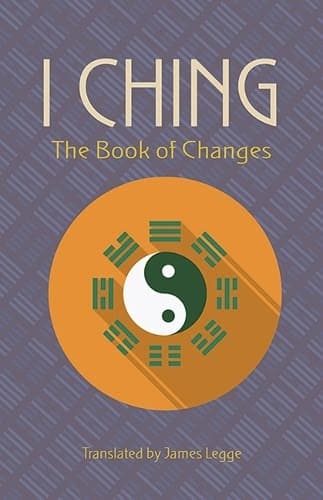
James Legge's 1882 translation, published in the Sacred Books of the East, was the first major English rendering and was long considered the standard. Legge approached the text as a scholar, providing extensive footnotes and treating it historically, though his Victorian idiom can obscure the text's philosophical dimensions . Richard Wilhelm's German translation, rendered into English by Cary Baynes in 1950 with a foreword by Carl Jung, presented the Yijing as a book of wisdom accessible to Western readers. Wilhelm's version was shaped by his engagement with Chinese teachers and his own psychological interests, and it became immensely popular in the English-speaking world . The difference matters: Legge offers a historical-critical entry point, while Wilhelm offers a philosophical and psychological one, and neither is neutral.
✦What is the most common misreading of the Yijing in contemporary culture?
The most persistent misreading treats the Yijing as a timeless repository of ancient wisdom, detaching it from its layered textual history and its origins as a divination manual. In contemporary popular culture, the text is often consulted for personal guidance or presented as a source of cryptic aphorisms, with little awareness that the hexagram statements are Bronze Age documents and the philosophical content comes from later commentaries . This misreading is not new—it parallels the traditional attribution of the Ten Wings to Confucius—but it obscures the text's most interesting feature: its transformation over centuries from a practical divination tool into a cosmological and moral system. Reading the Yijing as a unified philosophical work misses the editorial and interpretive labor that produced that unity.
Wealthy Psyche is an intellectual archive. We do not host, distribute, or sell book copies — physical or digital. We provide structured knowledge to help you think better, faster.