


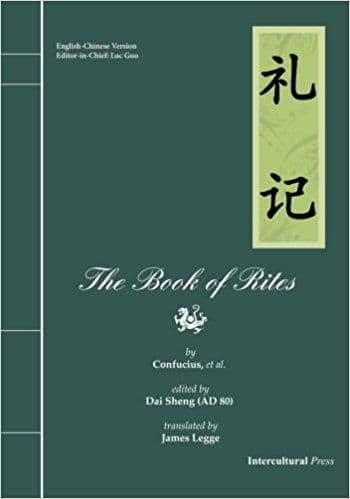
The Book of Rites (Liji)
The Liji is not a unified treatise but a heterogeneous anthology of ritual texts compiled by Dai Sheng in the first century BCE, and its distinctive mechanism is the preservation of 'records' (ji)—explanatory discourses on the meaning and principles of ritual—rather than ritual procedure itself. Unlike the Yili, which prescribes ceremonial actions, the Liji explains why rites matter, embedding them in cosmology, ethics, and social order. The received text of forty-nine chapters is a selection from a larger corpus, and recent bamboo manuscripts confirm that such 'records' circulated and were partially collected as early as the Warring States period.
Key Insights
✦What is the Liji's distinctive content, and how does it differ from the Yili?
The Liji is a collection of 'records' (ji)—discourses that explain the meaning, principles, and rationale of rituals—rather than a manual of ritual procedure. The Yili (Etiquette and Ceremonial) prescribes the precise actions and sequence of ceremonies, while the Liji steps back to ask why those ceremonies matter, embedding them in cosmology, human nature, and social order . This distinction is crucial: the Liji's chapters include definitions of ritual terms, teachings of Confucius and his disciples, and cosmological speculations, and it lacks the overall structural unity found in the Yili or the Rites of Zhou . The text is thus a reflective companion to ritual practice, not a replacement for it.
✦How was the Liji compiled, and what is Dai Sheng's role?
The received Liji is attributed to Dai Sheng, who according to the Book of Sui reduced an earlier collection of 214 books to 46, with three chapters added later to make 49 . Recent scholarship by Zhang Liang clarifies that Dai Sheng's compilation was not driven by court deliberations but by the internal development of ritual studies, and that he had access to earlier collections . Archaeological discoveries—including bamboo slips from Guodian, the Shanghai Museum, and the tomb of the Lord of Haihun—reveal that 'records'-like texts were already circulating and being collected as early as the Warring States period, before Dai Sheng's work . The Liji is therefore a selection from a pre-existing textual stream, not a creation ex nihilo.
✦What is the relationship between the Liji and the Great Learning (Daxue) and Zhongyong?
Both the Daxue and the Zhongyong were originally chapters within the Liji—specifically chapters 42 and 31 respectively—before Zhu Xi extracted them in the Song dynasty to form the core of the Four Books . This extraction transformed their status: what had been two among forty-nine heterogeneous ritual records became, through Zhu Xi's editorial intervention, foundational texts of Neo-Confucian philosophy. The Liji itself does not present them as a pair or as philosophical treatises in the later sense; they were chapters within a larger anthology of ritual discourse. Their elevation is a product of Song dynasty canon-formation, not of their original compositional context.
✦What does the Liji say about the nature and function of li (ritual propriety)?
The Liji presents li as the fundamental framework of civilized life, declaring that 'of all things to which the people owe their lives the rites are the most important' . Li is not merely ceremonial etiquette but the traditional forms that provide a standard of conduct, closely associated with human nature, ethics, and social order. Confucius, as the text portrays him, saw li as a way to restore the significance of traditional forms by looking to the simplicity of the past, easing the turmoil of the collapsing Zhou state . The Liji's chapters elaborate this vision across topics including mourning, sacrifice, music, education, and governance, presenting ritual as the connective tissue between individual cultivation and political harmony.
✦What are the major English translations of the Liji, and what are their limitations?
James Legge's 1885 translation, The Li Ki, published in Sacred Books of the East volumes 27–28, remains the standard complete English rendering and has been reprinted in various editions . Legge worked from the standard Chinese text with traditional commentaries, and his translation is careful and extensively annotated. However, it reflects Victorian assumptions and terminology, and Legge did not have access to the archaeological discoveries that have transformed Liji scholarship. No complete critical translation superseding Legge has appeared in English. Readers should be aware that the Liji's heterogeneous chapters vary widely in date and genre, and Legge's presentation sometimes treats the anthology as more unified than modern scholarship warrants.
✦What is the most common misreading of the Liji's relationship to Confucius?
A persistent misreading treats the Liji as a direct record of Confucius's teachings or as a unified work authored by him or his immediate disciples. In fact, the text is a compilation of heterogeneous materials of varied and uncertain origin and date, with parts traceable to pre-Han works such as the Xunzi and Lüshi Chunqiu, and other sections dating from the Former Han period . The attribution to Confucius reflects the text's canonical status as a Confucian classic, not its authorship. Reading the Liji as a single authorial composition mistakes an anthology for a book, and it obscures the historical processes—oral transmission, compilation, selection, and commentary—that produced the received text.
Wealthy Psyche is an intellectual archive. We do not host, distribute, or sell book copies — physical or digital. We provide structured knowledge to help you think better, faster.