


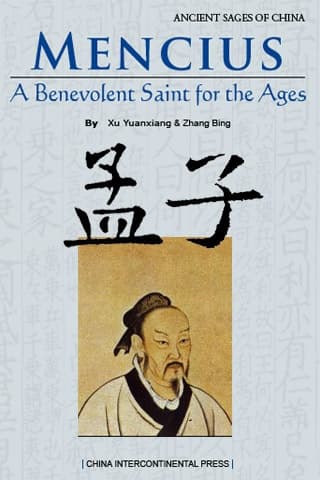
The Works of Mencius (Legge trans.)
This volume is James Legge's scholarly translation of the Mencius, and its distinctive contribution is not merely linguistic but interpretive: Legge frames the text with extensive prolegomena and exegetical notes that situate Mencius within the history of Confucian thought and present his doctrine of human goodness as the orthodox inheritance of Confucius. The translation's central mechanism is its mediation between the Chinese commentarial tradition—particularly Zhu Xi—and Victorian scholarly expectations, making it the foundational English access point to Mencius for over a century.
Key Insights
✦What is the central philosophical claim of Mencius that Legge's translation presents?
Legge's Mencius presents the doctrine that human nature is inherently good, grounded in the 'four sprouts' (siduan)—commiseration, shame, reverence, and the sense of right and wrong—that everyone possesses and that cultivation develops into the virtues of benevolence, righteousness, propriety, and wisdom . Mencius argues that these predispositions are innate and provide the emotional and cognitive resources for ethical life, opposing Gaozi's view that righteousness is external. Legge's translation renders this as a coherent philosophical position, presenting Mencius as the orthodox inheritor of Confucius who defended the Confucian project against Mohist and Yangist challenges, and whose system became foundational to Neo-Confucianism through Zhu Xi's canonization of the Four Books .
✦How does Legge's translation relate to the Zhu Xi commentary tradition?
Legge's translation is explicitly based on Zhu Xi's annotated edition of the Mencius, as noted in comparative studies of Mencius translations . This means Legge's rendering is not a neutral philological exercise but an interpretation shaped by the Neo-Confucian reading that had been orthodox in China since the Song dynasty. Zhu Xi's commentary framed Mencius's doctrine of human goodness as the correct understanding of Confucius, and Legge's notes and prolegomena largely adopt this framework. Readers seeking access to the Mencius as read in the imperial examination system will find Legge faithful to that tradition; readers seeking a reconstruction of the Warring States text independent of later interpretation must look elsewhere, such as D.C. Lau's translation.
✦What are the known limitations and errors in Legge's translation?
Arthur Waley noted that there are 'numerous passages where Legge is certainly wrong,' and later critics have catalogued specific errors . A detailed critique identifies several types: mistranslation of key terms (rendering qi as 'passion-nature' rather than 'spirit'), misreading of punctuation due to Legge's self-taught classical Chinese, and errors in parsing phrases (mistaking 'Wan Chang and men of his kind' for 'Wan Chang's disciples') . The translation also reflects Victorian assumptions and terminology. Despite these limitations, Legge's work remains valuable for its extensive notes and its historical role as the first complete scholarly English rendering, and the 1895 revised edition corrected many errata .
✦How did Mencius become one of the Four Books, and what role did Legge's translation play in that reception?
Mencius was elevated to canonical centrality by Zhu Xi in the twelfth century, who incorporated the text into the Four Books alongside the Analects, Great Learning, and Doctrine of the Mean . This collection became the core curriculum for civil service examinations from the Yuan dynasty until the early twentieth century. Legge's translation, published in 1861 as part of The Chinese Classics, made this canonical Mencius accessible to English readers for the first time in scholarly form. His choice to translate the Four Books in their Zhu Xi arrangement, rather than the earlier Five Classics configuration, embedded the Neo-Confucian canon in Western scholarship. The Dover and Hong Kong University Press reprints of Legge's Mencius have kept this foundational translation in circulation .
✦What is the most common misreading of Mencius's doctrine of human goodness that Legge's translation may encourage?
A persistent misreading, which Legge's Victorian phrasing can reinforce, treats Mencius's claim that 'human nature is good' as an assertion that people are born morally perfect or that evil is unreal. In the Mencius, the claim is that humans possess innate 'sprouts' or beginnings of virtue that require cultivation, and that failure to develop them—through negligence, bad environment, or lack of effort—produces vice . Mencius does not deny the reality of wrongdoing; he denies that it is the fundamental expression of human nature. Legge's translation, with its emphasis on 'the feeling of commiseration belongs to all men,' can obscure the active, developmental dimension of Mencius's ethics, making the doctrine seem more static and optimistic than the text warrants.
✦Which modern translations of Mencius supersede Legge, and how do they differ?
D.C. Lau's 1970 Penguin Classics translation is widely used for its clarity and accessibility, and it works from a modern critical understanding of the text rather than Zhu Xi's commentary . Bryan W. Van Norden's 2008 Hackett edition includes extensive philosophical commentary and is designed for classroom use. For scholarly precision, the late nineteenth-century translations of Leonard Lyall (1932) and the more recent work of scholars such as Irene Bloom offer alternatives. Legge remains useful for its historical significance and its extensive notes, but readers seeking the Mencius as a philosophical text rather than a Victorian artifact should consult Lau or Van Norden. The existence of 84 English translations, with 20 complete reference versions, means readers have ample choices .
Wealthy Psyche is an intellectual archive. We do not host, distribute, or sell book copies — physical or digital. We provide structured knowledge to help you think better, faster.