


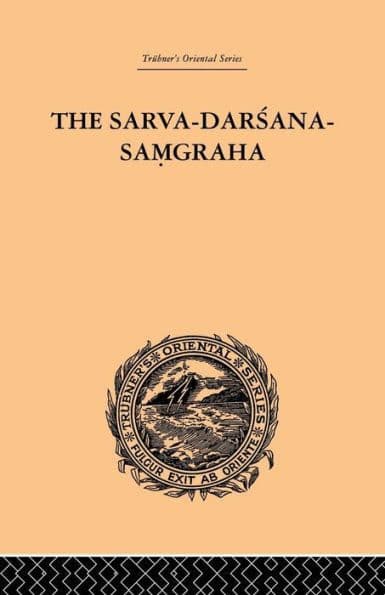
Sarvadarshana Sangraha
Attributed to Vidyaranya (Madhavacharya) but shown by modern scholarship to be the work of his protégé Cennu Bhatta, the Sarvadarshana Sangraha is a doxography reviewing sixteen Indian philosophical systems in ascending order, culminating in Advaita Vedanta. Its central mechanism is hierarchical arrangement: each school is presented with its key tenets and arguments, and the sequence is designed to exhibit a progressive ascent from materialism through dualism to non-dualism. The text's sixteenth chapter on Shankara's Advaita is absent from the standard editions, having been explained elsewhere by its author.
Book Archives
Detailed research articles, summaries and analyses from this book.
 Archive
The Mechanics of Liberation: Understanding Jivanmukti
 Archive
Consciousness and the Quantum Vacuum: A Vedantic Perspective
 Archive
Refuting The External World: Gaudapada’s Karika Analyzed
 Archive
Vichara-Sagara: A Deep Dive into Non-Dual Enquiry
 Archive
The Silence of the Sages: Understanding Dattatreya's Avadhuta Gita
 Archive
The Role of Negation (Neti Neti) in Absolute Realization
 Archive
The Secret Logic Behind Advaita's Theory of Maya
 Archive
Why Shankaracharya Rejected Buddhist Emptiness
 Archive
Brahma Sutra Bhashya: Decoding the Bhashyakara's Method
 Archive
The Hidden Meaning of Turiya in the Mandukya Upanishad
Key Insights
✦What is the central argument of the Sarvadarshana Sangraha, and what does it reject?
The text's central mechanism is not a single argument but a hierarchical arrangement: it presents sixteen Indian philosophical systems in an ascending sequence, from the materialist Charvaka through Buddhist, Jain, Nyaya, Vaisheshika, Samkhya, Yoga, and Mimamsa schools, culminating in Advaita Vedanta as the highest realization . The text rejects the view that all philosophical systems are equally valid or that any non-Advaita school represents the final truth. Each school is presented with its key tenets and principal arguments, and the progression is designed to show a gradual ascent from partial truths to the complete non-dualism of Shankara. The absence of the sixteenth chapter on Advaita from standard editions is explained by a note at the end of the fifteenth chapter stating that Shankara's system has been explained elsewhere .
✦Who actually wrote the Sarvadarshana Sangraha, and how was Vidyaranya's attribution overturned?
The text is traditionally ascribed to Madhavacharya (Vidyaranya), but the Indologist Anantalal Thakur demonstrated in a 1961 article in the Bulletin of the Adyar Library that the real author was Cennu Bhatta (also spelled Cannibhatta), a logician and younger contemporary of Madhava who served as a pandit in the Vijayanagara court [citation:6][citation:8]. Thakur's evidence includes a passage in Cennu Bhatta's Vivarana commentary on the Tarkikaraksha-sarasamgraha where the author explicitly refers to a point established 'in our own Sarvadarshana Sangraha' [citation:6]. A later study by Jon Yamashita (1998) reviewed Thakur's arguments and concluded that while the evidence is not absolutely conclusive, the author was certainly not Madhavacharya the elder brother of Sayana, and that Cennu Bhatta is a serious candidate [citation:8]. The attribution to Madhava may be explained by the work having been written under his patronage [citation:6].
✦How does the text's structure reflect its Advaita perspective?
The Sarvadarshana Sangraha arranges the sixteen systems in what Sarvepalli Radhakrishnan described as a gradually ascending series culminating in Advaita Vedanta, the 'crest-gem of all systems' . This structure is not neutral: it presupposes the Advaita view that other schools represent partial or incomplete realizations of truth, and that non-dualism is the final philosophical standpoint. The text is therefore both a descriptive doxography and a polemical work that positions Advaita at the apex of Indian philosophical inquiry. The arrangement has been influential in shaping how Indian philosophy is taught in modern curricula, even as scholars have noted that it imposes a hierarchical framework on traditions that did not see themselves as stages in a single ascent.
✦What is the textual history of the Sarvadarshana Sangraha and its English translations?
The text was first edited by Pandit Ishvarachandra Vidyasagara and published in the Bibliotheca Indica in 1858 [citation:9]. The standard English translation is by E.B. Cowell and A.E. Gough, first published by Trübner & Co. in 1882 as part of Trübner's Oriental Series [citation:3][citation:7]. This translation, however, omits the sixteenth chapter on Shankara's Advaita, which was not included in the editions Cowell and Gough used. A separate translation of that chapter by Klaus K. Klostermaier was later published [citation:6]. The Cowell-Gough translation has been reprinted numerous times, including by Motilal Banarsidass (1996) and Routledge (2000) [citation:11]. The Ānandāśrama edition, edited by V.G. Apte in 1950, is also a standard Sanskrit edition [citation:1].
✦What is a common misconception about the Sarvadarshana Sangraha's authorship and Vidyaranya's role?
A common misconception is that because the text is traditionally attributed to Vidyaranya (Madhavacharya) and is widely published under his name, it reliably represents his philosophical work. Modern scholarship has shown that the text was likely composed by Cennu Bhatta, one of Vidyaranya's court pandits, possibly at Vidyaranya's instigation or under his patronage [citation:6]. This means that readers seeking Vidyaranya's own Advaita position should consult his securely attributed works like the Panchadasi and Jivanmukti Viveka, rather than the Sarvadarshana Sangraha. The misconception matters because it obscures the collaborative nature of intellectual production in the Vijayanagara court, where Madhava/Vidyaranya presided over a circle of scholars whose works were sometimes attributed to him as the presiding intellectual authority.
✦How does the Sarvadarshana Sangraha differ from Vidyaranya's Panchadasi?
The two texts serve entirely different functions. The Panchadasi is a systematic manual of Advaita Vedanta in fifteen chapters, organized around sat-chit-ananda and designed to lead a student from discrimination to the recognition of bliss. It is a constructive work that teaches Advaita. The Sarvadarshana Sangraha, by contrast, is a doxography that surveys sixteen rival philosophical systems before culminating in Advaita. It is descriptive and comparative rather than systematically constructive. If Vidyaranya had any hand in its conception, it was as a patron or instigator of a survey of the intellectual landscape, not as the author of a pedagogical Advaita treatise. The Panchadasi remains the more reliable guide to Vidyaranya's own philosophical position [citation:5].
Wealthy Psyche is an intellectual archive. We do not host, distribute, or sell book copies — physical or digital. We provide structured knowledge to help you think better, faster.