


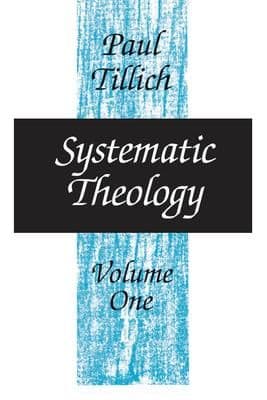
Systematic Theology (3 vols.)
Tillich's three-volume system is organized around the method of correlation: philosophy raises the questions implicit in human existence, and theology supplies the answers drawn from revelation. Volume I correlates reason with revelation and being with God, defining God as being-itself rather than a being beside others. Volume II correlates existence with the Christ, interpreting Jesus as the New Being who conquers estrangement. Volume III correlates life with the Spirit and history with the Kingdom of God, addressing ambiguity and the quest for unambiguous life. The work is not a summa but a mediating synthesis of ontology and biblical faith.
Key Insights
✦What is the method of correlation, and why is it the structural core of the system?
The method of correlation is Tillich's answer to the question of how philosophy and theology relate. Philosophy analyzes existence and formulates the questions that human finitude inevitably raises—questions about being, anxiety, estrangement, and meaning. Theology does not invent these questions; it receives them and then offers the answers drawn from Christian revelation. The relationship is not one of mutual dependence but of question and answer: philosophy identifies the form of the question, theology supplies the content of the answer . This method allows Tillich to engage secular culture seriously without subordinating revelation to reason. It also explains the tripartite structure: each volume addresses a fundamental existential question (reason, existence, life) and its theological correlate (revelation, the Christ, the Spirit).
✦How did the three volumes appear, and what does their publication history reveal about the work's composition?
The three volumes were published over more than a decade: Volume I in 1951, Volume II in 1957, and Volume III in 1963, all by the University of Chicago Press . This staggered publication matters because Tillich was developing the system while responding to the reception of earlier volumes and to changing historical circumstances. Volume I was written in the shadow of the Barthian-liberal controversy of the 1930s and 1940s, and critics have argued that the method of correlation bears the marks of that polemical context . The German translation appeared later, with Volume III translated by Renate Albrecht and Ingeborg Henel, published by De Gruyter . Readers encountering the system as a completed whole should remember that it was assembled piecemeal over a turbulent period.
✦What is the most significant internal criticism of Tillich's system, and who advanced it?
Wayne W. Mahan argued in Tillich's System (1974) that Tillich misunderstood his own system. Mahan's central claim is that the method of correlation, which Tillich regarded as the most fundamental structural element, is in fact a disruptive intrusion—a by-product of the polemics of the period rather than an organic component of the system . Mahan also identified an incoherence between Tillich's ontology, which affirms the primacy of being over non-being, and his phenomenology of existence, which implies a dualism of being and non-being in the conflict between participation and alienation. These tensions, on Mahan's reading, run through the whole system. Whether this constitutes a fatal flaw or a productive ambiguity depends on whether one expects Tillich to be a systematic thinker in the Hegelian sense or a mediating theologian working with inherited tensions.
✦How does Tillich's doctrine of God as 'being-itself' differ from classical theism?
Tillich's God is not a being, even the highest being, who exists alongside other beings. God is being-itself, the power of being in everything, the ground of all that exists . This means that God cannot be made into an object of knowledge or addressed as a person in the ordinary sense. Religious language about God is necessarily symbolic: it points to the unconditional without capturing it conceptually. The difference from classical theism is radical. Classical theism affirms that God is a personal agent who creates, judges, and redeems; Tillich reinterprets these affirmations as symbols for the depth dimension of reality. Critics have charged that this dissolves the living God of biblical faith into an impersonal principle, while defenders reply that Tillich is recovering the prophetic critique of all finite images of God, including theological ones.
✦What role does the third volume play, and why is it often considered the most difficult?
Volume III addresses the problem of life under the categories of ambiguity and the Spiritual Presence, then turns to history and the Kingdom of God . It is often considered the most difficult because it applies the system to domains where Tillich's concepts are least determinate: the ambiguities of religion, culture, and morality; the trinitarian symbols; the meaning of history. The central problem is ambiguity: every process of life contains its own contrast within itself, driving the quest for unambiguous life under the Spiritual Presence . Unlike the first two volumes, which follow the relatively clear correlations of reason/revelation and existence/Christ, Volume III must think through the Spirit's presence in the ambiguities of historical existence. Readers often find it less crisp than its predecessors, but it is essential to the system's claim to address the whole of human experience.
✦What is the most common misunderstanding of Tillich's system as a whole?
The most common misunderstanding is that Tillich is offering a philosophical system that competes with or replaces Christian faith. In fact, Tillich insists that the system is theology, not philosophy: its answers are drawn from revelation, and its norm is the Christian message. The method of correlation does not reduce theology to philosophy; it establishes a disciplined relationship between them. A related misunderstanding is that the system is a Summa, a complete and closed account of reality. Tillich explicitly denied this. As one reviewer notes, Tillich did not claim to be writing a Summa—only an attempt to bring relative coherence into a situation that must remain ambiguous until the fullness of the Kingdom of God . The system is a mediating synthesis, aware of its own provisionality.
Wealthy Psyche is an intellectual archive. We do not host, distribute, or sell book copies — physical or digital. We provide structured knowledge to help you think better, faster.