


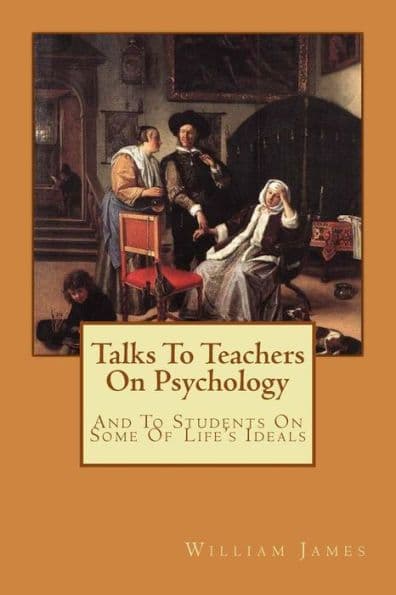
Talks to Teachers on Psychology: And to Students on Some of Life's Ideals
This book collects James's lectures to teachers and students, applying his psychology to education and life. Its central framework is that teaching must begin from the child's native interests and habits, and that psychology is a science of means, not of ends. James argues that habit is the great flywheel of society, that attention and memory can be trained, and that the teacher's task is to connect new material to what the pupil already cares about. The second part, addressed to students, urges them to find their own ideals and to treat the will as the power to hold attention on chosen ends.
Key Insights
✦What is the central argument of Talks to Teachers, and what does it reject?
The central argument is that psychology can inform teaching but cannot dictate its ends. James insists that psychology is a science of means, not of ends: it can tell the teacher how habits are formed, how attention works, and how memory can be trained, but it cannot tell the teacher what to teach or why . The teacher must supply the ideals and the moral purpose. James rejects the view that psychology can provide a complete pedagogy, and he warns against the 'psychologizing' that treats the classroom as a laboratory. The book's practical orientation is captured in its famous claim that habit is the great flywheel of society, and that the teacher's task is to help the pupil form useful habits and connect new material to native interests.
✦How does the book relate to James's Principles of Psychology?
Talks to Teachers is a practical application of the psychology developed in The Principles of Psychology (1890). James draws on his account of habit, attention, memory, and the stream of consciousness, but presents it in a form accessible to teachers who are not psychologists. The book is not a summary of the Principles; it is a selective application of its findings to the classroom. James is explicit that he is not offering a complete psychology but only those parts that are relevant to teaching . The relationship is thus one of application rather than extension: the Principles provides the theory, and the Talks provides the practice. Readers who want the full psychological background should consult the Principles; readers who want the practical upshot should start here.
✦What does James mean when he says habit is the 'flywheel of society'?
James argues that habit is the enormous flywheel of society, its most precious conservative agent. It alone keeps us all within the bounds of ordinance, and saves the children of fortune from the envious uprisings of the poor . Habit is what allows us to act without conscious deliberation, freeing the mind for other tasks. But habit is also a conservative force: it preserves the existing order, for good or ill. The teacher's task is therefore to help the pupil form good habits and break bad ones, because habits, once formed, are difficult to change. James's discussion of habit is one of the most influential parts of the book, and it has been widely cited in subsequent literature on education and self-improvement.
✦How does the second part, addressed to students, differ from the first part, addressed to teachers?
The first part, addressed to teachers, is practical and psychological: it deals with habit, attention, memory, and the application of psychology to the classroom. The second part, addressed to students, is more philosophical and exhortatory. James urges students to find their own ideals, to resist the temptation to conform, and to treat the will as the power to hold attention on chosen ends. The tone is different: the teacher is addressed as a professional who needs techniques, while the student is addressed as a person who needs direction. The second part is thus more in the tradition of moral exhortation, while the first part is more in the tradition of applied science. Both parts share James's characteristic emphasis on practice, habit, and the active will.
✦How was the book received, and what is its enduring significance?
The book was well received and became a standard text in teacher training. It was widely used in normal schools and colleges of education, and it helped to establish educational psychology as a practical discipline. Its enduring significance lies in its insistence that psychology is a means, not an end, and that teaching is a moral activity that cannot be reduced to technique. James's discussion of habit and attention has been influential in subsequent work on education, and his warning against the over-application of psychology to the classroom remains relevant. The book is also a valuable document of James's broader philosophy: it shows how his pragmatism, his pluralism, and his emphasis on practical consequences informed his approach to education and to life.
✦What is the most common misunderstanding of this book's purpose?
The most common misunderstanding is that it is a textbook of educational psychology, offering a complete theory of learning and teaching. It is not: James explicitly says that psychology is a science of means, not of ends, and that the teacher must supply the ideals and the moral purpose . A related misunderstanding is that the book is a collection of practical tips for classroom management. While it contains practical advice, its deeper purpose is to articulate a philosophy of education grounded in a philosophy of human nature. The book is best understood as a bridge between James's psychology and his practical philosophy, showing how his ideas about habit, attention, and will apply to the formation of character.
Wealthy Psyche is an intellectual archive. We do not host, distribute, or sell book copies — physical or digital. We provide structured knowledge to help you think better, faster.