


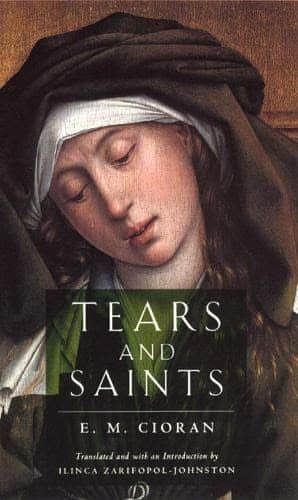
Tears and Saints

Tears and Saints is Cioran's aphoristic meditation on Christian mysticism, written in Romanian and first published in 1937. Its central framework is a Nietzschean diagnosis of sainthood: behind the saints' tears, their thirst for suffering, and their renunciation of the world, Cioran detects a fanatical will to power. He is drawn not to martyrs or theologians but to the mystics—primarily female figures like Catherine of Siena and Teresa of Avila—whose anti-institutional, anti-theological Christianity was based solely on intuition and sentiment. Tears, for Cioran, are the trace of a longing for a lost paradise, and the saint is the human being who has renounced being human.
Key Insights
✦What is the central argument of Tears and Saints, and what does it reject?
The central argument is that behind the saints' tears, their thirst for suffering, and their renunciation of the world lies a fanatical will to power. Cioran follows Nietzsche in reading the saints' ascetic practices not as humble self-denial but as a form of spiritual ambition and a capacity to endure pain that is itself a kind of voluptuousness [citation:1][citation:9]. He rejects the theological and institutional framing of sainthood, focusing instead on the mystics' anti-theological, anti-institutional Christianity based solely on intuition and sentiment [citation:2]. He is not interested in martyrs or heroes but in figures like Catherine of Siena, Teresa of Avila, and Saint John of the Cross, whose tears are the trace of a longing for a lost paradise rather than evidence of conventional piety.
✦How was the book received on publication, and what was its scandalous reputation?
The book caused a scandal when it appeared in Romania in 1937. According to Cioran's own account, a compositor at the first publisher who agreed to print it was so shocked by the text that he showed it to his superiors, who then refused to have anything to do with it; Cioran had to pay for the printing himself and carry the galley proofs around Bucharest in a bag searching for a publisher . The text seemed to its first readers both blasphemous and, paradoxically, more religious than anything Cioran had yet written. Critics at the time did not receive it well, but it has since come to be regarded as one of the most attractive of his Romanian books . The scandal was intentional: the book's anti-Christian tone was almost unheard of in Romania, yet it was written by the son of a Romanian Orthodox priest who was deeply familiar with Christian doctrine.
✦How does the book relate to Cioran's earlier work, Romania's Transfiguration, and his later French writings?
Tears and Saints was written largely while Cioran was teaching in Brașov, after he had completed Romania's Transfiguration, his most politically engaged and nationalist work. His friend Jenny Acterian called Tears and Saints 'the saddest' book he ever wrote, and Cioran said he had something like a nervous breakdown after finishing the earlier book, with Tears and Saints being at once evidence of it and its cure . The book marks a turn away from contemporary European politics toward a subject with hardly a single reference to Europe beyond the Middle Ages. It also plants the seeds of his later French works: the aphoristic style, the gnomic voice, and the preoccupation with suffering, mysticism, and the renunciation of being human all anticipate the themes he would develop in On the Heights of Despair and his mature French writings [citation:1].
✦How does Ilinca Zarifopol-Johnston's English translation shape the book we read, and what is its significance?
Zarifopol-Johnston's translation, published by the University of Chicago Press in 1995, was the first appearance of the book in English and remains the standard version [citation:14]. She also wrote a lengthy introduction that frames the book as a 'discourse on spirituality, asceticism and suffering for the love of Christ' [citation:9]. Her translation is significant because it made available a work that had been largely inaccessible to English readers, and it brought Cioran's Romanian-period writing into the Anglophone conversation about his thought. The translation was praised in Booklist for having 'a chillingly contemporary ring that makes this translation important here and now' [citation:2]. However, as with any translation of Cioran's dense, aphoristic prose, readers should be aware that the stylistic intensity of the Romanian original is inevitably mediated by the translator's choices.
✦What is the most common misunderstanding of Tears and Saints?
The most common misunderstanding is that the book is a work of Christian devotion or a sympathetic study of mysticism. It is neither. Cioran is an important religious thinker in the Nietzschean sense: he takes religion seriously precisely in order to diagnose its psychological and political mechanisms [citation:1]. The book is an iconoclastic, blasphemous discourse on mysticism, written by someone who was 'altogether too much of a Christian' to be a simple unbeliever . A related misunderstanding is that Cioran celebrates the saints. He does not: he is fascinated by them, but his fascination is the fascination of a diagnostician who sees in their suffering a will to power that is all the more powerful for being disguised as humility. The book is a critique, not a devotional tribute.
Wealthy Psyche is an intellectual archive. We do not host, distribute, or sell book copies — physical or digital. We provide structured knowledge to help you think better, faster.