



The Classic of Filial Piety (Xiaojing)
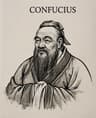
The Xiaojing is a compact Confucian classic that presents filial piety not merely as family duty but as the root of social and political order. Its distinctive mechanism is a graduated analogy: the reverence a child owes a parent is the same disposition that, properly extended, produces loyalty to rulers and harmony in the state. Framed as a dialogue between Confucius and his disciple Zengzi, the text argues that serving one's parents is the training ground for serving one's sovereign, making filial piety the foundational virtue from which all other social obligations derive.
Key Insights
✦What is the Xiaojing's central argument about the relationship between family and state?
The text's governing claim is that filial piety is the root of all virtue and the source of social order. It argues that the disposition cultivated in serving one's parents—reverence, obedience, and care—can be transferred directly to the ruler: 'As they serve their fathers, so they serve their rulers, and they reverence them equally' . This is not merely an analogy but a causal claim: a person who loves and serves their parents will naturally do the same for their sovereign, producing a harmonious society. The Xiaojing thus presents filial piety not as a private family matter but as the foundational political virtue, making the family the training ground for citizenship and the state an extension of the household.
✦Who actually wrote the Xiaojing, and when was it composed?
The text claims to record a conversation between Confucius and his disciple Zengzi, but scholars agree it was not written by Confucius himself. The most likely date of composition is the late Warring States period, roughly the 4th to 3rd century BCE . The actual authorship is unknown. A twelfth-century account by He Yin, cited by James Legge, proposed that Zengzi repeated Confucius's teachings to his own disciples after the master's death, and they compiled the sayings into the treatise . Legge himself found this plausible but noted that the style and method of the text do not suggest direct composition by either Confucius or Zengzi, though it likely came from Zengzi's school .
✦What is the textual history of the Xiaojing, and what versions exist?
The Xiaojing survived the Qin book-burning in two distinct recensions. The 'Modern Text' in eighteen chapters was recovered when a scholar named Yen K'ih retrieved a hidden copy, while the 'Ancient Text' in twenty-two chapters was said to have been found in the wall of Confucius's house and deciphered by Kong Anguo . The received text as edited into eighteen chapters with descriptive headings cannot be traced back beyond the commentary of Emperor Xuanzong of Tang . This dual textual tradition—with the Ancient Text being longer and the Modern Text shorter—mirrors the pattern seen with other Confucian classics and has generated centuries of scholarly debate about authenticity and priority.
✦How did the Xiaojing's status change from the Han dynasty to the Song dynasty?
The text's fortunes declined dramatically over this period. During the Han and Tang dynasties, the Xiaojing was highly esteemed and used for elementary moral education alongside the Analects . It was politically important because filial piety demonstrated moral virtue and could facilitate entry into officialdom for those with court connections . However, from the Song dynasty onward, scholars began to question the text's authorship, dating, and content. Zhu Xi's critical work, the Xiaojing Kanwu (Errors in the Classic of Filial Piety), epitomized this skeptical turn . Even efforts by figures like Lu Jiuyuan could not reverse the decline, and the text's influence waned as Confucian scholarship turned toward the Four Books.
✦What is the most common misreading of the Xiaojing's doctrine of filial piety?
A persistent misreading treats the text as advocating blind obedience, as though filial piety required absolute submission to parents and rulers without qualification. The text itself refutes this. In the chapter on 'Remonstrance,' Zengzi asks whether obeying a father's command constitutes filial piety, and Confucius responds with a sharp rebuke, arguing that true filial piety requires a son to remonstrate when a parent is wrong . The text even notes that a ruler with seven remonstrating ministers would not lose his kingdom despite his own failings. The Xiaojing's filial piety is thus not servile compliance but a relational ethic that includes the duty to correct, a nuance often lost when the text is reduced to a slogan about obedience.
✦Which English translations of the Xiaojing are most useful for study?
James Legge's 1879 translation in Sacred Books of the East volume 3 remains the foundational English version and is widely reprinted . Ivan Chen's 1908 The Book of Filial Duty offers a different interpretive lens, and a recent edition combines Legge's and Chen's translations with the Chinese text . The most significant modern scholarly translation is Roger T. Ames and Henry Rosemont Jr.'s 2009 The Chinese Classic of Family Reverence, which renders xiao as 'family reverence' rather than 'filial piety' to avoid the term's Victorian and Christian connotations . For readers seeking philosophical precision and an argument for the text's contemporary relevance, Ames and Rosemont's edition is the standard. Legge remains valuable for historical comparison and its extensive notes.
Wealthy Psyche is an intellectual archive. We do not host, distribute, or sell book copies — physical or digital. We provide structured knowledge to help you think better, faster.