


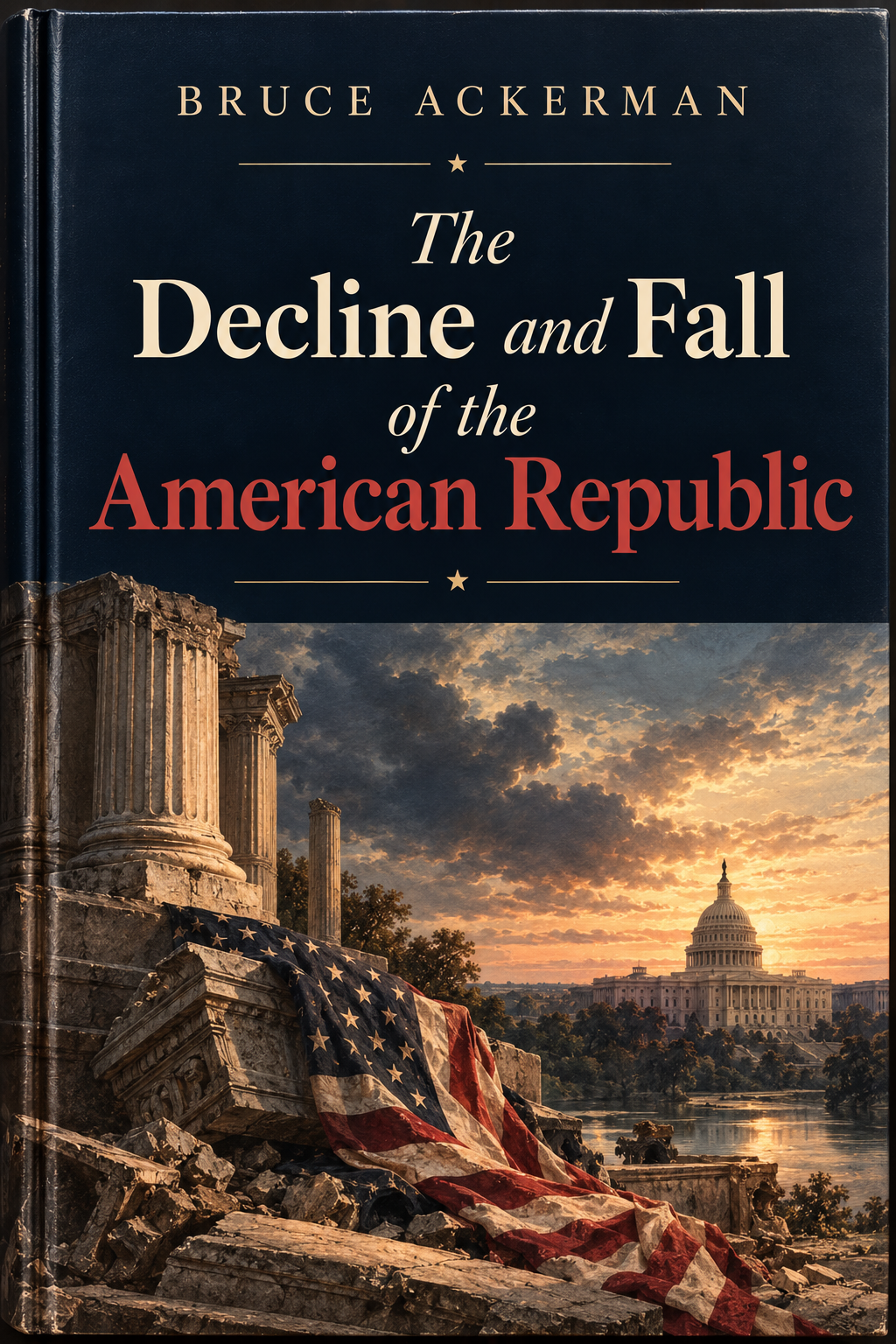
The Decline and Fall of the American Republic
 Bruce Ackerman
Ackerman's Decline and Fall argues that the modern American presidency has become a platform for political extremism and lawlessness, and that this danger is structural rather than personal. His central mechanism is a convergence of previously separate developments: the rise of presidential primaries, the use of pollsters and media gurus, the centralization of power in White House czars, the politicization of the military, and the manipulation of constitutional doctrine to justify power-grabs. Ackerman traces how these transformations interact to generate constitutional crises, and proposes reforms — including a Supreme Executive Tribunal — to restore institutional checks before the next extremist president exploits them.
What is the central argument of The Decline and Fall of the American Republic?
Ackerman argues that the institutional dynamics of the last half-century have transformed the American presidency into a potential platform for political extremism and lawlessness. Watergate, Iran-Contra, and the War on Terror are presented as symptoms of deeper pathologies rather than isolated failures [citation:2][citation:5]. He identifies a series of developments previously treated independently — the rise of presidential primaries, the role of pollsters and media gurus, the centralization of power in White House czars, the politicization of the military, and the manipulation of constitutional doctrine — and shows how these can interact to generate profound constitutional crises in the twenty-first century [citation:2][citation:5].
What is the 'Supreme Executive Tribunal' that Ackerman proposes?
Ackerman proposes replacing the Office of Legal Counsel with a 'Supreme Executive Tribunal' of nine presidentially nominated, Senate-confirmed judges for the executive branch. This Tribunal would replace OLC as the principal source of centralized legal analysis, and Ackerman would grant it an even broader mandate: it could take up legal questions not only as they arise within the executive branch but also at the behest of members of Congress, and its answers would be legally binding on everyone in the executive branch, including the President [citation:8]. The proposal is part of his broader call for fundamental institutional reform to check presidential power.
What is the most common criticism of the book's argument?
The most sustained criticism comes from Trevor Morrison's Harvard Law Review essay, 'Constitutional Alarmism,' which argues that Ackerman's account of executive branch legal interpretation is simply wrong. Morrison shows that the Office of Legal Counsel has a long history of providing principled, independent legal analysis, and that the White House and other executive components have bound themselves to OLC's opinions. He calls the book 'an exercise in unwarranted alarmism married to radical calls for fundamental institutional reform,' arguing that Ackerman is insufficiently attentive to how executive constitutionalism actually works and that his reform proposals are not only troubling but entirely unwarranted [citation:8].
How does the book relate to Ackerman's earlier work Before the Next Attack?
Both books address threats to constitutional order, but from different angles. Before the Next Attack focuses on the specific problem of terrorism and proposes an 'emergency constitution' with a supermajoritarian escalator to prevent the permanent normalization of emergency powers. The Decline and Fall widens the lens to the structural transformation of the presidency itself, arguing that the danger is not terrorism alone but the office's capacity to be captured by an extremist. The later book is less about designing a specific framework for one threat and more about diagnosing a systemic institutional pathology [citation:2][citation:5].
What does Ackerman mean by 'executive constitutionalism'?
Executive constitutionalism refers to the practice of legal interpretation within the executive branch, particularly as carried out by offices like the White House Counsel's Office and the Justice Department's Office of Legal Counsel. Ackerman's core claim is that this practice is hopelessly compromised and cannot be relied upon to foster principled, good-faith adherence to legal constraints. Executive branch lawyers, he contends, inevitably say yes to whatever the President wants to do, even if it means defending the legally indefensible. This diagnosis grounds his call to replace OLC with an independent tribunal whose rulings would bind the President [citation:8].
How has the book's argument held up since its publication in 2010?
The book's warnings about presidential extremism and the erosion of institutional checks have been read with renewed interest following the 2016 election and the January 6, 2021 attack on the Capitol. Scholars have drawn on Ackerman's analysis of the 'politics of unreason' — the use of media consultants, opinion polls, and targeted emotional appeals — to explain the rise of plebiscitary leadership [citation:11]. However, the specific reform proposal of a Supreme Executive Tribunal has not been adopted, and Morrison's critique of the book's alarmism remains a standard counterpoint. The book is best understood as a diagnosis and provocation rather than a blueprint that has been implemented [citation:8][citation:14].
Wealthy Psyche is an intellectual archive. We do not host, distribute, or sell book copies — physical or digital. We provide structured knowledge to help you think better, faster.