


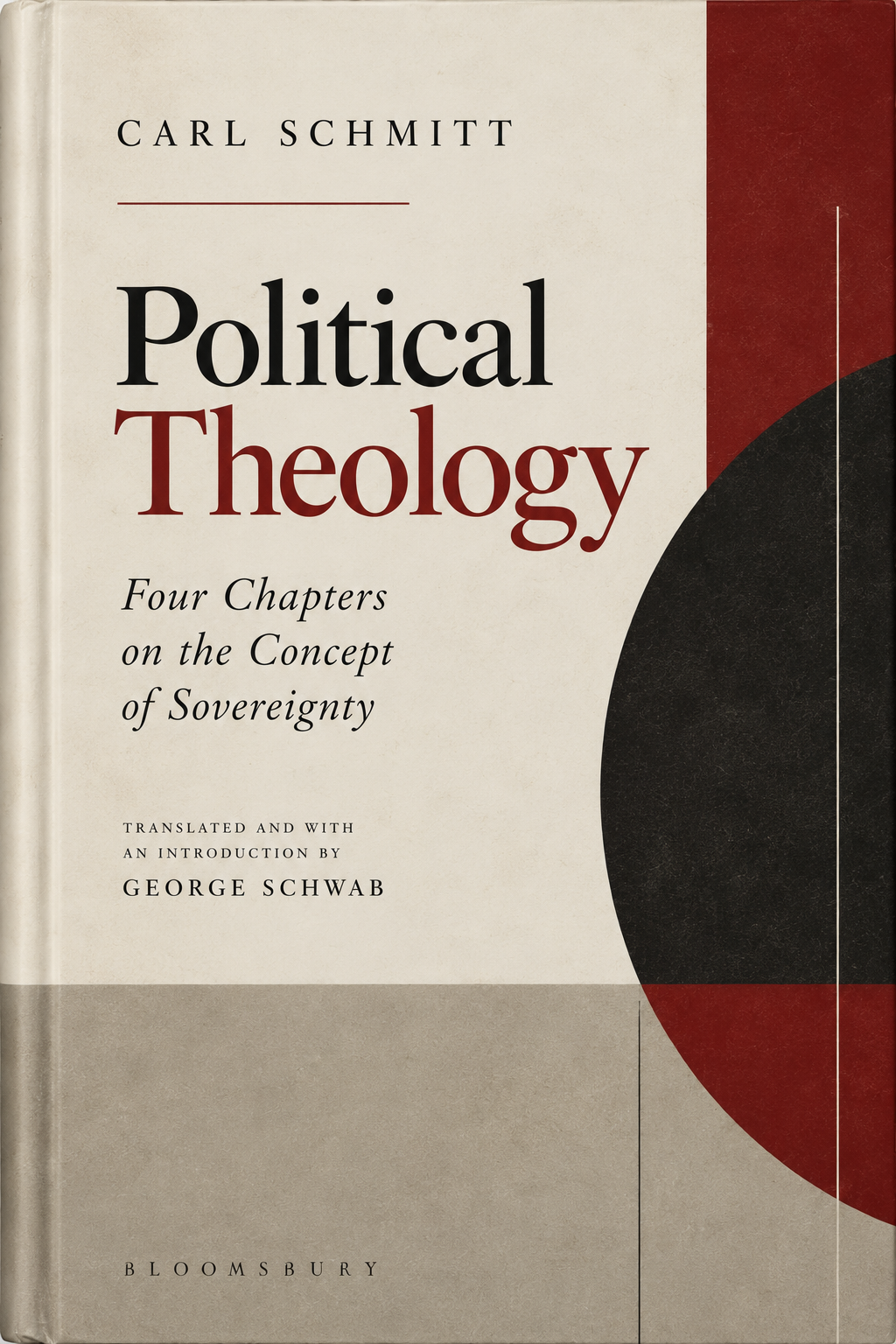
Political Theology: Four Chapters on the Concept of Sovereignty
 Carl Schmitt
Schmitt's Political Theology argues that the sovereign is whoever decides on the exception, and that legal order ultimately rests on decision rather than norm. Its central mechanism is the claim that all significant concepts of the modern state are secularized theological concepts — the exception in jurisprudence is analogous to the miracle in theology. The work attacks liberal normativism for attempting to depoliticize political thought by avoiding fundamental decisions, and defends a decisionist theory of sovereignty in which the sovereign transcends the legal order to reestablish it .
What is the central claim of Political Theology, and what does it reject?
The book's opening sentence states its thesis: 'Sovereign is who decides on the exception' . Schmitt argues that legal order ultimately rests not on norms but on the decision of the sovereign, who alone can meet the needs of an exceptional time and transcend the legal order to reestablish it . He rejects liberal normativism — the view that law can be understood purely as a system of norms without reference to the decision that establishes and suspends them. The exception reveals the essence of sovereignty because it is precisely the case that norms cannot govern .
What does Schmitt mean by 'political theology,' and what is the analogy he draws?
Schmitt claims that 'all significant concepts of the modern theory of the state are secularized theological concepts' . The specific analogy is between the exception in jurisprudence and the miracle in theology: just as the miracle is a suspension of the laws of nature by divine omnipotence, the exception is a suspension of legal norms by sovereign decision . Schmitt traces this structure through the counterrevolutionary thinkers de Maistre, Bonald, and Donoso Cortés, arguing that their decisionism is the political analogue of theological voluntarism .
How does Political Theology relate to Schmitt's later works like The Concept of the Political and Constitutional Theory?
Recent scholarship challenges the standard narrative that these works form a unified trajectory. Croce and Salvatore argue that Political Theology formulated a theory of law and normality that Schmitt himself dismantled a few years after its publication . Through The Concept of the Political (1928) and Constitutional Theory (1928), Schmitt tried to pull himself out of the 'quagmire' of 'exceptionalist decisionism' that marked Political Theology . Interpretations that identify a direct connection between the 1922 essay and the later works are therefore wrong in at least one important respect .
What is the most common criticism of Political Theology?
The most persistent criticism is that Schmitt's decisionism provides no normative resources for constraining the sovereign's decision once the exception is declared. The sovereign who creates exceptions to confirm his sovereignty tends toward martial law as his natural environment . Critics from the normativist tradition, particularly Kelsen, argue that grounding legal order in decision rather than norm dissolves the very concept of legality. The theological analogy itself has been challenged: the claim that the exception is the secularized miracle presupposes a concept of natural law foreign to ancient thought, making the analogy anachronistic .
How has Schmitt's involvement with Nazism affected the reception of Political Theology?
Schmitt joined the Nazi Party in May 1933 and published works defending the regime, some anti-Semitic. He was detained after the war but never charged . The 1934 second edition of Political Theology, with its rhetoric of 'degeneration' applied to liberal normativism and its reference to the 'elements of the political unity' — 'state, movement, people' — can be read as a document relevant to Schmitt's decision to ally himself with the NSDAP . Tracy Strong's foreword to the English edition argues that seeing this choice as blind or venal misunderstands Schmitt's thought, while not excusing it .
Why is Political Theology considered foundational for debates about the state of exception?
Political Theology is the founding text of modern debates about the state of exception. Schmitt's argument that the sovereign is whoever decides on the exception established the terms of a debate that continues through Giorgio Agamben's work on states of exception and Carl Schmitt's later Nomos of the Earth . The book's compactness — it is only four chapters — and its provocative opening sentence have made it one of the most cited works in twentieth-century political and legal theory. Its influence extends beyond law and political theory into theology, philosophy, and critical theory .
Wealthy Psyche is an intellectual archive. We do not host, distribute, or sell book copies — physical or digital. We provide structured knowledge to help you think better, faster.