


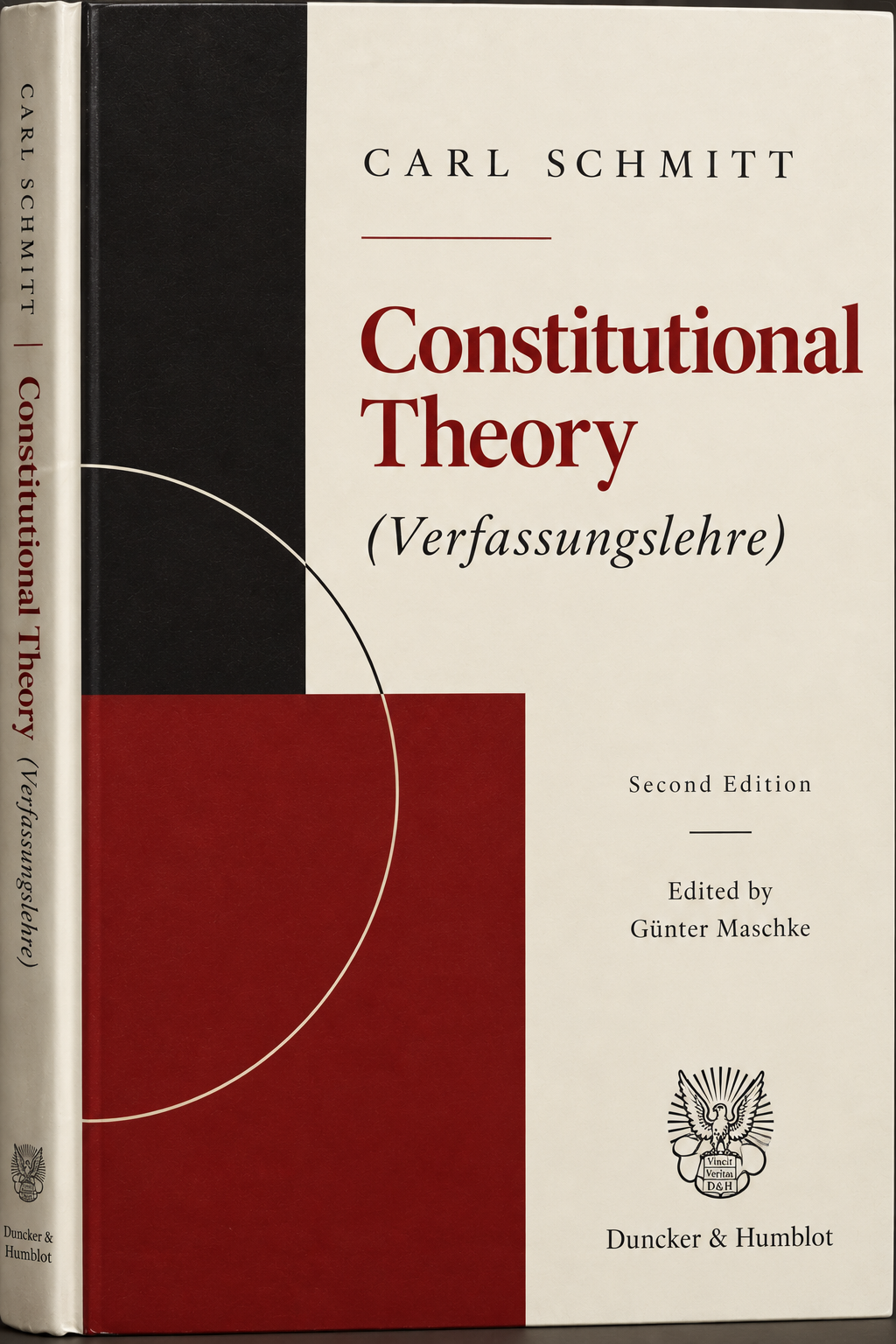
Constitutional Theory (Verfassungslehre)
 Carl Schmitt
Schmitt's Constitutional Theory argues that the legitimacy of a constitution rests not on legal norms but on a sovereign decision of the people — the constitution-making power (verfassunggebende Gewalt). Its central mechanism is the distinction between the constitution (Verfassung) as a substantive political order and constitutional laws (Verfassungsgesetze) as particular legal provisions, a distinction that permits the former to override the latter in crisis. Through a comparative history of European and American constitutional government, Schmitt defends a strong, independent state against what he saw as the pluralist dissolution of parliamentary democracy, and develops the political-formal principles of identity and representation that structure modern constitutions.
What is the central claim of Constitutional Theory, and what does it reject?
Schmitt argues that the legitimacy of a constitution depends on a sovereign decision of the people — the constitution-making power (verfassunggebende Gewalt) — rather than on legal norms or procedures . He rejects the positivist identification of the constitution with a mere collection of constitutional laws, and he rejects Kelsen's normativist attempt to ground constitutional validity in a presupposed basic norm . For Schmitt, the constitution is a substantive political order, a decision about the form of political existence, which stands prior to and above the particular constitutional laws that express it.
What is the distinction between 'constitution' and 'constitutional law' in Schmitt's theory?
This is Schmitt's most consequential conceptual move. The constitution (Verfassung) is the total decision of the people about the form and mode of their political existence — a substantive order that constitutes the state . Constitutional laws (Verfassungsgesetze) are particular legal provisions, such as individual rights or separation of powers, that are valid only within the framework of the constitution. This distinction permits the constitution to be defended against its enemies even when doing so requires violating particular constitutional laws. The 'militant democracy' provisions of postwar constitutions — entrenchment of basic commitments, party bans — are arguably indebted to this structure .
How does Schmitt's Constitutional Theory relate to his polemic against Kelsen?
The Verfassungslehre is Schmitt's most systematic counter to Kelsen's Pure Theory. Where Kelsen grounds the legal order in a presupposed Grundnorm and advocates constitutional adjudication as the guardian of legality, Schmitt insists that the source of constitutional validity is a political decision, not a norm . Their dispute crystallized in the 'guardian of the constitution' controversy: Kelsen argued for a constitutional court; Schmitt argued for the Reich President as the neutral power who could decide on the exception and preserve the constitution's substantive core . Schmitt's constitutional theory is, in effect, the theoretical foundation for his anti-normativist position.
What are the 'political-formal principles' of identity and representation?
Schmitt argues that every genuine political form is constituted by the relation between identity and representation . Identity is the principle of democracy: the people are present to themselves as a political unity, without mediation. Representation is the principle of monarchy and aristocracy: the ruler embodies the political unity on behalf of the people. Modern constitutions combine these principles in varying proportions. Parliamentary democracy, for Schmitt, suffers from a tension between its claim to represent the people and its actual operation through party pluralism and interest bargaining, which dissolves the substantive homogeneity he considers necessary for political unity .
What is the most common criticism of Schmitt's Constitutional Theory?
The most persistent criticism is that Schmitt's theory, by subordinating constitutional laws to a substantive decision of the people, provides no legal resources for constraining the sovereign decision once it is made. Kelsen argued that Schmitt's interpretation of the Weimar Constitution was not a neutral reading but a political program: it intended a transformation of the parliamentary system into a constitutional monarchy in plebiscitarian guise, with the president as a popularly elected monarch . Critics contend that this structure, whatever Schmitt's intentions before 1933, in effect helped destroy the Weimar Republic and pave the way for Nazism .
Why was the Verfassungslehre not translated into English until 2008?
The delay was a consequence of Schmitt's collaboration with the Nazi Party after 1933, which made his work politically toxic in the English-speaking world for decades . The Verfassungslehre was originally published in 1928 and remained in print in German continuously . The 2008 Duke University Press translation, edited by Jeffrey Seitzer and Christopher Thornhill, was described as an 'unparalleled milestone in Schmitt translations' and 'indispensable to scholars in political and legal theory' . The introduction examines the work's reception in the postwar era and its larger theoretical ramifications.
Show 1 more insights
How has Schmitt's Constitutional Theory influenced constitutional design outside Europe?
The theory of constitution-making as decision has profoundly influenced constitutional theorists and designers in Asia, Latin America, and Eastern Europe . Schmitt's insistence that a constitution rests on a prior political decision, not merely on legal procedures, has been drawn upon in debates about constituent power and constitutional founding in post-authoritarian transitions. His analysis of 'militant democracy' — the idea that a constitution can defend itself against its enemies — has also been appropriated by scholars of comparative constitutionalism, including those who developed the concept of 'militant democracy' for postwar European constitutions .
Wealthy Psyche is an intellectual archive. We do not host, distribute, or sell book copies — physical or digital. We provide structured knowledge to help you think better, faster.