


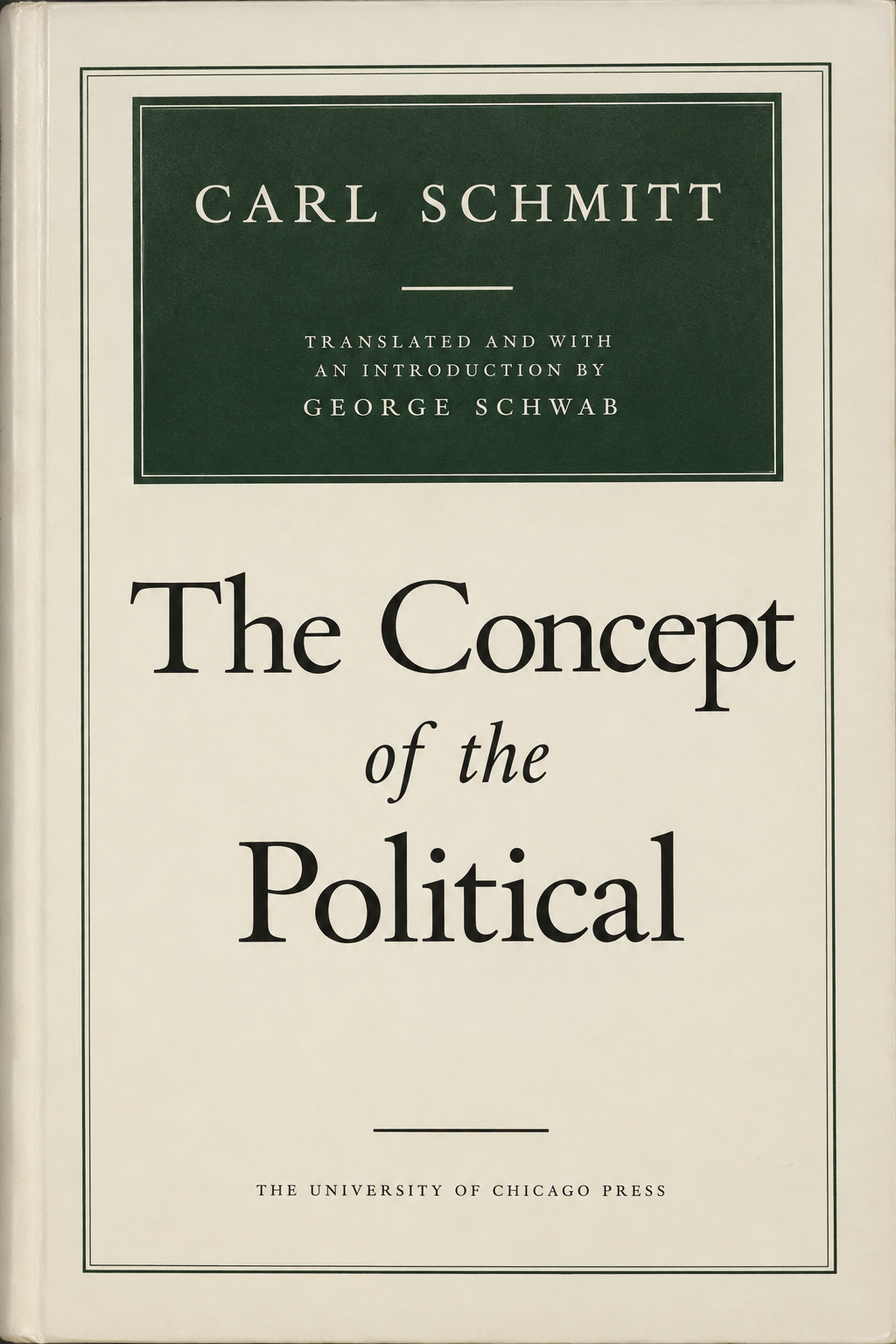
The Concept of the Political
 Carl Schmitt
Schmitt's The Concept of the Political argues that the political is an autonomous domain defined not by morality, economics, or law, but by the existential distinction between friend and enemy. Its central mechanism is the claim that the political consists in the intensity of an association or dissociation — a conflict can arise from any domain and become political when it reaches the point where groups are willing to fight and die for their way of life against an existential threat. Schmitt argues that liberalism's basis in individual rights cannot provide a reasonable justification for sacrificing oneself for the state, and that the state presupposes the political rather than creating it.
What is the central claim of The Concept of the Political, and what does it reject?
Schmitt argues that the political is not a substance or a domain alongside morality, economics, or religion, but rather a criterion defined by the specific distinction between friend and enemy. He rejects the liberal assumption that politics can be reduced to ethics, economics, or law, insisting that all genuine political concepts have a polemical sense and refer to a concrete antagonism. The political emerges when a conflict becomes existential — when groups are willing to fight and die against an enemy that threatens their way of life. This cuts to the heart of the liberal claim that individual rights can provide a reasonable justification for sacrificing oneself for the state.
What specific concept did the book introduce, and where has it been used in later political thought?
The friend-enemy distinction (Freund-Feind-Unterscheidung) is Schmitt's most influential and enduring concept. It defines the political as the most intense and extreme antagonism, where the enemy is not a personal foe but a public enemy (hostis, not inimicus) who threatens one's existential mode of life. This distinction has been used across the political spectrum: the Frankfurt School, including Walter Benjamin and Habermas, drew on Schmitt; the Italian and French Left, associated with the journal Telos, investigated his nonideological conception of the political; and American conservatives of a Straussian persuasion found in his work a theory of authority addressing perceived failings of individualistic liberalism. Chantal Mouffe's work on agonistic democracy is directly indebted to this concept.
How does the book relate to Schmitt's Political Theology and the theory of sovereignty?
Recent scholarship challenges the alleged connection between Political Theology (1922) and The Concept of the Political (1927/1932), arguing that the link was a later construal by Schmitt himself, made in light of contemporary critics. The Concept of the Political focuses on the existential dimension of the political as a domain of intensity, while Political Theology addresses the sovereign's power to decide on the exception. The decisionist element in Schmitt's thought — that the sovereign is he who decides on the exception — is present in both, but the former is concerned with the friend-enemy grouping, while the latter is concerned with the suspension of the legal order. Critics from the Left argue that his insistence on antagonistic relations opens the door to a kind of postmodernism that sees liberalism as a historical event bearing structures of power and domination.
What is the most common criticism of Schmitt's friend-enemy distinction?
The most persistent criticism is that the concept of the political is a tautology: it defines the political by the friend-enemy distinction, but the friend-enemy distinction is itself defined as whatever reaches the intensity of the political. Critics argue that this makes the concept formal and empty, capable of justifying any antagonism as political without providing normative criteria. Another line of criticism focuses on the apparent irrationalism and decisionism of Schmitt's approach, which seems to abandon rational justification in favor of existential conflict. Böckenförde lamented that the friend-enemy distinction has been as widely misunderstood as it has been influential.
Why did Leo Strauss write notes on Schmitt's essay, and what was his critique?
Leo Strauss's Notes on Carl Schmitt are included in the standard English edition and constitute one of the most influential early critiques. Strauss argues that Schmitt, in his effort to affirm the political against liberalism, remains trapped within the horizon of liberal morality. By affirming the political and the existential seriousness of death and conflict, Schmitt implicitly affirms something about the meaningfulness of life — and this, Strauss argues, is ultimately a moral affirmation. Schmitt remains concerned with the meaningfulness of life and fears that modernity will make life unmeaningful; he thus 'remains within the horizon of liberal moralism.' Strauss concludes that 'the affirmation of the political is ultimately nothing other than the affirmation of the moral,' and that Schmitt has unwittingly moralized even his would-be amorality.
What is the significance of the 1932 edition and its expanded 2007 English edition?
The Concept of the Political was first published as a journal article in 1927 and as a book in 1932. The 1932 German edition is the basis for the standard English translation by George Schwab, first published in 1976. The expanded 2007 University of Chicago Press edition includes several additional texts: Schwab's introduction highlighting Schmitt's intellectual journey leading to the Hitlerian one-party state, a translation of Schmitt's 1929 lecture 'The Age of Neutralizations and Depoliticizations' (which Schmitt himself added to the 1932 edition), Leo Strauss's notes on Schmitt's essay, and a foreword by Tracy B. Strong placing the work in contemporary context. This expanded edition is described as 'an essential update on a modern classic.'
Show 1 more insights
How has the book's reception changed since Schmitt's involvement with the Nazi regime?
Schmitt joined the Nazi Party in May 1933, the same month as Martin Heidegger, and published works defending the regime, some of them anti-Semitic. He was detained for eighteen months after the war by Allied authorities but never formally charged. From the beginning of his career, Schmitt was taken seriously across the political spectrum: Friedrich cited him approvingly in 1930 on Article 48; Franz Neumann and Otto Kirchheimer drew extensively on him; and members of the Frankfurt School, especially Walter Benjamin, spoke highly of him. The 1990s saw a 'Schmitt Renaissance' in Western academia, reflecting what critics call a conservative-restorative Zeitgeist. His cooperation with the Nazi regime has been interpreted by some scholars not as mere political opportunism but as a natural expression of a specific tendency inherent in his political thought.
Wealthy Psyche is an intellectual archive. We do not host, distribute, or sell book copies — physical or digital. We provide structured knowledge to help you think better, faster.