


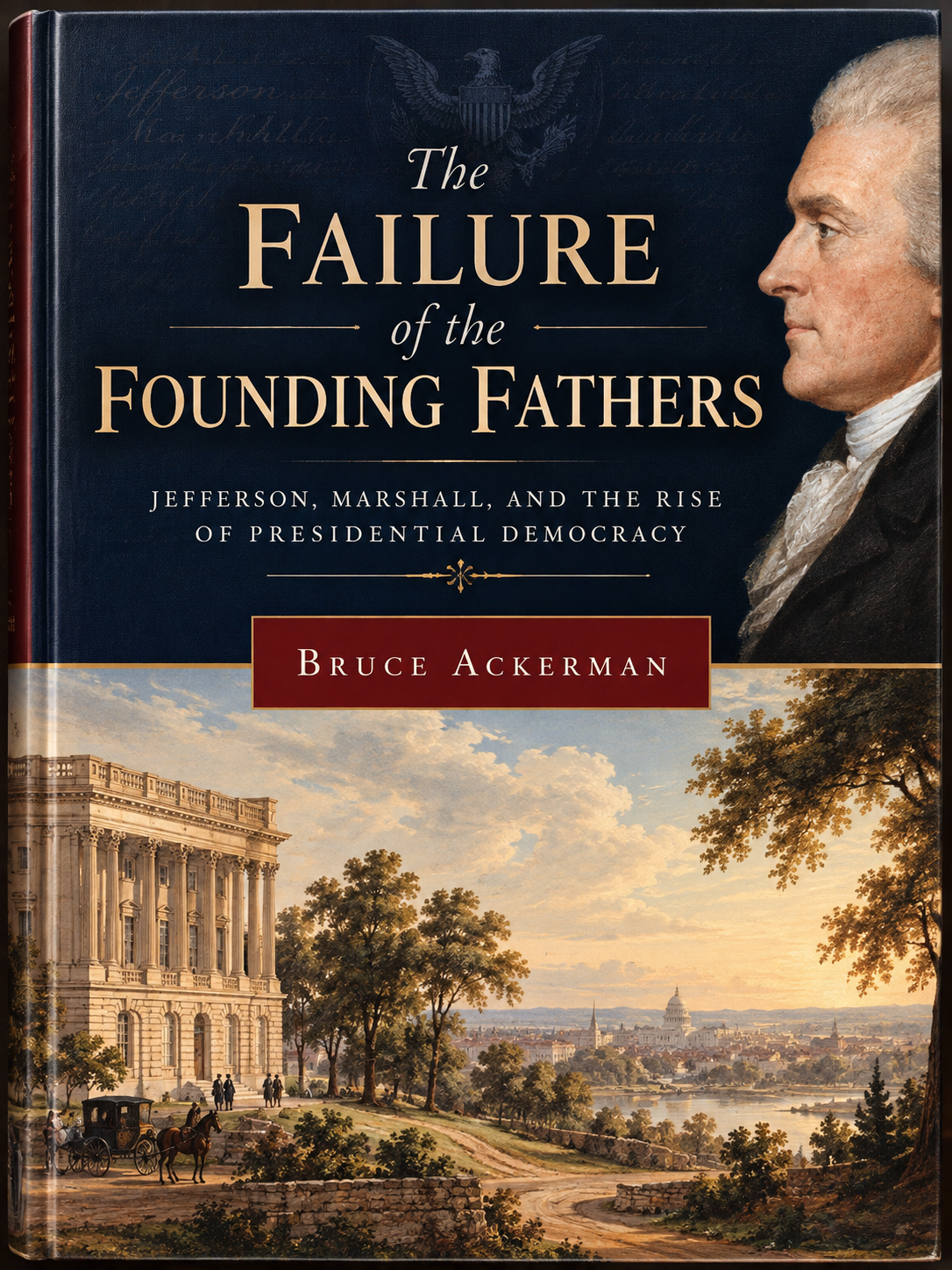
The Failure of the Founding Fathers: Jefferson, Marshall, and the Rise of Presidential Democracy
 Bruce Ackerman
Ackerman's Failure of the Founding Fathers argues that the Constitution nearly collapsed in 1800 because the Framers had not anticipated political parties. The electoral college deadlocked between Jefferson and Burr, and the crisis was resolved not by constitutional text but by a synthesis between Jefferson's plebiscitarian presidency and Marshall's Supreme Court. Ackerman's central mechanism is the 'switch in time' of Marbury v. Madison, which he reads alongside the almost-forgotten Stuart v. Laird as a judicial retreat that secured the Court's survival. The result was a new 'living Constitution' forged in the shadow of a presidential mandate.
What is the central argument of The Failure of the Founding Fathers?
Ackerman argues that the Constitution nearly destroyed itself in 1800 because the Framers had not anticipated the rise of political parties. The electoral college deadlocked between Jefferson and Burr, and the crisis was resolved not by constitutional design but by 'acts of statesmanship and luck.' The deeper consequence was a synthesis between Jefferson's plebiscitarian presidency — an office claiming a popular mandate for sweeping transformation — and Marshall's Supreme Court, which retreated strategically in the face of that mandate to preserve its own institutional survival. The result was a new 'living Constitution' for the early republic.
What specific concept or framework did the book introduce, and where has it been used since?
The book extends Ackerman's 'constitutional moments' framework from We the People to the election of 1800, treating it as the 'birth-agony of the plebiscitarian presidency.' It also introduces a revisionist reading of Marbury v. Madison, arguing that the case must be understood in combination with the almost-unknown Stuart v. Laird, decided a week earlier. Where conventional accounts treat Marbury as the triumphant assertion of judicial review, Ackerman reads both cases as a coordinated judicial retreat from a confrontation with Jefferson's popular mandate. This interpretation has influenced subsequent scholarship on the Marshall Court and the early republic.
How does this book differ from Ackerman's We the People trilogy?
We the People offers sweeping accounts of three constitutional moments — the Founding, Reconstruction, and the New Deal. The Failure of the Founding Fathers is a narrower, more focused study of a half-decade bracketing the 'Revolution of 1800.' Ackerman approaches this period 'with the preoccupations of a theorist and a historian,' using detailed archival research to serve both instincts. The book is less a new theory than a demonstration of the theory in a single, dramatic case: how a constitutional crisis produced a new institutional synthesis without formal amendment.
What is the most common criticism of the book's argument?
The most sustained criticism comes from historians who argue Ackerman's use of 'plebiscitarian' to describe Jefferson's presidency is historically inaccurate, implying a Napoleonic outcome that Jefferson did not claim. Critics note that Jefferson insisted he was elected by electoral votes, not the popular vote, and that he acted as an originalist in the 1800 crisis. Some reviewers also argue the book is strewn with historical omissions and mischaracterizations, and that Ackerman's broader project seeks to undermine the Framers' normative authority rather than simply to reinterpret their work.
How does Ackerman's account of Marbury v. Madison differ from the conventional understanding?
The conventional view treats Marbury as the triumphant establishment of judicial review, with Chief Justice Marshall boldly asserting the Court's power to strike down unconstitutional legislation. Ackerman argues that Marbury must be read alongside Stuart v. Laird, decided a week earlier. Together, the two cases represent a 'switch in time' — a strategic retreat by the Court in the face of Jefferson's plebiscitarian presidency. Rather than a bold assertion of power, Marbury was part of the Court's survival strategy, allowing it to integrate Federalist and Republican themes into the living Constitution of the early republic.
What does the book reveal about the election of 1800 that is not widely known?
Based on seven years of archival research, Ackerman describes previously unknown aspects of the electoral college crisis. He shows how Jefferson counted his Federalist rivals out of the House runoff and how Federalists threatened to place John Marshall in the presidential chair. The book also raises fresh questions about how far Marshall promoted his own presidential candidacy, whether Jefferson fudged the counting of his own votes, and why James Bayard ended the congressional impasse. These details, drawn from documents and the author's own 'detective' work, give the narrative a sense of unfolding discovery.
Wealthy Psyche is an intellectual archive. We do not host, distribute, or sell book copies — physical or digital. We provide structured knowledge to help you think better, faster.