


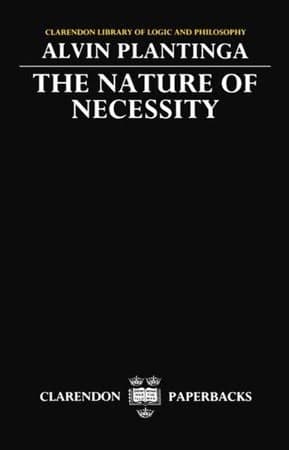
The Nature of Necessity
Plantinga's central framework is a defence of de re modality—the idea that objects have essential and accidental properties—developed through the apparatus of possible worlds. He argues that necessity can be understood as truth in all possible worlds and uses this machinery to clarify essences, transworld identity, and the existence of unactualised objects. The book's final two chapters apply the metaphysical groundwork to natural theology: the Free Will Defense deploys the concept of transworld depravity to reconcile God's goodness and omnipotence with evil, while a modal version of the ontological argument shows that if a maximally great being is even possible, its existence follows.
Key Insights
✦What is the central thesis of The Nature of Necessity, and what philosophical position does it reject?
The book's central thesis is that de re modality is coherent and indispensable: objects genuinely have essential and accidental properties, and this can be rigorously analysed through the notion of possible worlds . Plantinga develops this by treating necessity as truth in all possible worlds and defining an object's essential properties as those it has in every world in which it exists. This directly rejects Quine's influential scepticism about quantified modal logic, which held that necessity could only apply to sentences (de dicto) and not to objects (de re). The appendix specifically addresses Quinean objections . The first three chapters clarify the de re/de dicto distinction and defend it against standard criticisms, establishing the metaphysical framework that the later theological chapters presuppose .
✦What is 'transworld depravity,' and how does it function in Plantinga's Free Will Defense?
Transworld depravity is the property a free creature has if, in every possible world in which God could actualise that creature, it performs at least one morally wrong action . Plantinga introduces this concept in Chapter 9 to address the logical problem of evil: the objection that God's omnipotence, omniscience, and goodness are incompatible with the existence of evil. His defence argues that it is possible that every creaturely essence suffers from transworld depravity. If so, God could not actualise a world containing free creatures who always do right—not because his power is limited, but because there is no such world to actualise. The Free Will Defense is a defence, not a theodicy: it aims to show that theism is logically consistent with evil, not to explain why God permits specific evils .
✦How does Plantinga's modal ontological argument differ from Anselm's or Descartes's versions?
Plantinga's version is deliberately modest in its conclusion: it aims to show only that the argument is valid, not that its premise is true. He defines a maximally great being as one that has omnipotence, omniscience, and moral perfection in every possible world. The key premise is that such a being is possibly instantiated—that there is a possible world containing a maximally great being. If that premise is granted, the conclusion follows: since a maximally great being exists in some possible world and possesses its great-making properties essentially, it exists in every possible world, including the actual one . Plantinga does not claim to establish the premise; his point is that atheists who treat 'God exists' as possibly true but actually false, and theists like Aquinas who accept God's existence but reject the argument's validity, both face difficulties .
✦How does this book relate to Kripke's Naming and Necessity, published four years earlier?
The two works are closely aligned in their metaphysical commitments but differ in scope and method. A contemporary review notes that in its philosophical (though not theological) parts, The Nature of Necessity is 'close to Kripke's Naming and Necessity,' sharing similar accounts of the a priori/necessary distinction, proper names, transworld identity, and the identity theory . Both books contributed to the revival of essentialism in analytic philosophy after decades of Quinean suspicion. However, Plantinga's book is a systematic study of modality itself—developing possible-worlds semantics, defending de re necessity, and addressing unactualised objects—while Kripke's lectures were more focused on reference and the necessary a posteriori. Plantinga extends the Kripkean framework into explicitly theological territory in the final chapters, a move Kripke did not make.
✦What is the most common misunderstanding of the Free Will Defense presented in this book?
The most common misunderstanding is that Plantinga is offering a theodicy—an explanation of why God actually permits the evil we observe—rather than a defence. A defence only needs to show that theism is logically consistent with some evil; it does not need to identify God's actual reasons for permitting evil . A related misunderstanding is that transworld depravity is a claim about human psychology or a empirical prediction about how people behave. It is a modal claim about what is possible for creaturely essences across possible worlds. Critics have also challenged the defence, most notably Daniel Howard-Snyder and John O'Leary-Hawthorne, who argue that positing a creature with 'transworld sanctity'—one who always does right in every feasible world—is at least as plausible as positing universal transworld depravity . Plantinga's argument requires only the possibility of universal transworld depravity, not its actuality.
✦What role do possible worlds play in the book's method, and does Plantinga commit to their real existence?
Possible worlds are the central technical device through which Plantinga analyses modality. He explicates a possible world as a maximal possible state of affairs—a complete way things could have been—and defines necessity as truth in all such worlds . This allows him to translate claims about what is essential to an object into claims about what is true of that object in every world in which it exists. Plantinga's stance on the metaphysical status of possible worlds is deflationary compared to David Lewis's modal realism: he does not treat them as concrete universes existing in the same sense as the actual world, but as abstract states of affairs or propositions. The book's contribution is to show that this apparatus can be used to clarify traditional philosophical problems, including those in natural theology, without requiring commitment to any particular ontology of worlds.
Wealthy Psyche is an intellectual archive. We do not host, distribute, or sell book copies — physical or digital. We provide structured knowledge to help you think better, faster.