


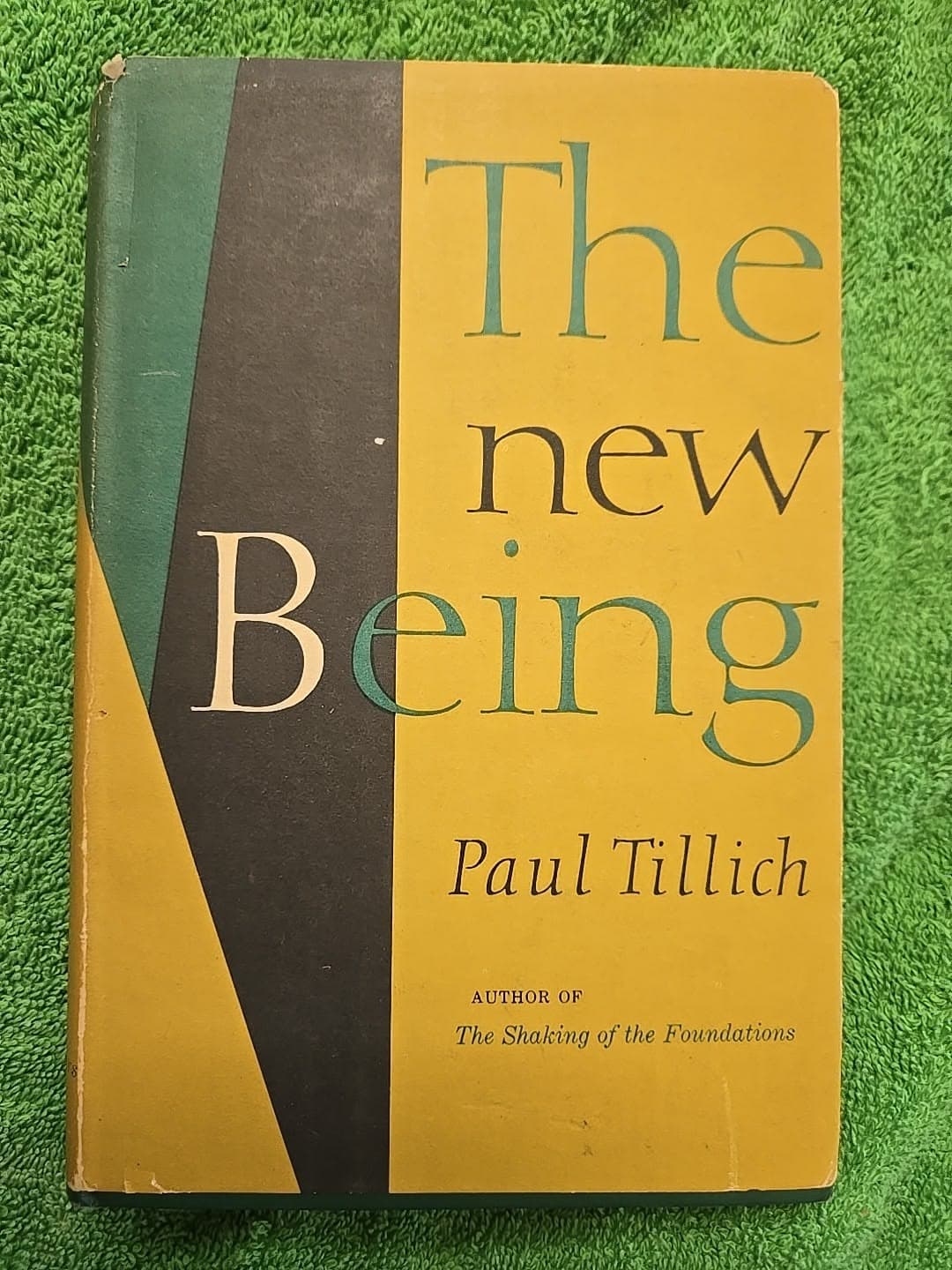
The New Being
This collection of twenty-three sermons, delivered at colleges and universities, translates Tillich's systematic theology into the idiom of existential address. Its central framework is the concept of the New Being: a new reality of reconciliation and resurrection that appeared in Jesus as the Christ and can grasp the believer here and now, overcoming the estrangement of existence. Tillich insists that Christianity is not a religion among others but the message of this New Creation, and that resurrection is not a distant event but the power of the New Being to create life out of death in the present moment. Faith is being grasped by this power, not believing unproven assertions.
Key Insights
✦What does Tillich mean by 'the New Being,' and how does it function as the book's central concept?
The New Being is Tillich's term for the reality of reconciliation and new creation that appeared in Jesus as the Christ and is available to the believer in the present. It is not a doctrine about a past event but a power that grasps a person existentially, overcoming the estrangement of existence. In the second sermon, Tillich states that if he were to sum up the Christian message in two words, he would say with Paul: 'New Creation' . The New Being is not a possession but a gift that appears 'here and there in the world and now and then in ourselves,' usually hidden, sometimes manifest . The concept serves as the unifying thread across the twenty-three sermons, connecting forgiveness, love, healing, and resurrection as manifestations of this new reality.
✦How does this collection relate to Tillich's Systematic Theology, and can it be read independently?
The New Being is a companion volume to The Shaking of the Foundations and applies Tillich's systematic theology in sermonic form rather than developing it technically . Readers who have struggled with the dense ontology of the Systematic Theology often find the sermons clearer: a contemporary reviewer noted that the sermon suggestions 'are more transparent of his real position than are most of his other writings' . The book can be read independently, but its concepts—estrangement, New Being, ultimate concern—presuppose Tillich's broader framework. The sermons do not argue for the system; they enact it in the register of address, making them an accessible entry point for those who want to encounter Tillich's thought before committing to the technical works.
✦What was the critical reception of The New Being, particularly from evangelical reviewers?
The reception was divided along theological lines. A 1955 review by Nels F. S. Ferré acknowledged Tillich's profundity but concluded that his theology 'destroys' traditional Christianity: Tillich rejects a personal God who created the world and will raise believers to new life after death, substituting a 'transcendental' faith for a 'transcendent' one . Ferré argued that salvation in Tillich becomes acceptance of life here and now, with no other life to come. More recent appraisals are warmer: Booklist praised the sermons' ability to simplify the Christian message for the common reader, and the New York Times Book Review called them 'profound' and 'compelling' . The divide reflects the ongoing controversy over whether Tillich's existential reinterpretation of Christian doctrine is a renewal or an abandonment of the tradition.
✦How has recent scholarship reappropriated or critiqued the concept of the New Being?
Recent work has engaged Tillich critically from feminist and decolonial perspectives. Hannah Bowman's 2026 article in the Journal of Feminist Studies in Religion proposes a 'decolonial feminist critique' of the New Being, arguing that Tillich's concept presupposes a unified subject when subjectivity is better understood as 'split' or constituted by intersecting systems of oppression . Bowman seeks to reconstruct the New Being as 'an emergent phenomenon of resistance to self-estrangement and material oppression' grounded in marginalized identities, drawing on transformative justice practices . This represents a significant shift: where mid-century critics debated whether Tillich was sufficiently orthodox, contemporary critics ask whether his categories can address structural injustice. The concept's durability lies in its adaptability, even as its original formulation is challenged.
✦What is the most common misunderstanding of Tillich's claim that 'Christianity is not a religion'?
The most common misunderstanding is that Tillich is dismissing Christianity or reducing it to secular humanism. In the first sermon, he states that 'Christianity as a religion is not important, for Christianity is more than a religion. It is the New Being that is important' . This is not a rejection of Christianity but a radicalization of it: Tillich is arguing that the message of the New Being transcends the institutional and doctrinal forms of any religion, including Christianity. The Church, he suggests, would be more truly the Church of Christ if it joined Jesus in encountering those judged unacceptable . The claim is continuous with his Protestant principle—that no finite expression of the ultimate can be identified with the ultimate itself—not a secularist reduction. Readers who take it as a dismissal miss the theological seriousness of the paradox.
Wealthy Psyche is an intellectual archive. We do not host, distribute, or sell book copies — physical or digital. We provide structured knowledge to help you think better, faster.