


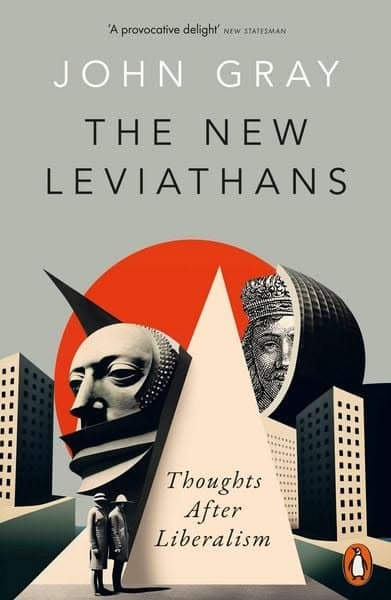
The New Leviathans: Thoughts After Liberalism

Gray's argument is that the post-Cold War liberal triumphalism was a delusion, and that the twenty-first century is witnessing the return of Hobbesian sovereign power in new forms. His mechanism is a reinterpretation of Hobbes: the new Leviathans—Russia, China, and the fragmented identity-states of the West—are not safeguards against tyranny but shelters against chaos. Liberalism's belief in universal rational progress has blinded it to the persistence of collective myth, sectarian violence, and the human need for order at any price. Gray does not predict a future; he strips away the consoling narrative that the present is an aberration from a liberal norm.
Key Insights
✦What is the central claim of The New Leviathans, and what does it reject?
Gray's governing proposition is that the liberal conviction that history moves toward universal rational governance was a post-Cold War illusion, and that the twenty-first century is seeing the return of Hobbesian sovereign power in forms liberalism cannot comprehend. He rejects the triumphalist narrative that tyranny and unreason belong to the past, treating present crises as aberrations that will dissolve. Instead, drawing on Hobbes, he argues that the new Leviathans—Russia, China, and the fragmented identity-driven politics of the West—function less as protections against tyranny than as shelters against chaos . The book is not a prediction but a diagnosis: it strips away the consoling story liberalism tells itself about the direction of history.
✦How does Gray reinterpret Hobbes, and is this reading contested?
Gray reads Hobbes not as a theorist of absolute monarchy but as a thinker for whom the sovereign's primary function is to prevent the war of all against all—to provide order, whatever the regime form. This allows him to present figures like Putin and Xi as Hobbesian sovereigns responding to real needs for stability. This reading is sharply contested. Critic Dan Lazare argues that dragging Hobbes into this is 'especially offensive,' noting that Hobbes was in fact an optimist who believed collective self-organization could lift society from anarchy, and that his theory of sovereignty was compatible with democracy, not a brief for authoritarianism . The dispute concerns whether Gray's Hobbes is a legitimate interpretation or a selective appropriation serving a pre-determined pessimistic conclusion.
✦What role does the concept of 'hyper-liberalism' play in the book's argument?
Gray uses 'hyper-liberalism' to name what he sees as the contemporary liberal project of emancipating individuals from inherited identities. His claim is that this project does not produce free, rational citizens but instead generates 'artificial states of nature' among self-defined collective identities . When identity becomes the primary terrain of political conflict, the space for compromise and mediation disappears. This argument is Gray's attempt to explain the rise of identity politics not as a peripheral phenomenon but as a consequence of liberalism's own logic. It is one of the book's most controversial moves, as it treats emancipatory movements as symptoms of the same liberal delusion rather than as responses to genuine injustice.
✦What are the main criticisms of the book's method and argument?
The most persistent criticism concerns Gray's method. Publishers Weekly describes the book as an 'idiosyncratic excoriation' and a 'wild and wide-ranging treatise' . Reviewer Dan Lazare calls Gray a 'master of free association,' noting that one thinker leads to another without the construction of a sustained argument, and accuses the book of descending from Spengler's cultural pessimism . Even sympathetic readers on library platforms describe it as 'meandering' and 'free-associative' . The charge is not that Gray's observations are false but that they do not cohere into a thesis. The book's defenders might reply that this is deliberate—that Gray writes in the aphoristic, essayistic mode of a moralist rather than a system-builder—but the question of whether this mode constitutes rigorous political thought remains open.
✦How does The New Leviathans relate to Gray's earlier work, particularly Straw Dogs?
The book extends the anthropological pessimism of Straw Dogs and The Silence of Animals into the domain of geopolitics. The earlier works argued that humans are myth-making animals whose belief in progress is a fiction; The New Leviathans applies this framework to international relations, arguing that liberalism's belief in universal rational governance is one more such fiction. What is new is the sustained engagement with Hobbes and the specific diagnosis of the post-1989 era. The continuity is unmistakable: the same suspicion of human improvement, the same attention to the persistence of cruelty and unreason, the same refusal to offer a programmatic solution. Readers who found Straw Dogs a bracing corrective will recognize the sensibility here; those who found it nihilistic will find little to reassure them.
Wealthy Psyche is an intellectual archive. We do not host, distribute, or sell book copies — physical or digital. We provide structured knowledge to help you think better, faster.