


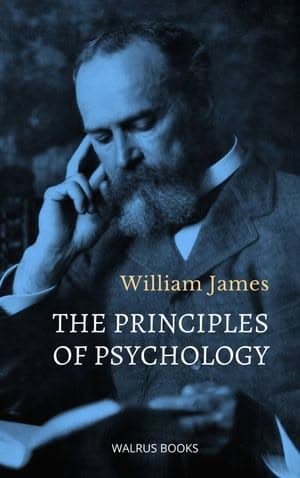
The Principles of Psychology
This two-volume work is James's masterwork of psychology, published in 1890 after twelve years of labour. Its central framework is a functional and introspective psychology that treats mental life as a stream of consciousness—continuous, selective, and purposive—rather than a collection of discrete states. James argues that consciousness is personal, always changing, and inherently selective: it is a 'fighter for ends,' not a passive recorder of experience. The book introduces the concept of the stream of thought, the James-Lange theory of emotion, the distinction between 'I' and 'me,' and a pragmatic account of truth and habit that would shape his later philosophy.
Key Insights
✦What is the central argument of The Principles of Psychology, and what does it reject?
The central argument is that mental life is a stream of consciousness: continuous, selective, purposive, and personal. James rejects the associationist psychology that dominated the nineteenth century, which treated the mind as a collection of discrete ideas linked by mechanical laws . He argues that consciousness is not a chain of separate states but a flowing stream, and that its selectivity is what makes it a 'fighter for ends.' The book is functionalist in orientation: it asks what mental processes are for, how they help the organism adapt, and how they are connected to behaviour and physiology. The book is also introspective: James grounds his claims in careful description of first-person experience, not just laboratory experiment.
✦What is the 'stream of consciousness,' and why is it such an influential concept?
The stream of consciousness is James's metaphor for the continuous flow of mental life. He argues that consciousness is not a series of discrete states but a continuous stream, in which each moment is shaped by the moments that preceded it and anticipates the moments that follow. The stream has five characteristics: it is personal, it is always changing, it is continuous, it is selective, and it is cognitive (it involves knowledge of relations as well as of things) . The concept was revolutionary because it challenged the atomistic psychology of the time and because it offered a richer, more accurate description of first-person experience. It influenced not only psychology but also literature, where the 'stream of consciousness' technique was developed by writers such as Virginia Woolf and James Joyce.
✦What is the James-Lange theory of emotion, and how did it challenge common sense?
The James-Lange theory of emotion holds that emotions are the perception of bodily changes that occur in response to a stimulus. We do not cry because we are sad; we are sad because we cry. We do not tremble because we are afraid; we are afraid because we tremble . This reverses the common-sense view that the emotion comes first and the bodily expression follows. James argues that the bodily changes are the emotion: without the bodily response, there would be no emotional experience. The theory was independently developed by the Danish physiologist Carl Lange, hence the name. It was widely influential and remains a starting point for contemporary theories of emotion, even though it has been modified and criticized by later research.
✦How does James distinguish the 'I' and the 'me' in his account of the self?
James distinguishes between the 'I' and the 'me' in his chapter on the self. The 'I' is the self as knower, the pure ego or the thinker that is aware of its own experiences. The 'me' is the self as known, the empirical self, which James divides into three constituents: the material self (body, clothes, possessions), the social self (the recognition we receive from others), and the spiritual self (our inner dispositions and values) . James argues that the 'I' is not a substantial soul but a function: it is the stream of thought itself, considered as the thinker of its own thoughts. This distinction influenced later psychology and philosophy of mind, including the work of George Herbert Mead and the symbolic interactionists.
✦How was the book received, and what was its impact on psychology and philosophy?
The Principles of Psychology was immediately recognized as a major achievement. It was praised for its literary style, its psychological insight, and its philosophical depth. It became a standard text in psychology and influenced a generation of psychologists, including John Dewey and the functionalists . In philosophy, it influenced phenomenology (Husserl read it carefully), pragmatism (James's own later work), and the philosophy of mind. The book is also notable for its critical treatment of the 'psychologist's fallacy'—the mistake of confusing one's own standpoint as an observer with the standpoint of the person being observed. James warns against this fallacy throughout the book, and it remains a methodological principle in psychology and anthropology.
✦What is the most common misunderstanding of the book's scope and method?
The most common misunderstanding is that it is a textbook of experimental psychology, a summary of laboratory findings. It is not: James was sceptical of the experimental psychology of his time, and he relied more on introspection and philosophical analysis than on laboratory data . The book is a work of philosophical psychology, asking foundational questions about the nature of consciousness, the self, and the relation of mind and body. A related misunderstanding is that James is a dualist or a materialist. He is neither: he is a neutral monist, holding that experience is the fundamental stuff of reality, and that the mental and the physical are different ways of organizing the same experience. The book is thus a contribution to philosophy as much as to psychology.
Wealthy Psyche is an intellectual archive. We do not host, distribute, or sell book copies — physical or digital. We provide structured knowledge to help you think better, faster.