


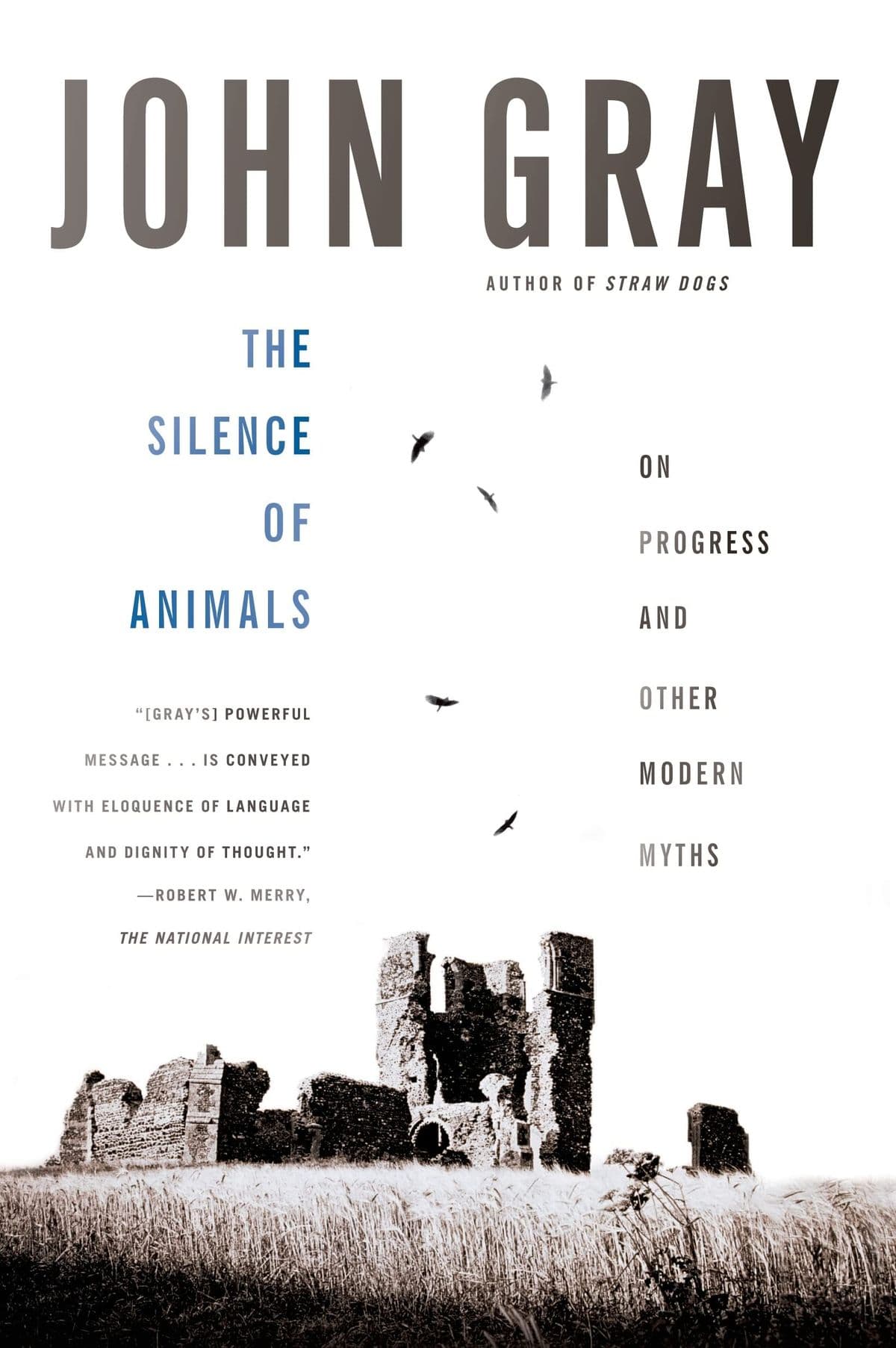
The Silence of Animals: On Progress and Other Modern Myths

Gray's sequel to Straw Dogs argues that the human animal is unique not in its capacity for reason but in its compulsion to manufacture myths—progress, humanism, science—that conceal its continuity with other animals. The book's mechanism is a deliberate deflation: drawing on Conrad, Ballard, Freud, and the poetry of Wallace Stevens, Gray shows how extremity (starvation, imprisonment, war) strips away the fictions we use to avoid acknowledging that we too are animals. What remains is not despair but a 'godless mysticism'—an outward turn toward the non-human world where, in the silence of animals, the self might briefly be forgotten.
Key Insights
✦What is the central claim of The Silence of Animals, and what does it reject?
The book's spine is the claim that what distinguishes humans from other animals is not reason or consciousness but the compulsion to fabricate myths—progress, humanism, science, redemption—that obscure our animal continuity. Gray rejects the secular faith that history has a direction or that human nature can be improved through politics or knowledge. Drawing on Conrad, Ballard, and Freud, he shows that extremity strips these fictions away, revealing creatures driven by the same basic needs as any other. The 'silence of animals' names what remains when the chatter of myth subsides: not a revelation but a release from the self's endless narration, available only when we stop looking inward and turn toward the non-human world.
✦How does this book relate to Straw Dogs, and what does it add?
The Silence of Animals is explicitly positioned as a sequel to Straw Dogs, and the continuity is unmistakable: the same deflationary anthropology, the same suspicion of humanism, the same bleak catalogue of civilizational failure . What the later book adds is a more sustained exploration of what Gray calls 'godless mysticism'—the possibility of an epiphany without God, achieved not through inward contemplation but through outward attention to non-human life. Straw Dogs diagnosed the disease; The Silence of Animals experiments with a cure, however temporary. The turn to J.A. Baker's The Peregrine and the poetry of Wallace Stevens marks this shift from critique to a tentative practice of self-forgetting .
✦What is a common criticism of the book's argument, and who has made it?
A recurring criticism, voiced in reviews by Peter Conrad in The Guardian and in The Independent, is that Gray's pessimism tips into misanthropy without offering any purchase on how to live . Conrad notes that Gray's tundra is 'adapted mainly for animals, the odd philosopher, and John Gray's readers,' and that the book has little to say about the relationships—family, community, love—that lend significance to most human lives. The BPS review by Matthew Edward Harris and Claire Harris observes that Gray's solution of 'an outward focus on peaceful nature' is 'romantic, but impractical; at some point the modern world demands we turn back from nature not only to society, but also to our own thoughts' .
✦What does Gray mean by 'godless mysticism,' and how does it differ from traditional mysticism?
Gray's 'godless mysticism' is an explicitly secular practice of self-effacement. Traditional mysticism seeks union with a divine or transcendent reality; Gray's version seeks no union and no higher knowledge. Its aim, as he puts it, is 'to wipe away their inexistent selves'—not to find a deeper self or merge with something larger, but to forget the self altogether . The model is J.A. Baker, whose The Peregrine records a year spent following falcons with such intensity that the human observer nearly disappears into the observation. Gray recommends this as a discipline: not contemplation in the philosophical sense, but intense outward attention to the non-human world, where the mind might briefly stop generating the myths that make us human and therefore miserable.
✦Why does Gray devote so much attention to writers like Conrad and Ballard rather than to philosophers?
Gray's method is deliberately literary rather than philosophical. The book is, as one reviewer describes it, 'effectively an anthology with detailed commentary' . Conrad, Ballard, Freud, and the poets Stevens and Ashbery are chosen not for their arguments but for their capacity to render extremity vivid—the moment when starvation, imprisonment, or environmental catastrophe strips away the veneer of civilization and reveals the animal beneath. Gray's point is that literature can do something philosophy cannot: make the reader feel the collapse of myth rather than merely be told about it. This is consistent with his broader suspicion of systematic philosophy, which he treats as one more myth-making enterprise, no more immune to self-deception than religion or politics.
Wealthy Psyche is an intellectual archive. We do not host, distribute, or sell book copies — physical or digital. We provide structured knowledge to help you think better, faster.