


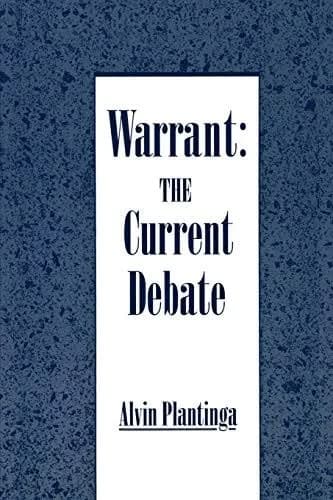
Warrant: The Current Debate
This is the first volume of Plantinga's Warrant trilogy, and its central framework is a sustained diagnostic critique of contemporary epistemology. Plantinga examines the major internalist and reliabilist accounts of warrant—Chisholmian internalism, coherentism, Bayesianism, Pollock's quasi-internalism, and the reliabilism of Alston, Dretske, and Goldman—and argues that each fails to identify what turns true belief into knowledge. The book's unifying thesis is that the entire debate has been conducted within the wrong framework: justification, conceived as deontological permission or obligation, is not the same as warrant, and no internalist account can supply the external connection to truth that knowledge requires.
Key Insights
✦What is the central distinction between justification and warrant that drives this book?
Plantinga argues that contemporary epistemology has conflated two distinct concepts. Justification, in the internalist tradition descending from Chisholm and others, concerns whether a believer has fulfilled epistemic duties, has adequate evidence, or is blameless in holding a belief. Warrant, by contrast, is whatever property must be added to true belief to yield knowledge, and it is external: the believer need not have cognitive access to it . The book's survey aims to show that every account of justification on offer fails precisely because it remains internalist, lacking the connection to truth that warrant requires. This distinction sets up the positive account in the companion volume, where warrant is grounded in proper function rather than deontological status.
✦Which specific epistemological positions does Plantinga examine and reject in this volume?
The book proceeds through a series of critical chapters, each devoted to a major position. Chapter 2 examines classical Chisholmian internalism; Chapter 3, its post-classical variant; Chapter 4, coherentism; Chapter 5, BonJour's coherentism; Chapters 6 and 7, Bayesian coherentism and its rationality constraints; Chapter 8, Pollock's quasi-internalism; and Chapter 9, reliabilism, with separate treatments of Alston, Dretske, and Goldman . The table of contents confirms this structure, and reviewers note that Plantinga 'discerns a pattern in their failure' that motivates his own alternative . The cumulative effect is a comprehensive map of the epistemological landscape as it stood in the early 1990s, organized around the question of what each view can and cannot explain about warrant.
✦How does this book relate to Plantinga's earlier Reformed epistemology work, such as Faith and Rationality?
The shift is significant and deliberate. In Faith and Rationality (1983), Plantinga and Wolterstorff argued that theistic belief could be properly basic and that classical foundationalism was self-referentially incoherent. That project was formulated within an internalist framework of epistemic obligation and permission. Warrant: The Current Debate marks a radical new strategy: Plantinga now argues that no account of knowledge can succeed on internalist terms at all . The earlier question was whether theistic belief is rationally permissible; the new question is what warrant is, and the answer will be externalist. Paul Helm's review notes that the trilogy 'marks a shift away from this earlier internalism' toward a position where 'no account of knowledge can be provided that is not externalist' .
✦What is the relationship between this volume and Warrant and Proper Function?
The two books were published simultaneously in 1993 and function as a pair, though the second can be read independently. Warrant: The Current Debate is the negative, diagnostic volume: it surveys and critiques existing accounts of warrant and concludes that they all fail. Warrant and Proper Function is the constructive volume: it develops Plantinga's own proper functionalist account, arguing that warrant requires cognitive faculties functioning properly according to a design plan aimed at truth . The publisher notes that the arguments of the second do not presuppose those of the first, but readers who want the full force of Plantinga's case against rival views should read both. The first volume establishes the inadequacy of the alternatives; the second supplies the replacement.
✦What is the most common misunderstanding of this book's purpose?
The most common misunderstanding is that it is a standalone statement of Plantinga's epistemology. It is not. It is a critical survey, and Plantinga's positive account appears only in the companion volume. Readers who pick up Warrant: The Current Debate expecting to find proper functionalism fully developed will be disappointed; they will find instead a meticulous dismantling of Chisholm, BonJour, Pollock, Goldman, and others . A related misunderstanding is that the book is primarily about philosophy of religion. It is not: the argument is entirely within general epistemology, and the theological payoff does not arrive until Warranted Christian Belief (2000). The book is best understood as the necessary clearing of ground before Plantinga's constructive proposal can be built.
✦How was the book received by epistemologists, and what were the main criticisms?
The reception was respectful but not uniformly enthusiastic. Reviewers acknowledged the scale and ambition of the project and the rigor of Plantinga's critiques. Christopher Hookway, writing in The Philosophical Quarterly, noted that Plantinga 'discerns a pattern in their failure' and that the books 'will provide a focus for much future research' . Paul Helm, however, observed that the trilogy represented a 'radical new strategy' that departed from the internalism of the earlier Reformed epistemology work, and some critics questioned whether Plantinga's externalism could avoid the problems he identified in reliabilism. The most persistent criticism concerned whether proper functionalism, developed in the second volume, was itself vulnerable to the same kinds of objections Plantinga raised against his rivals.
Wealthy Psyche is an intellectual archive. We do not host, distribute, or sell book copies — physical or digital. We provide structured knowledge to help you think better, faster.