


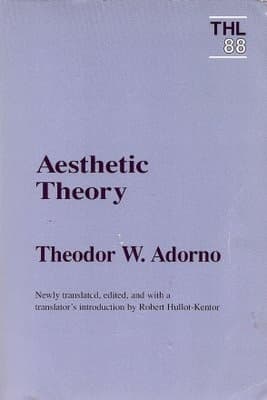
Aesthetic Theory (Ästhetische Theorie)
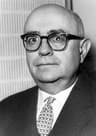
Left unfinished at Adorno's death in 1969 and published posthumously in 1970, Aesthetic Theory argues that art's truth-content lies in its double character: it is both autonomous, obeying its own formal laws, and a social fact, shaped by the same forces it resists. The work's distinctive thesis is that art survives only by maintaining a negative relation to the administered world—its formal dissonance and refusal of meaning are the residue of a rationality that has not yet been reconciled with suffering. Beauty is not harmony but the fragile trace of what identity thinking excludes.
Key Insights
✦What is the central claim of Aesthetic Theory, and what does it reject?
The central claim is that art has a double character: it is autonomous, following its own formal laws, and it is a social fact, shaped by the same reifying forces it opposes. Art's truth-content lies in this tension—in its ability to resist the administered world through formal dissonance, refusal of easy meaning, and fidelity to suffering. Adorno rejects both the view that art is merely a vehicle for political messages and the view that art is a pure, self-enclosed realm untouched by society. He also rejects the classical aesthetics of harmony and beautiful appearance, arguing that after Auschwitz, beauty cannot be affirmed without complicity in the world that produced it.
✦Why was the book left unfinished, and how did its posthumous editing shape the published text?
Adorno died suddenly in August 1969 while on vacation in Switzerland, leaving the manuscript of Aesthetic Theory in a state he had not fully revised. His widow, Gretel Adorno, and his student Rolf Tiedemann prepared the text for publication in 1970, working from the surviving drafts and notes . Tiedemann's editorial choices have been the subject of scholarly debate, particularly regarding the ordering of the sections and the handling of passages Adorno had marked for revision. The English translation by Robert Hullot-Kentor, published in 1997, is based on Tiedemann's edition and includes extensive editorial apparatus explaining the state of the manuscript. Readers should be aware that they are encountering a text Adorno did not see through to final form.
✦What does Adorno mean by the 'truth-content' of art, and how does it differ from pleasure or instruction?
The truth-content (Wahrheitsgehalt) of art is not its propositional content or its moral lesson but the way its formal organization registers and resists the contradictions of the social world. Art's truth is historical and negative: it lies in what the artwork does not say, in its gaps, dissonances, and refusals of reconciliation. Adorno distinguishes this from pleasure (the hedonistic reduction of art to sensation) and from instruction (the didactic reduction of art to message). The truth-content is accessible only through philosophical interpretation, which reads the artwork's formal structure as a sedimentation of historical experience. This is why Aesthetic Theory is not a manual of criticism but a philosophical meditation on what art can still be after its traditional legitimations have collapsed.
✦How does Aesthetic Theory relate to Adorno's earlier work, particularly Dialectic of Enlightenment and Negative Dialectics?
Aesthetic Theory can be read as the culmination of Adorno's philosophical project. Dialectic of Enlightenment had diagnosed the reversal of Enlightenment reason into domination; Negative Dialectics had developed a method for thinking against identity; Aesthetic Theory shows how art practices that method in the realm of sensuous form. Art, for Adorno, is the privileged site where the non-identical survives, where the particular resists subsumption under the universal. The book extends the critique of the culture industry developed in the earlier work by showing what authentic art must do to resist it. It is thus both a culmination and a new departure, applying the negative dialectic to the specific domain of aesthetics.
✦How does Robert Hullot-Kentor's translation differ from the earlier Lenhardt translation?
C. Lenhardt's translation was published by Routledge & Kegan Paul in 1984, the first English version of the text. It was criticized for its handling of Adorno's key terminology and for occasional inaccuracies. Robert Hullot-Kentor's translation, published by the University of Minnesota Press in 1997, is generally regarded as the superior version, praised for its fidelity to Adorno's prose and its extensive editorial apparatus . Hullot-Kentor also translated Adorno's Kierkegaard book and has written extensively on the challenges of rendering Adorno's German. His translation includes a substantial translator's introduction and notes that help the reader navigate the text's density.
✦What common misreading of Aesthetic Theory should readers avoid?
A common misreading treats the book as a defense of high modernism or a prescriptive theory of what art should be. Adorno does not offer a program for artistic production; his concern is with the philosophical conditions under which art can have truth-content. Another misreading assumes the book is a rejection of mass culture in favor of elite art. While Adorno is critical of the culture industry, his aesthetic theory is not a simple defense of the canon; it is an analysis of how art, whatever its form, can resist reification. A third misreading treats the book as a systematic aesthetics in the classical sense. It is, as its title indicates, a theory—but a negative, fragmentary one, consistent with Adorno's refusal of systematic closure.
Wealthy Psyche is an intellectual archive. We do not host, distribute, or sell book copies — physical or digital. We provide structured knowledge to help you think better, faster.