


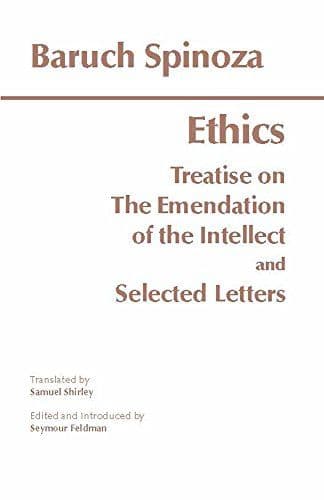
Treatise on the Emendation of the Intellect (Tractatus de Intellectus Emendatione)
Spinoza's unfinished methodological treatise proposes a way of purifying the intellect so it can grasp true ideas and, through them, the highest good. Its distinctive mechanism is reflexive: the method does not begin from a external rule but from reflection on an idea already known to be true, which yields the norm for distinguishing truth from falsity. Spinoza classifies four kinds of knowledge and argues that only the fourth—knowledge through the thing's proximate cause—can serve the method. The work breaks off before completing its account of the intellect's power.
Key Insights
✦What is the central methodological claim of the Treatise on the Emendation of the Intellect?
The treatise argues that before we can acquire adequate knowledge of nature, we must first emend the intellect—purge it of the distractions and confused ideas produced by the pursuit of wealth, honor, and sensual pleasure. The method for doing this is reflexive. It begins not from a rule imposed on thought from outside but from an idea already known to be true, and by reflecting on that idea (the 'idea of the idea') it derives the norm by which truth can be distinguished from falsity. The method is thus self-correcting and internal to the intellect's own operations, rather than a checklist applied from without.
✦What are the four kinds of knowledge Spinoza distinguishes, and why does only one serve the method?
Spinoza classifies knowledge into four genera: (1) hearsay or arbitrary signs; (2) vague experience not ordered by the intellect; (3) knowledge by inference from other things, but inadequately; and (4) knowledge through the thing itself or its proximate cause. Only the fourth kind qualifies as adequate knowledge, because it grasps the thing through its actual causal structure rather than through accidental associations or discursive inference. The method requires this fourth kind because it alone yields the clear and distinct grasp of essences that can serve as the foundation for further deduction. The other three genera produce only confusion or inadequate ideas.
✦How does the treatise relate to Descartes' methodological works?
Spinoza was familiar with Aristotle's and Bacon's methodological writings, but Descartes provided the closest model. The treatise follows the pattern of Descartes' Discourse on Method, which prefaced scientific works with an autobiographical account of redirecting one's life toward truth, and it even more closely parallels Descartes' Rules for the Direction of the Native Intellect—a work left unfinished and unpublished in Descartes' lifetime, which Spinoza likely knew . But Spinoza departs from Descartes in crucial respects, particularly in rejecting the Cartesian notion that the will can suspend judgment independently of the understanding, and in grounding the method in the intrinsic mark of the true idea rather than in a divine guarantee against error.
✦Why was the treatise left unfinished, and what does its incompleteness mean for reading it?
Spinoza wrote the bulk of the treatise before the Short Treatise and before the Ethics, and he never returned to complete it. The editors of the 1677 Opera Posthuma noted in their preface that the author intended to finish it but was prevented by other occupations and death, and they published it in its defective state because it contained many useful things . The text breaks off just as Spinoza is about to discuss the power of the intellect and its limits—arguably the culminating topic of the method. Readers should therefore treat the work as a set of powerful programmatic reflections rather than a completed epistemology; its value lies in the problems it poses and the reflexive method it sketches, which the Ethics later presupposes and transforms.
✦How does the 'idea of the idea' in this treatise differ from the same concept in the Ethics?
In the Ethics, the idea of an idea has a causal and essential identity with the original idea: the mind's idea of its own body is the same mode of thought considered under a different aspect. In the Treatise on the Emendation of the Intellect, the reflexive idea is not yet understood in this strictly parallelistic way; it is produced through the fourth kind of knowledge as a distinct act of reflection on a true idea already possessed . The treatise thus presents a more epistemic and less metaphysically grounded version of reflexivity. This difference is one index of the philosophical distance between Spinoza's early methodological project and the mature system of the Ethics.
✦What common misreading of the treatise should readers avoid?
A persistent misreading treats the treatise as a failed or superseded draft whose only value is antiquarian, because it never delivers the promised definition of the intellect. This judgment, long endorsed by editors and commentators, overlooks the extent to which the definition is implicitly present in the text's analysis of true ideas and their properties . The treatise is not merely a preliminary sketch that the Ethics replaces; it articulates the reflexive structure of method that the Ethics will presuppose without repeating. Reading it as a failure obscures what is genuinely distinctive in its account of how truth is recognized—not by an external sign, but by the intrinsic mark of the true idea itself.
Wealthy Psyche is an intellectual archive. We do not host, distribute, or sell book copies — physical or digital. We provide structured knowledge to help you think better, faster.